 702461526@qq.com
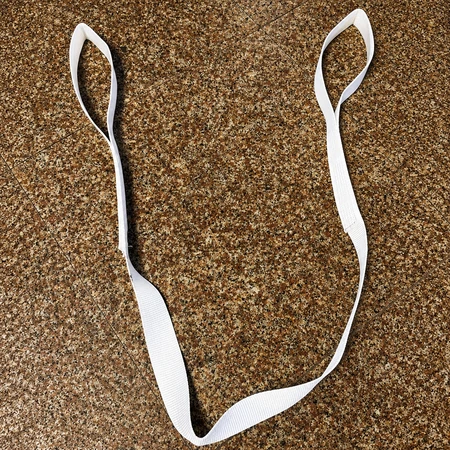
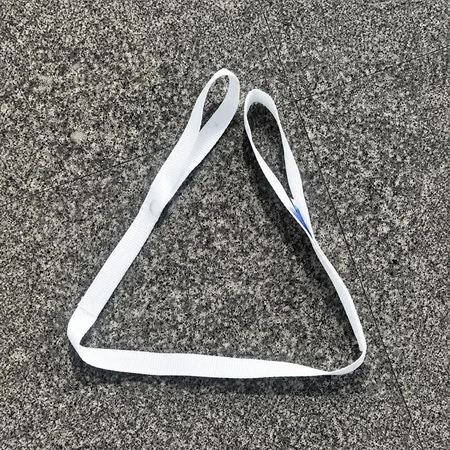

Lift sling rigging company produce Dyneema Webbing Sling,UHMWPE webbing sling,Ultra high molecular weight polyethylene webbing sling,Dyneema lifting Sling.
Dyneema Webbing Sling
Flat Woven UHMWPE Webbing — 1 t to 100 t · Around Half the Weight of Polyester · Thin Enough for a Narrow Lifting Eye
A Dyneema webbing sling is a flat woven sling whose band is woven from UHMWPE fibre — ultra-high-molecular-weight polyethylene, also called HMPE — rather than polyester. The difference is not cosmetic. For the same working load limit the band is narrower, thinner and around half the weight, it stretches a fraction as much, and it is strong enough that a slim band does the work of a much wider conventional one. That matters wherever the sling has to pass through a narrow lifting eye, wrap a tight radius, or be carried and flown into position. The whole load path is the webbing itself, so it is also fully visible for inspection along its entire length.
- UHMWPE woven band — the highest strength-to-weight of any commonly used lifting fibre
- Narrow and thin — a slim band replaces a much wider polyester sling at the same capacity
- Low stretch — holds a level lift and keeps the load exactly where it was set down
- Whole load path visible — inspect the entire working length, not a sleeve over a hidden core


Key Features
Highest Strength for the Weight
UHMWPE carries far more load per kilogram than polyester. On a high capacity lift that is not a marginal gain — it changes what the band can be.
A Slim Band Where Space Is Tight
Because the fibre is so much stronger, a narrower and thinner band carries the same working load limit. That is what lets the sling pass a narrow lifting eye or sit under a crowded hook.
Very Low Stretch
The band barely elongates at the working load limit, so the load stays where it was set down and the sling does not creep across the bearing surface as it is landed.
Fully Visible Load Path
The webbing itself carries the load, so the whole working length can be examined directly. There is no hidden core behind a sleeve to be guessed at.
Floats and Does Not Corrode
UHMWPE is lighter than water, so the sling floats, and it is unaffected by water, salt spray, mud and most chemicals — no rust, no rot, no loss of strength when wet.
Soft Against the Load
A flat band spreads the bearing pressure and conforms to the surface, so it will not bruise a painted, machined or polished component the way chain or wire rope does.
Eyes, Plies and the Endless Form
A flat webbing sling is defined by how its ends are made and how many thicknesses of webbing are in the band. Both choices change the working load limit and both are worth settling before the order rather than after.
| Eye-and-eye | A flat reinforced eye at each end, formed by folding the band back on itself and closing the overlap with dense stitching. The standard configuration for most lifting, and the one that suits a hook or a shackle. |
|---|---|
| Endless loop | The band closed on itself into a ring with no ends, so it can be used in a basket, a choke or a vertical hitch and rotated to spread wear. Suited to slinging round and irregular loads. |
| Reinforced eye | An extra layer, a wear pad or a protective sleeve built into the eye — the eye is the part that dies first, so this is where the extra material earns its place. |
| Single-ply and multi-ply | How many thicknesses of webbing sit in the band. Capacity can come from a wider single-ply band or from a narrower multi-ply one, which is a real choice when the lifting eye is narrow. |
Dyneema Webbing vs Polyester Webbing vs Dyneema Round Sling
These three are often quoted against each other. They share the same colour coding and the same mode factors, but they are not interchangeable — the difference is where the load is carried and how much material is in the way.
| Property | Polyester webbing sling | Dyneema (UHMWPE) webbing sling | Dyneema (UHMWPE) round sling |
|---|---|---|---|
| What carries the load | The woven webbing itself | The woven webbing itself | A parallel core inside a woven sleeve |
| Weight at the same WLL | Baseline | Around 40–50 % lighter | Around 50 % lighter |
| Profile on the hook | Wide, flat, bulky | Narrow, flat, lowest build-up | Round — the bulkiest of the three |
| Elongation at the WLL | Approx. 3 % | Approx. 1 % | Approx. 1 % |
| Fits a narrow lifting eye | Limited by width and plies | Best of the three | Poor — the round section is in the way |
| Abrasion protection | Wear thins the load path directly | Wear thins the load path, but UHMWPE resists abrasion well | Best — the sleeve sacrifices itself before the core |
| Inspection | Whole load path visible | Whole load path visible | Core hidden inside the sleeve |
| Melting point of the fibre | Approx. 255 °C | Approx. 145 °C | Approx. 145 °C |
| Choose it for | General purpose lifting — the value choice | Tight openings, weight-critical rigging, high capacity in a slim band | Rough, wet and abrasive environments where the sleeve earns its keep |
Working Load Limit, Band Width and Colour Code
The whole point of a Dyneema band is that it carries the same load in less material, so the width column is where that shows up. The table below puts a typical polyester band beside a typical Dyneema band at the same working load limit.
| Working load limit | EN 1492-1 colour | Typical polyester band width | Typical Dyneema band width |
|---|---|---|---|
| 1 t | Purple | 30 mm | 15–20 mm |
| 2 t | Green | 60 mm | 25–30 mm |
| 3 t | Yellow | 90 mm | 40–50 mm |
| 4 t | Grey | 120 mm | 50–60 mm |
| 5 t | Red | 150 mm | 60–75 mm |
| 6 t | Brown | 180 mm | 75–90 mm |
| 8 t | Blue | 240 mm | 100–120 mm |
| 10 t | Orange | 300 mm | 125–150 mm |
How the working load limit changes with the way you rig it
The figure on the label is the vertical working load limit. Every other arrangement has its own figure, derived from that one by a mode factor.
| Vertical — × 1.0 | The band hangs in a single straight run. The label figure, and the highest capacity of any arrangement. |
|---|---|
| Choked — × 0.8 | The band is passed around the load and back through its own eye, so it grips as it takes the weight. The grip costs you a fifth of the capacity. |
| Basket, 0–7° — × 2.0 | Both legs gathered onto the hook and running almost parallel. The load is shared, so the capacity doubles. |
| Basket, 7–45° — × 1.4 | As the legs open out, the tension in each leg rises and the usable capacity falls. |
| Basket, 45–60° — × 1.0 | At this spread the basket gives you no more than a vertical lift — plan the rigging rather than assume the basket is free capacity. |
Technical Specifications
| Product name | Dyneema webbing sling / UHMWPE webbing sling / HMPE webbing sling / high strength flat webbing sling |
|---|---|
| Construction | Flat woven UHMWPE webbing; eye-and-eye or endless; single-ply or multi-ply |
| Webbing material | UHMWPE / HMPE (Dyneema®-class) high-modulus polyethylene yarn, woven flat |
| Band width | 25 mm to 300 mm as standard; wider to order |
| Band thickness | Set by the ply construction; a Dyneema band is typically thinner than the polyester band of the same capacity |
| Working load limit | 1 t to 100 t, in the standard steps 1 · 2 · 3 · 4 · 5 · 6 · 8 · 10 · 12 · 15 · 20 · 25 · 30 · 40 · 50 · 100 t |
| Safety factor | EN 1492-1 practice is 7:1 for general-purpose flat woven webbing slings; other factors produced to order where your market requires them |
| Effective working length | 0.5 m to 20 m as standard; longer to order |
| Elongation | Approx. 1 % at the working load limit; approx. 3–4 % at break |
| Eye type | Flat folded eye, reinforced eye, or endless loop; wear pads and protective sleeves available |
| Water and chemicals | Floats; unaffected by water, salt spray, mud, and most acids and alkalis |
| Colour | Natural white or silver-grey UHMWPE band, with the EN 1492-1 capacity stripe or edge colour as required; other colours to order |
| Marking | Sewn label with working load limit, length and batch; printed band marking optional |
| Packing | Coil in a poly bag or carry bag, labelled carton, custom export packing |
| MOQ & OEM | Low MOQ for trial orders; full OEM — capacity, width, ply, length, colour, label layout and packing |
Handling, Inspection and Limitations
A flat webbing sling has one thing a round sling does not: the entire load path is on the outside, where you can see it. Use that. Every cut, every worn patch and every glazed section is a direct reduction of the strength of the sling, not merely damage to a cover.
- Inspect the whole band before every use — run it through your hands and look for cuts, holes, burns, glazing, abrasion, pulled or broken yarns, and any damage at the eyes or the stitching.
- Protect it from sharp edges — use an edge protector or a protective sleeve. A cut edge is the most common way a webbing sling is destroyed.
- Keep friction heat out of the lift — do not drag a loaded sling and do not let it slip across a rough surface. UHMWPE has a low melting point and friction heat is the hazard that separates it from a polyester sling.
- Do not use it where it will touch hot material — the fibre’s strength falls away well before the band looks any different, so heat damage can be invisible.
- Avoid sustained static load — UHMWPE is prone to creep under a load held for a long period. This is a lifting sling, not a permanent lashing or a long-term tie-down.
- Store out of direct sunlight — keep it clean, dry and away from heat, chemicals and sharp objects.
- Record it — keep the batch marking and a simple log of use. It is the most reliable guide to when the sling should be retired.
Applications
- Lifting through narrow eyes, holes and apertures where a wide band or a round sling will not pass
- High capacity lifts where the rigging weight is part of the problem, not just the load
- Machined components, rolls, dies and castings where the band must not mark the surface
- Lifts where the band has to wrap a tight radius around a small-diameter shaft or pin
- Crowded hook assemblies where a slim band has to sit alongside other rigging
- Marine and wet environments — the sling floats and will not corrode
- Heavy fabrication and wind energy, where rigging has to be carried up and flown into position


Customisation and OEM Service
Webbing slings are built to the line rather than picked off a shelf, so the enquiry is where the sling is designed. Tell us the load, the lifting point it has to enter, the configuration you intend to rig and the environment, and we will size the band, the plies and the eyes to suit.
- Capacity — 1 t to 100 t, including intermediate steps between the standard sizes
- Width and plies — single-ply or multi-ply webbing, width chosen around your lifting point as well as your load
- Ends — eye-and-eye or endless, plain or reinforced eyes, wear pads and protective sleeves
- Length — effective working length to order, from 0.5 m up
- Marking — your label layout, language and marking convention; batch traceability on request
- Related items — matching Dyneema round slings, polyester webbing slings and wire rope slings for the same lift
Quality Control
Every band is checked for width, thickness, weave density and colour before the eyes are closed, and every finished sling is checked on its stitching, its working load limit marking, its overall length and its label before packing. We have manufactured slings, webbing and rope products for industrial, safety and export customers for close to three decades, and we keep the process visible: on request we supply the fibre certificate, the batch test figures and a sample sling for you to handle and load-test before volume production begins.
Frequently Asked Questions
What is a Dyneema webbing sling?
A flat woven lifting sling whose band is woven from UHMWPE (HMPE) fibre instead of polyester. Dyneema is a brand name for that class of fibre. The webbing itself carries the load — there is no separate core — and the whole working length is visible for inspection.
Why choose Dyneema webbing instead of polyester webbing?
Less material for the same load. At the same working load limit a Dyneema band is narrower, thinner and around 40–50 % lighter, and it stretches far less — roughly 1 % at the working load limit against roughly 3 % for polyester. That is what lets a slim band pass through a narrow lifting eye or wrap a tight radius, and it is why the sling is worth specifying on high capacity or weight-critical lifts.
Dyneema webbing sling or Dyneema round sling — which do I need?
Choose the webbing sling where the profile matters: it is flat and thin, so it passes narrow openings and adds the least build-up on the hook, and its whole load path is visible for inspection. Choose the round sling where abrasion matters more than profile: its sleeve sacrifices itself before the load-bearing core, which makes it better suited to rough, wet and awkward surfaces. Both are available in matching capacities.
How much can it lift in a choke or a basket?
The label gives the vertical working load limit. A choke reduces it to 0.8 times that figure; a basket at a narrow angle increases it to 2 times, falling to 1.4 times between 7 and 45 degrees and to 1 times between 45 and 60 degrees. The configuration you actually rig is the one whose figure applies — never the largest number in the table.
What are the limitations?
Heat, creep and edges. UHMWPE has a far lower melting point than polyester, so friction heat from dragging a loaded sling, or contact with hot material, can damage the fibre without the band looking different. UHMWPE is also prone to creep under sustained static load, so this is a lifting sling rather than a permanent lashing. And like any flat band, it must be protected from sharp edges — with a webbing sling the band is the load path, so a cut is a direct loss of strength.
Can I get custom widths, ply constructions, lengths and OEM labelling?
Yes. We build from 1 t to 100 t including intermediate steps, in single-ply or multi-ply construction, with width chosen around your lifting point as well as your load, in any effective working length from 0.5 m up, with your own label layout, language and marking convention. Tell us the marking or certification your market requires and we will confirm what can be provided before the order.
Request a Quote for Dyneema Webbing Slings
Send us the capacity, the lifting point the sling has to enter, the configuration you intend to rig, the length and the environment — plus any marking or certification your market requires. We will come back with a specification, a sample and a factory-direct price.