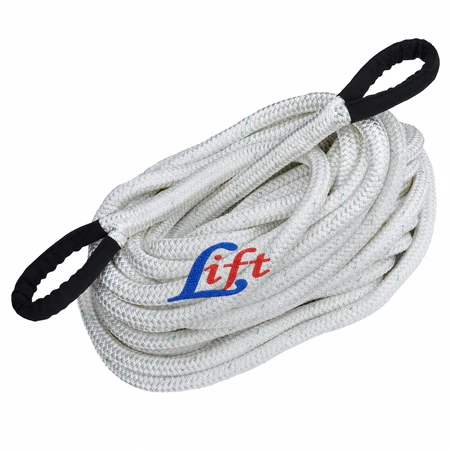
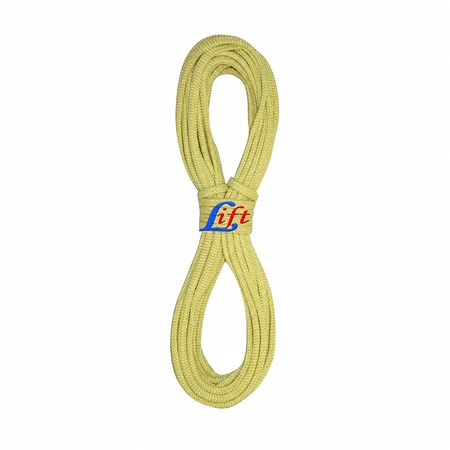
Nylon rope here means a braided rope in synthetic fibre, and it is bought for three duties that look alike on a shelf and behave differently in use. Climbing asks for a rope that takes a shock, sits in a hand and survives an edge; lifting asks for a rope that does not stretch, so the load stays where it was put and the height is not lost on the way up; pulling asks for a rope that is not destroyed by whatever surface it is dragged across.
The range covers three-strand twisted rope, eight, twelve and sixteen-strand braided rope and double braid with a protected core, made to the diameter the duty needs and finished with spliced eyes, thimbles, hooks or buckles. Tell us the duty, the load and the length, and we will confirm the rope and the ends that suit it.
One rope, three duties: what each of them actually asks for
The three duties in this category are usually bought on the same enquiry, and the first thing worth separating is what each one is really paying for. A climbing rope is bought for energy absorption and handling; a lifting rope for stability, because stretch under load is height lost and a swinging load; a pulling rope for abrasion resistance, because the surface it drags over is the thing most likely to end its life. A rope that is excellent for one of these is often the wrong choice for another.
What the duty decides
| The duty |
What the rope is really chosen for |
What to write on the enquiry |
| Climbing and access |
Shock absorption, a firm hand, grip and resistance to abrasion over an edge or a rung. |
The duty in detail (ladder line, access, work positioning), the length, the diameter, and any edge the rope will bear on. |
| Lifting |
Low stretch and a known end: the rope is a load path, so the splice and the marking matter as much as the fibre. |
The load, how the rope is arranged, the length, the end finish, and whether the article is to be marked as a lifting sling. |
| Pulling and towing |
Abrasion resistance and strength per millimetre, with a diameter a hand, a capstan or a winch can handle. |
The pull required, the length, the diameter, the surfaces and rollers the rope runs over, and the fittings at each end. |
| Mooring and securing |
Elasticity to take a shock, and resistance to sunlight and water over long exposure. |
The length, the diameter, how it is fixed, and how long it stays out in the weather. |
Construction: what twisted, braided and double braid change
- Three-strand twisted — economical and easy to splice by hand, with good abrasion behaviour. It tends to rotate under load, which is a handling matter on a lift and a nuisance on a climb.
- Eight, twelve and sixteen-strand braided — no rotational twist, higher strength for the same diameter and a better hand. This is the general-purpose construction for access lines and pulling.
- Double braid — a braided core inside a braided cover: the cover takes the abrasion and the core carries the load, so the two can be chosen separately for the job.
Fibre, and the honest difference between them
Nylon is tough, abrasion-resistant and absorbs shock, which is why it is the usual choice for access lines, ladders and mooring. The same elasticity is why it is not always the right answer for lifting or precise pulling: under a load it stretches, and stretch means the load settles lower than it was set. Where low stretch matters more than shock absorption, polyester or UHMWPE are the fibres to consider, and the page on UHMWPE high-strength traction rope takes up that case in detail.
The ends are part of the specification
A rope is only as useful as its ends. A spliced eye keeps far more of the rope’s strength than a knot, and it is the finish to specify for any duty where the rope carries load; a thimble protects the eye where it meets a shackle or a pin; whipping or a heat-sealed end stops the rope unravelling where it is handled. Say which end goes where, because a finished end shortens the usable length and has to be allowed for in the figure you order.
Two safety lines worth writing down
A rope used to lift is a load path: it should be made with spliced ends, marked with what it will carry, and treated as a lifting article rather than as general cordage. And a rope used where a person could fall is only acceptable if the article itself is made and certified for that duty — a general-purpose rope, however strong it is, is not a fall-protection device.
Frequently asked
Which is better for lifting, nylon or polyester? For a rated sling, low stretch is normally preferred, which favours polyester or UHMWPE; nylon is chosen where shock absorption and abrasion resistance matter more than stability.
What diameter do I need? It follows from the duty and the load, then from what a hand, a capstan or a winch can handle. Give us the duty and the load rather than a diameter alone, and the two answers can be reconciled.
Can two ropes be joined with a knot? They can, at a cost — a knot gives away a large part of the rope’s strength, and it is the point where the rope is most likely to fail. Splices and rated fittings are the answer where load is involved.
Does it need a certificate? Tell us what the rope is for. Where it is part of a lifting or protective arrangement, the article, its marking and the paperwork are specified together from the start.
Where to go next
Related categories: nylon rope, rope ladder, safety harnesses, lifting sling. For the forms this rope is made up into, see colour changing nylon braided rope, double buckle nylon lifting rope, fire escape rope and steel wire core fire rope and cargo soft lifting net.
Contact
Lift Sling Rigging Co., Ltd — telephone and WeChat 18066002268, e-mail 702461526@qq.com, Lifute Industrial Park, Taizhou City, Jiangsu Province, China. HS code 630790. Send the duty, the load, the length and the ends, and we will confirm the rope before it is cut.
 702461526@qq.com