 702461526
Products Categories
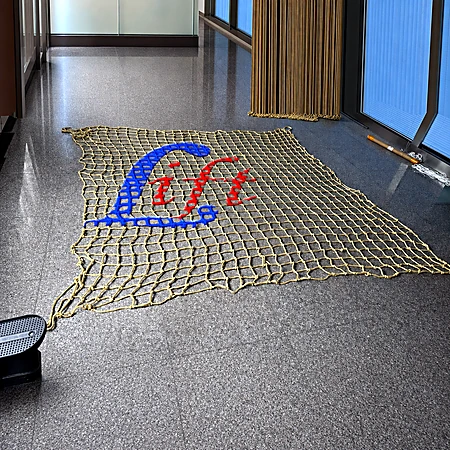
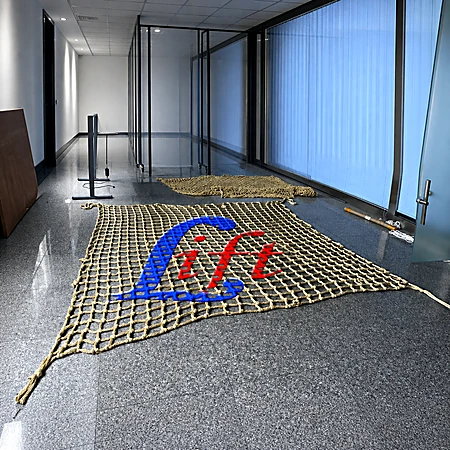
A safety rope net is a flexible barrier woven from high-strength synthetic fibre, made as a panel with an edge rope and fixing points. It is bought for two duties that look alike and are engineered differently: catching what falls — or prevents a person from falling — in a horizontal or near-horizontal net, and holding back a person, a load or debris at the side, where the net stands in a plane rather than catching underneath.
Panels are made to size in knotted and knotless mesh, in nylon, polyester, aramid and UHMWPE rope, with reinforced edges, regular fixing points and any colour a site needs to see it. Because a net only works as part of its fixing arrangement, tell us the opening to be closed, the supports and the clearances, and we will confirm the panel and its edge detail together.
Two duties, and why they are not the same net
The phrase covers both, and the first thing worth separating on this page is what each duty asks the net to do. A catching net works underneath: it has to absorb a fall over a distance, so it needs sag, clearance below and an edge that is properly anchored all round. An interception net works at the side: it has to stop something that would otherwise cross a boundary, so it needs to stand in a plane, to be held at close intervals, and to be tall enough that nothing goes over the top. Buying one for the other is the most common mistake in this category.
| The duty | How the load reaches the net | What the net needs | What to write on the enquiry |
|---|---|---|---|
| Fall protection, catching (horizontal) | A person or a mass arrives from above, and the net absorbs the energy over its sag. | Elastic, energy-absorbing fibre; a properly anchored edge; clear space below the net. | The height of the fall, the mass to be caught, the opening size, and the clear height below. |
| Side interception (vertical) | Something arrives from the side, and the net restrains it rather than catching it from underneath. | Support at close intervals, a stiff edge detail, and a height that cannot be overtopped. | The boundary to be closed, the height, the supports and their spacing, and what may strike the net. |
| Debris and object containment | Small objects, tools or material arrive with little energy but in quantity. | A mesh fine enough to retain what is being worked on, and fixing points that are not disturbed by its removal. | The smallest object that must not pass, and how the net is to be emptied or lifted. |
| Perimeter and edge warning | The net is not a load path; it is there to make a boundary visible and to prevent casual approach. | Visibility and light weight rather than capacity. | The length of the boundary, the colour, and how it is to be fixed and removed. |
Rope, mesh and edge: what the net is actually made of
- Knotted mesh — the traditional construction, repairable on site and easy to see through; the knots are the points the net wears first, and they are also where a local repair is possible.
- Knotless mesh — the rope turns through itself at each crossing, so there is no knot to wear against the rope beside it and the net hangs flatter and lighter.
- Rope diameter and mesh size — together they set what the net can hold and what it will let through. The mesh follows the smallest thing that must not escape; the diameter follows the load the net has to take. Both are chosen from the duty, not from the panel size.
- Fibre — nylon absorbs energy and is the usual choice where a falling mass has to be caught; polyester is lower in stretch and more stable where the net has to stand in a plane; aramid is used where heat or flame is part of the hazard, which the page on high-temperature resistant and fire-resistant safety nets takes up in detail; UHMWPE gives the highest strength for its weight and the best abrasion resistance.
- Edge rope and fixing points — the edge is where every load leaves the net, so its rope is heavier than the mesh rope, reinforced at the corners, and the fixing points are set at the interval the supports require rather than at a convenient spacing.
A net is a panel inside an installation
The single most useful thing a buyer can understand about this category is that the net’s performance is the installation’s performance. What it is fixed to, at what spacing, with what sag, with what clearance beneath, and with what happens at the corners and at the openings, together decide whether a fall is caught or not. So the panel is made from the drawing of the opening, not from the area alone: send the shape, the dimensions, the position of the supports and anything the net must pass around, and the panel, the edge detail and the fixing points come out of that.
Standards, testing and marking
Where a net is used to protect people, the standard it must meet, the type testing required, and the marking and documents that have to travel with it are part of the specification. Tell us the market the net is going to and the standard the buyer has to see, and we will confirm what the article can be supplied and marked as, and what documentation accompanies it.
Installation and the inspection round
Most failures in this category are installation failures rather than material failures, and they are avoidable. Fix the net at every point the design shows, all the way round, so that no gap opens at an edge or a corner. Keep the clear space below a catching net empty — the clearance is part of the system, and a net that catches something it was not allowed to sag under has done its job and still failed. Do not cut mesh to pass a service through it; make the opening as a reinforced detail on the drawing. Then inspect on a fixed interval: the edge rope and the corner fixings, the knots, abrasion where the net meets structure, corrosion on the fixings, ultraviolet exposure and, on a debris net, the load of material that has collected in it.
Frequently asked
Is a net better than a hard barrier? They answer different problems. A net absorbs a falling mass over a distance, which a solid barrier cannot do; a solid barrier excludes something without any clearance behind it. Sites use both, in the places each suits.
What mesh size should I specify? The smallest object that must not pass through it, and on a fall-protection net, the geometry of the body it has to retain. Give the requirement rather than the mesh and the two can be reconciled.
Can the net be made to a shape other than a rectangle? Yes, provided the edge rope can be carried all round and the fixing points fall on the supports. Send the drawing rather than the area.
Can it be repaired on site? On knotted construction, local repairs are normally made with the same rope by a competent person and recorded; a net with a cut edge rope, a damaged corner or a large area of damage is repaired properly or replaced. What must never happen is a repair that nobody wrote down.
Does it need to be certified? If it protects people, yes: the standard it is made to and the certification the buyer requires should be stated at the enquiry, and marking and instructions travel with the net.
Where to go next
Related categories and pages: nylon safety net, safety harnesses, cargo net, rope ladder. For related articles see double layer flat reinforced suspension net, the role of the suspension net in the transport of goods, high altitude anti fall device and speed differential controller and the general cargo and safety net range.
Contact
Lift Sling Rigging Co., Ltd — telephone and WeChat 18066002268, e-mail 702461526@qq.com, Lifute Industrial Park, Taizhou City, Jiangsu Province, China. HS code 630790. Send the opening, the supports, the clearances and the market the net is going to, and we will confirm the panel, the edge detail and the marking before it is woven.