 702461526

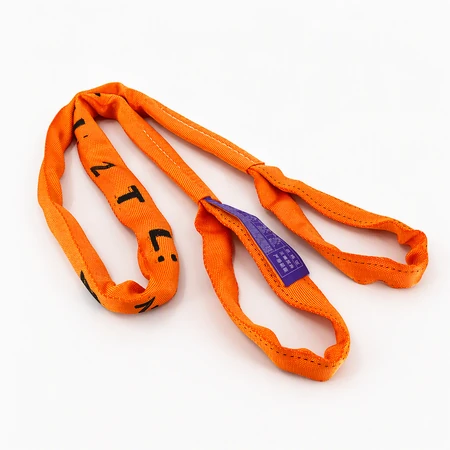
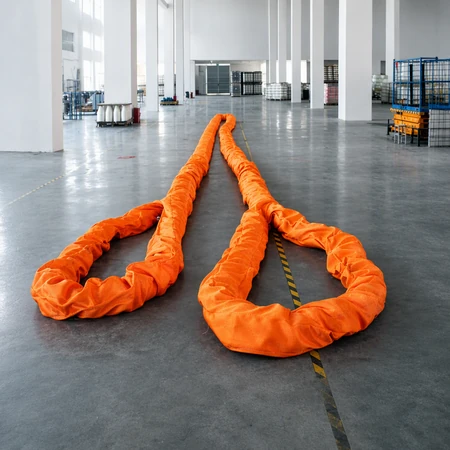
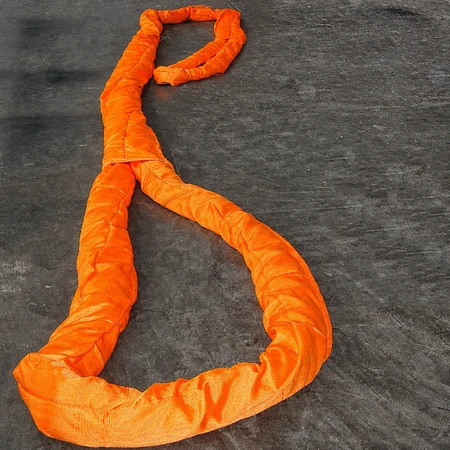
Lift sling rigging company produce Dyneema Round Sling,Engineered lifting slings,lightweight industrial lifting slings,Dyneema Lifting Round Sling
Dyneema Round Sling
UHMWPE Core in a Woven Polyester Sleeve — 1 t to 100 t · Low Stretch · Floats · Around Half the Weight of Polyester
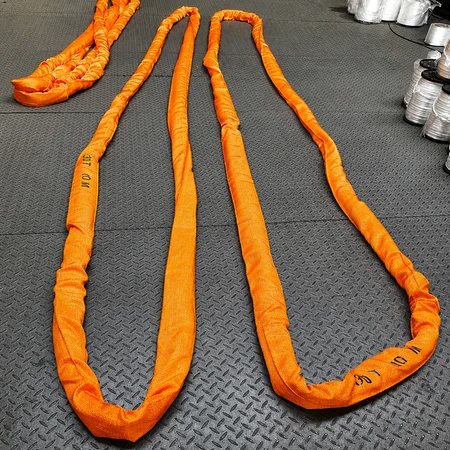
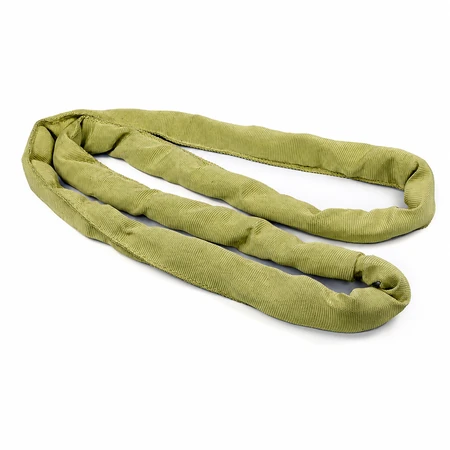
A Dyneema round sling is a continuous loop formed from a woven polyester sleeve, with a load-bearing core of parallel UHMWPE (ultra-high-molecular-weight polyethylene, also called HMPE) yarns running inside it. The sleeve takes the abrasion; the core takes the load. Because the core is UHMWPE rather than polyester, the sling carries far more for its weight and stretches far less — so on a high capacity lift, or any lift where the rigging has to be carried, hauled or flown into position, a sling around half the weight of a polyester round sling does the same job. We build them from 1 t to 100 t, colour coded to the EN 1492-2 scheme, with the working load limit printed on the sleeve.
- UHMWPE core — the highest strength-to-weight of any commonly used lifting fibre
- Around half the weight of a polyester round sling at the same working load limit
- Low stretch — holds a level lift and keeps the load where it was set down
- Floats and never corrodes — safe in water, mud, salt spray and wet yards

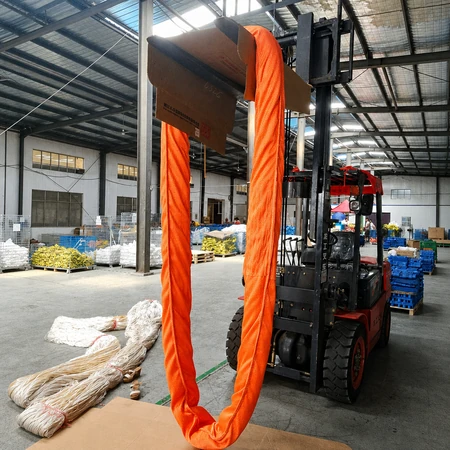
Key Features
Highest Strength for the Weight
UHMWPE carries far more load per kilogram than polyester, nylon or wire rope. Where the sling weight itself works against you, that difference is the whole reason to buy.
Half the Weight to Handle
A Dyneema round sling is typically around half the mass of a polyester round sling rated the same. That pays off three times: in the price of carriage, in freight, and for whoever has to carry it to the load.
Very Low Stretch
The core barely elongates at the working load limit, so the load stays where it was set down and the sling does not creep along the bearing surface while you are landing it.
Floats and Does Not Corrode
UHMWPE is lighter than water, so the sling floats. It is also unaffected by water, salt spray, mud and most chemicals — no rust, no rot, no loss of strength when wet.
Soft Against the Load
The woven sleeve conforms to the bearing surface and will not bruise a painted, machined or polished component the way chain or wire rope does.
Colour Coded and Labelled
The sleeve carries the EN 1492-2 capacity colour stripe and a sewn label with the working load limit, so the sling can be identified on site at a glance.
What Makes It a Round Sling
A round sling is not a woven band with the ends joined. It is two separate parts working together: an inner core of parallel yarn that carries all the load, and an outer woven sleeve that protects the core. Because the core is continuous and parallel — not twisted and not braided — there is no single point along it that sees more stress than its neighbours, which is why a round sling handles high capacity so comfortably.
| Core | Parallel UHMWPE (HMPE) yarn, running as a continuous loop through the sleeve. Carries the entire working load. Not twisted, so no strand takes more than its share. |
|---|---|
| Sleeve | A woven tubular cover, normally double layer, that carries no load at all — it exists to protect the core from abrasion, and to hold the colour stripe and the label. |
| Dyneema® / UHMWPE / HMPE | Three names for the same family of fibre: ultra-high-molecular-weight polyethylene. It is the fibre that gives this sling its strength-to-weight ratio. |
| Why that matters | Because the sleeve does no work, a damaged sleeve is not automatically the end of the sling — but it is always the end of the inspection: once the core is exposed or contaminated, the sling must be taken out of service. |
Dyneema Round Sling vs Polyester Round Sling
Both are round slings with the same sleeve-over-core construction and the same colour coding. The difference is entirely in the core, and it changes what the sling is worth to you.
| Property | Polyester round sling | Dyneema (UHMWPE) round sling |
|---|---|---|
| Core fibre | High-tenacity polyester | UHMWPE / HMPE parallel yarn |
| Weight at the same WLL | Baseline | Around 50 % lighter |
| Elongation at the working load limit | Approx. 3 % | Approx. 1 % |
| Elongation at break | Approx. 15–20 % | Approx. 3–4 % |
| Density | 1.38 g/cm³ — sinks | 0.97 g/cm³ — floats |
| Melting point of the fibre | Approx. 255 °C | Approx. 145 °C |
| Abrasion resistance of the fibre | Good | Excellent |
| UV resistance | Excellent | Good — store out of direct sun |
| Best used where | General purpose lifting, the value choice at every capacity | High capacity lifts, weight-critical rigging, marine and wet environments |
Working Load Limit, Colour Code and Configuration
A round sling does not have one capacity — it has one capacity per configuration. The figure printed on the label is the vertical working load limit, and the capacity in every other arrangement is derived from it. The multiplier depends on how the sling is used, so the arrangement you actually rig is the arrangement whose figure applies.
| WLL (vertical) | EN 1492-2 colour | Choked (× 0.8) | Basket 0–7° (× 2.0) | Basket 7–45° (× 1.4) | Basket 45–60° (× 1.0) |
|---|---|---|---|---|---|
| 1 t | Purple | 0.8 t | 2.0 t | 1.4 t | 1.0 t |
| 2 t | Green | 1.6 t | 4.0 t | 2.8 t | 2.0 t |
| 3 t | Yellow | 2.4 t | 6.0 t | 4.2 t | 3.0 t |
| 4 t | Grey | 3.2 t | 8.0 t | 5.6 t | 4.0 t |
| 5 t | Red | 4.0 t | 10.0 t | 7.0 t | 5.0 t |
| 6 t | Brown | 4.8 t | 12.0 t | 8.4 t | 6.0 t |
| 8 t | Blue | 6.4 t | 16.0 t | 11.2 t | 8.0 t |
| 10 t | Orange | 8.0 t | 20.0 t | 14.0 t | 10.0 t |
| 12 t | Orange | 9.6 t | 24.0 t | 16.8 t | 12.0 t |
Technical Specifications
| Product name | Dyneema round sling / UHMWPE round sling / HMPE round sling / endless round sling |
|---|---|
| Construction | Continuous parallel UHMWPE core enclosed in a woven tubular sleeve, closed into an endless loop |
| Core material | UHMWPE / HMPE (Dyneema®-class) high-modulus polyethylene, parallel yarn |
| Sleeve material | High-tenacity polyester, woven tubular, single or double layer; polyamide sleeve on request |
| Working load limit | 1 t to 100 t, in the standard steps 1 · 2 · 3 · 4 · 5 · 6 · 8 · 10 · 12 · 15 · 20 · 25 · 30 · 40 · 50 · 100 t |
| Safety factor | EN 1492-2 practice is 7:1; other factors produced to order where your market requires them |
| Effective working length | 0.5 m to 20 m as standard; longer to order |
| Elongation | Approx. 1 % at the working load limit; approx. 3–4 % at break |
| Temperature range | Continuous service within the fibre’s limits — see the handling notes below; not for hot work |
| Water and chemicals | Floats; unaffected by water, salt spray, mud, and most acids and alkalis |
| Colour | White sleeve with the EN 1492-2 capacity stripe as standard; other sleeve colours to order |
| Marking | Sewn label with working load limit, length and batch; printed sleeve marking optional |
| Packing | Coil in a poly bag or carry bag, labelled carton, custom export packing |
| MOQ & OEM | Low MOQ for trial orders; full OEM — capacity, length, sleeve colour, label layout and packing |
Handling, Inspection and Limitations
A round sling is a two-part article, and it must be treated as one. The sleeve is there to be worn — that is its job — but the moment the wear reaches the core, the sling is out of service.
- Inspect the sleeve before every use — look for cuts, holes, burns, glazing, abrasion through the outer layer, and any sign of the core showing or bulging.
- Protect it from sharp edges — use an edge protector or a protective sleeve. A cut edge is the most common way a round sling is destroyed.
- Keep friction heat out of the lift — do not drag a loaded sling, and do not let it slip across a rough surface. UHMWPE has a low melting point and friction heat is the hazard that separates it from a polyester sling.
- Do not use it where it will touch hot material — the core’s strength falls away well before the sleeve shows any sign of damage, so heat damage can be invisible from the outside.
- Avoid sustained static load — UHMWPE fibres are prone to creep under a load held for a long period. A Dyneema round sling is a lifting sling, not a permanent lashing or a long-term tie-down.
- Store out of direct sunlight — the sleeve protects the core from UV, so a perished or torn sleeve is a UV problem for the core as well as an abrasion problem.
- Record it — keep the batch marking and a simple log of use. It is the most reliable guide to when the sling should be retired.
Applications
- High capacity lifts where the rigging weight is part of the problem, not just the load
- Machined shafts, rolls, forgings and castings where the sleeve must not mark the surface
- Marine, offshore and port lifting — the sling floats and will not corrode in salt water
- Shipyards and dry docks, where wet, muddy and abrasive conditions are normal
- Wind energy and heavy fabrication, where rigging has to be carried up and flown into position
- Lifts where headroom is tight and the very low stretch keeps the load steady
- Rigging that has to be manhandled into a confined space

Customisation and OEM Service
Round slings are built to the line rather than picked off a shelf, so the enquiry is where the sling is designed. Tell us the load, the configuration you intend to rig, the headroom and the environment, and we will size the core and the sleeve to suit.
- Capacity — 1 t to 100 t, including intermediate steps between the standard sizes
- Length — effective working length to order, from 0.5 m up
- Sleeve — single or double layer woven polyester, standard white with capacity stripe or your own sleeve colour
- Labelling — your label layout, language and marking convention; batch traceability on request
- Protection — additional outer sleeves and edge protectors for abrasive or sharp-edged loads
- Related items — matching polyester round slings, flat webbing slings and wire rope slings for the same lift
Quality Control
Every core is checked for yarn count and lay before the sleeve is closed, and every finished sling is checked on its working load limit marking, its overall length, its sleeve integrity and its label before packing. We have manufactured slings, webbing and rope products for industrial, safety and export customers for close to three decades, and we keep the process visible: on request we supply the fibre certificate, the batch test figures and a sample sling for you to handle and load-test before volume production begins.
Frequently Asked Questions
What is a Dyneema round sling?
A continuous loop formed from a woven polyester sleeve with a load-bearing core of parallel UHMWPE (HMPE) yarn inside it. Dyneema is a brand name for that class of fibre. The sleeve protects the core from abrasion and carries no load itself; the core carries the entire working load.
Why choose Dyneema instead of a polyester round sling?
Weight and stretch. At the same working load limit a Dyneema round sling is typically around half the mass, and it elongates far less — roughly 1 % at the working load limit against roughly 3 % for polyester. That matters on high capacity lifts, where rigging has to be carried or flown into position, and where a load has to stay exactly where it was set down. It also floats and will not corrode in a marine environment.
What are the limitations of a Dyneema round sling?
Heat and creep. UHMWPE has a far lower melting point than polyester, so friction heat from dragging a loaded sling, or contact with hot material, can damage the core without the sleeve showing it. UHMWPE is also prone to creep under sustained static load, so a Dyneema round sling is a lifting sling rather than a permanent lashing. It should always be protected from sharp edges.
What does the colour of the sleeve mean?
It is the EN 1492-2 capacity code: purple 1 t, green 2 t, yellow 3 t, grey 4 t, red 5 t, brown 6 t, blue 8 t and orange 10 t, with 12 t also orange. Above 12 t the colour no longer identifies the sling, so the working load limit printed on the label is the figure that governs.
How much can it lift in a choke or a basket?
The label gives the vertical working load limit. A choke reduces it to 0.8 times that figure; a basket at a narrow angle increases it to 2 times, falling to 1.4 times between 7 and 45 degrees and to 1 times between 45 and 60 degrees. The configuration you actually rig is the one whose figure applies — never the largest number in the table.
Can I get custom capacities, lengths and OEM labelling?
Yes. We build from 1 t to 100 t including intermediate steps, in any effective working length from 0.5 m up, with your choice of sleeve colour and your own label layout, language and marking convention. Tell us the marking or certification your market requires and we will confirm what can be provided before the order.
Request a Quote for Dyneema Round Slings
Send us the capacity, the configuration you intend to rig, the effective working length and the environment — plus any marking or certification your market requires. We will come back with a specification, a sample and a factory-direct price.