 702461526
Products Categories
A lifting spreader beam is slung between the crane hook and the load so that the lifting legs stay vertical instead of closing inwards. The beam takes that closing force itself, which means the load is not squeezed, the sling legs work at their rated capacity instead of having it reduced by the angle, and a long or delicate article can be picked at two points without being compressed between them.
This range covers the fixed-span beam and the equalizing beam with a central pivot, in box, beam-on-edge and truss construction, made to the span, working load and bottom-point arrangement your pick needs. Tell us the load, the two pick positions and the height you have under the hook, and we will confirm the beam that fits it.
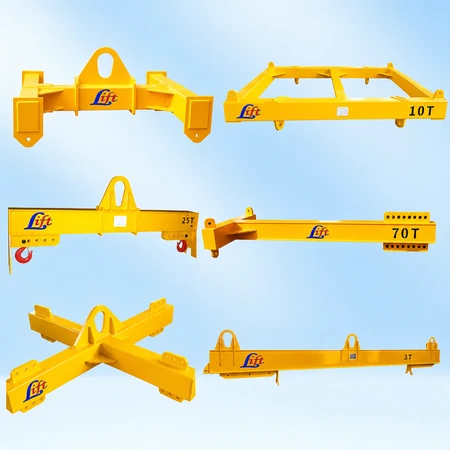
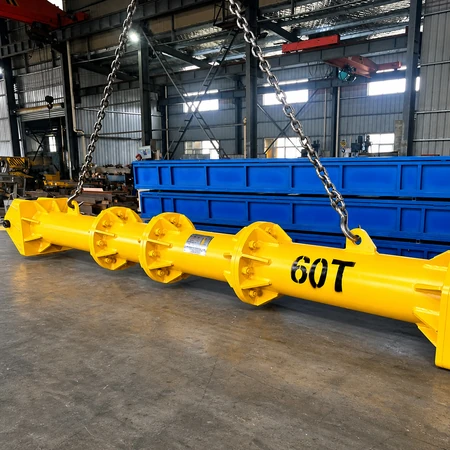
A spreader beam is bought from the pick points, not from the tonnage
A sling set is bought from the mass; a beam is bought from the geometry. The span follows from the distance between the two pick positions on the load, the bottom-point arrangement follows from how those positions are fitted (shackle, hook, pin or sling), and the height the beam occupies follows from the headroom you actually have under the hook. The working load comes out of those three figures rather than leading them.
Fixed span or equalizing: what “balanced lifting” means in practice
The word balance describes two different behaviours, and they are not interchangeable. A fixed-span beam holds two pick points at a set distance; each leg then carries whatever share its position gives it, and the level of the load is trimmed at the crane with the sling lengths or a movable point. An equalizing beam carries a central pivot, so the two legs share the load automatically even when the centre of gravity is not halfway between the pick points — the version to specify when the load is not symmetrical, when the pick points cannot be placed symmetrically, or when nobody can say before the lift exactly where the centre of gravity will sit.
The trade-off is worth stating plainly. An equalizing beam gives balance without trimming, and in exchange it is usually heavier, taller and has more to inspect. A fixed beam is simpler, lighter and cheaper, and puts the trimming back into your sling lengths.
What a beam does that slings alone cannot
- It keeps the legs vertical. Each sling then works at its rated capacity instead of having that capacity reduced by the angle between the legs, and the inward force the legs would otherwise produce is carried by the beam rather than by the load.
- It takes compression off the load. This is the point that decides the choice for pipe and tube bundles, panel and sheet stacks, timber packs, coils, moulds and fabricated assemblies, where an inward squeeze is the damage nobody sees until the coating or the surface is inspected.
- It fixes where the load is picked. The article is lifted where the beam says rather than where the sling happens to fall, which matters when the load will be re-slung at the far end or when a finished face must be touched at a known place or not at all.
- It costs headroom and adds dead weight. The beam and its rigging sit between the hook and the load, so the lift needs more height, and the crane carries the beam’s own mass on top of the load. Both figures have to be known before the beam is chosen, and they are the two lines most often left off an enquiry.
What to specify
| The figure | Why the beam needs it | What to write |
|---|---|---|
| Working load limit | The load as it is presented, plus the beam’s own mass carried by the crane. | The load’s mass and whether the mass of the beam and rigging has to be added. |
| Span | It is the distance between the pick positions, not the length of the load. | The distance between the two points, and whether the span must be fixed or adjustable. |
| Bottom points | Two, three or four, fixed or movable, and the fitting at each one. | How many points, where they go, and what attaches there (shackle, hook, pin, sling). |
| Top rigging | How the beam itself is hung — one point, two points, or a fixed bail. | The hook or shackle you will use, and the height of the top rigging. |
| Beam height and headroom | A beam needs room under the hook; a lift with a tight ceiling may need a shallower section. | The clear height between the hook and the load when the lift is made. |
| Self-weight | It is part of what the crane is lifting and part of what someone has to handle on the ground. | Ask for it, and check it against the crane’s capacity at the radius you will work at. |
| Construction and finish | Box, beam-on-edge or truss; painted, galvanised, or fitted for a particular environment. | The working environment, indoors or at the water, and any restriction on the finish. |
| Marking and records | A beam is a load-bearing device and has to be identified as one. | What has to be marked and whether documentation is required with the delivery. |
Frequently asked
Can I not simply use a wider sling angle instead of a beam? You can, but the capacity of each leg falls as the angle opens, and the legs pull the load inwards while they lift it. A beam removes both effects, which is why it is specified wherever the load cannot be squeezed or the capacity cannot be given away.
Is an equalizing beam always the better choice? Only where balance cannot be arranged another way. It costs weight and headroom, and it has more parts to inspect, so a fixed beam with correctly cut slings is often the cheaper answer to the same problem.
Can the span be adjustable? Yes. Adjustable and telescopic versions exist for sites with several different pick spacings, at the cost of more weight and more to check.
Does the beam have to be inspected? It should be treated as equipment in its own right: marked with its working load and its own mass, kept with its records, and examined on its own interval rather than with the slings it works with.
Where to go next
For the rest of the range see lifting beam, and for what hangs from it see lifting hook, lifting sling and steel coil lifting device. For the loads a beam is most often bought for, see export steel pipe sling, glass lifting sling and special lifting equipment for dock lifting vehicles.
Contact
Lift Sling Rigging Co., Ltd — telephone and WeChat 18066002268, e-mail 702461526@qq.com, Lifute Industrial Park, Taizhou City, Jiangsu Province, China. HS code 630790. Send the two pick positions and the headroom you have, and we will confirm the span and the section before anything is fabricated.