What it replaced, and why it won on finished work
A wire rope sling is stronger per millimetre of its own thickness and it survives abuse that would end a webbing sling’s life. So the swap is not a question of strength; it is a question of contact and handling. A steel rope presents a hard, narrow surface to the load and a fringe of broken wires to the hands that rig it, and on a finished article it does the damage before the lift begins. A webbing sling presents a wide soft face to the load and a smooth one to the rigger, so it is chosen where the surface is worth more than the extra care a rope would need, and where the load is not so abrasive or so hot that the fibre is out of its depth.
Three things the name has to carry: width, figure and ends
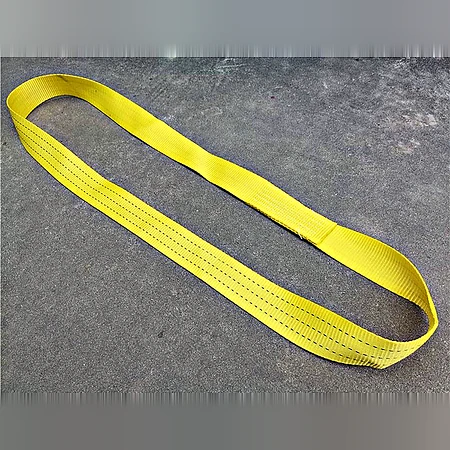
- Width — sets the pressure on the load. A narrow band concentrates the load and is the right answer on a light, stiff article; a wide band spreads it and is the right answer on anything soft, coated or finished. It also sets what the band can be folded into.
- Figure, per mode — a webbing sling does not have one capacity. It has a capacity in vertical, a different one in basket and a lower one choked, and the label states each of them. Purchasing on “the tonnage” alone is the single most common error in this category.
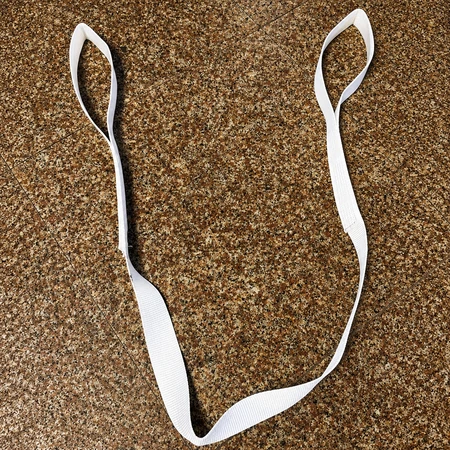
- Ends — flat loop, folded eye or reinforced eye; they decide how the band sits on a hook, whether it can be used in a choker, and how the last of the fibres at the end are protected. The end is where a band wears out first, so it is worth specifying deliberately rather than accepting by default.
One band, several figures: the arrangement decides the rating
The figures below are the standard mode factors used across the market for flat webbing slings: each is multiplied by the sling’s own marked working load limit to give the capacity in that arrangement. The angle is the angle of the leg to the vertical, and the label on the article always overrides the table.
Mode factor by arrangement
| Arrangement |
Mode factor |
What it means on the floor |
| Vertical |
1.0 |
One leg, straight up. The band hangs and carries. |
| Choked |
0.8 |
The band goes round the load and back through its own eye. The wrap grips the load, and the band is loaded against itself. |
| Basket, 0–45° |
2.0 |
Band under the load, both ends on the hook, legs near vertical. |
| Basket, 45–60° |
1.4 |
Basket with the legs spread; the spread costs capacity. |
| Two legs, 0–45° |
1.4 |
Two bands to one hook, legs near vertical, load shared. |
| Two legs, 45–60° |
1.0 |
The same pair with the legs spread — the same loss of capacity. |
| Three and four legs, 0–45° |
2.1 |
Three or four legs; note it is not three or four times the figure, because the load rarely shares evenly. |
| Three and four legs, 45–60° |
1.5 |
The same arrangement spread. Re-check rather than assume. |
Two consequences worth stating plainly. A choked webbing sling is weaker than the same sling used vertically, so a load that must be choked needs a bigger band rather than a longer one. And as the legs spread the capacity falls, which is a geometric fact rather than a material one — it is answered by a wider angle-free arrangement, by a spreader, or by a bigger sling, and by nothing else.
Colour on the band is identification, not certification
Flat webbing slings are colour-coded by working load limit under the convention most of the market uses — 1 t violet, 2 t green, 3 t yellow, 4 t grey, 5 t red, 6 t brown, 8 t blue, 10 t orange. It is genuinely useful on a site: a rigger can spot a two-tonne band in a pile from across the yard. What the colour cannot do is replace the label, because the figure that applies is the one printed and affixed to that individual sling, and above the top of the coded range there is no colour to read at all. Treat the colour as the fast check and the label as the answer.
Replacing a wire rope: where the swap works and where it does not
Where a band beats a rope, and where it must not go
| The condition |
Webbing sling |
Wire rope sling |
| Finished or painted surface |
The reason to choose it: wide soft contact, no marking. |
Marks and scuffs the surface; needs padding to compete. |
| Weight to be handled |
A fraction of a rope of the same figure. |
Heavy, stiff, and awkward above a certain size. |
| Sharp edges and burrs |
Requires an edge protector or a sleeve, without exception. |
Copes with much more, which is why it still owns the fabrication yard. |
| Hot surfaces and hot work |
These fibres have a working limit around 100 °C and fail by melting, not by deforming politely. |
Far more tolerant, though not unlimited. |
| Abrasion, grit, dragging over concrete |
Wears quickly; the cover can be added but the band’s life is measured in shifts. |
The better answer where the environment itself is the attack. |
| Chemical contact |
Depends on the fibre; acids, caustics and some solvents are hostile to most of them. |
Steel is indifferent to most of what destroys a band. |
The practical rule is that a webbing sling is chosen for the sake of the load, not for the sake of the sling, and the environment the band works in is the price of that choice. Where both a finished surface and an abrasive environment are present, the answer is normally a covered or sleeved band rather than a return to wire rope — but that is a decision to take with the supplier on the specific job, not a default.
Lifting, lashing and towing are three different duties
The same article is often bought for all three and should not be. They load the band differently and are rated differently, and the confusion is the reason this section exists.
Three duties, three ratings
| Duty |
How the band is loaded |
What it has to be rated for |
What must never happen |
| Lifting |
Briefly, visibly, with a person watching and a standing load. |
A lifting rating, stated per hitch and per angle, with the marking that goes with it. |
A band bought for restraint used to lift. |
| Lashing / restraint |
Continuously, in tension, in transit, unattended, with fatigue and vibration. |
A restraint rating — a lashing capacity, tensioned by a ratchet or a buckle, not a lifting rating. |
A lifting sling used as a lashing, or a lashing used as a sling. The duties do not transfer. |
| Towing and recovery |
In snatch loads: repeated shock, far above the steady figure, plus elastic recoil if anything parts. |
A purpose-made tow or recovery strap, built for shock loading, with its own rating and its own safe practice. |
A lifting sling, or even a plain lashing, used as a tow rope. This is a fatal-practice, not a marginal one. |
Where a load has to be both lifted and held in transit, the correct answer is two articles rather than one used twice: a sling that lifts, and a ratchet cargo lashing belt or ratchet tie down strap that restrains. It costs less than the incident.
Edges, sleeves and the protection that is part of the specification
A band cut by an edge starts as a small notch and ends as a failure, so edge protection is a specification line rather than an accessory decision. Where the load has a sharp corner, a machined lip, a burr, a weld spatter or a rough casting skin, either the band is sleeved and the sleeve is part of the article, or the corner is protected with a pad or a corner piece that travels with the band. Ask for it at the enquiry stage: a sleeve added later cannot be retro-fitted to a band already woven, and a band ordered without one is a band that will be used without one.
Inspection, and the conditions that end a band’s life
Inspect before every use, and formally at the interval the site rules set. The conditions that remove a webbing sling from service are specific rather than a matter of judgement: acid or caustic burns, melting or charring, snags, punctures, tears or cuts, broken or worn stitching, distortion of the fittings or the eyes, and a label that can no longer be read. A band with any of those is out of service, and it is out of service because the damage is in the load path, not because it looks untidy. Store clean and dry, out of sunlight, and keep the record with the article.
Frequently asked
Can a webbing sling really replace a wire rope of the same capacity? For the lift itself, yes, provided the figure is taken per hitch and the edges and the temperature are within the band’s limits. The two are not interchangeable in the environment, which is a different question from the load.
What width should I order? The narrowest width that will carry the figure without crushing the load, or the widest the load’s geometry will accept. Send the load and the figure, and the width follows.
Why is the choked figure lower? Because the band is loaded against itself and the wrap grips, so the fibres are working in a way the vertical figure does not describe. It is normal, it is on the label, and it is the reason a choke sometimes needs the next size up.
Can I use one sling as a lashing as well? Not as the same article. Restraint is rated for continuous tension, not for a lift, and the two duties are marked differently. Buy the lashing as a lashing.
How long will a band last? The environment decides, not the calendar: a band on painted steel in a workshop gives years, the same band dragged over concrete and grit gives shifts. Inspect for condition rather than age, and never against a fixed service life.
Does the colour tell me the capacity? It identifies the working load limit by convention, and it is not a substitute for the label. Where the colour and the label disagree, or the label is unreadable, the band is out of service.
Where to go next
Related categories and products: lifting sling, wire rope sling, lifting beam, lifting hook, lifting chain. For the neighbouring articles see nylon woven flat sling, polypropylene flat sling, heavy duty lifting sling, endless webbing sling, eye and eye type webbing sling, alkali resistant sling, lightweight UHMWPE endless loop flat webbing sling, flame resistant aramid webbing sling belt and single use endless webbing sling.
Contact
Lift Sling Rigging Co., Ltd — telephone and WeChat 18066002268, e-mail 702461526@qq.com, Lifute Industrial Park, Taizhou City, Jiangsu Province, China. HS code 630790. Send the load, the figure per hitch, the arrangement and the working environment, and we will confirm the width, the length, the protection and the marking before the band is woven.
ZH
 702461526