

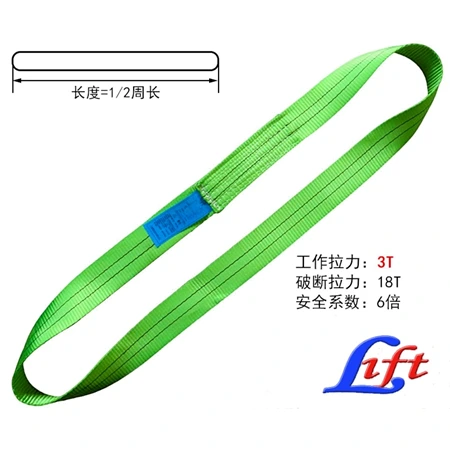
Lift Sling Rigging Company produce Single Ply Endless Flat Sling
Otu Ply Flat Sling na-adịghị agwụ agwụ
A single ply endless flat sling is a continuous loop of flat woven webbing — one ply, one piece, no sewn eye and no end fitting. Because the loop has no fixed wear points, the sling can be rotated slightly on every lift so that a different part of the webbing takes the load, which makes it the longest-serving sling in a warehouse or on a production line. Ụlọ ọrụ Lift Sling Rigging (Bulite) has manufactured endless flat webbing slings in Taizhou, Jiangsu kemgbe 1985, si 1 t ka 12 t arụ ọrụ ibu oke, na polyester, nylon or polypropylene webbing, with a safety factor of 5:1, 6:1 ma ọ bụ 7:1.
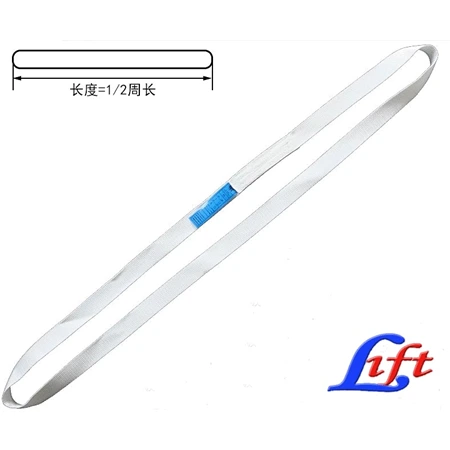
What makes an endless sling different
Ebè na anya na anya nwere anya abụọ a dụchara na ahụ dị larịị n'etiti ha, so the webbing always wears in the same places. An endless sling is a closed loop: there is no eye to wear out, no stitching in the path of the load, and the whole circumference is available as the bearing surface. In practice that means three things on site:
- Longer service life — the sling can be rotated so a different section of the webbing sits under the load on the next lift.
- All three hitches are possible - kwụ ọtọ, choke and basket — with the same sling, n'otu oke ibu ọrụ.
- Dị nro, kọntaktị enweghị akara — flat woven webbing spreads the load and does not scratch painted, plated, polished or powder-coated parts the way a chain or wire rope does.
How a single ply endless flat sling is built
Single ply construction
“Otu mpempe akwụkwọ” means one layer of woven webbing forms the whole loop. It is the lightest, most flexible and most economical construction, and it is the right choice when the sling has to be threaded through tight spaces or wrapped around small diameters. Where a heavier duty is needed at the same width, the same sling is supplied as a double ply (duplex) èbè, or in a round sling with a protective sleeve.
Ihe onwunwe
The webbing is woven from high-tenacity polyester as standard, with nylon and polypropylene available for specific duties. Polyester has low elongation under load, resists UV and moisture well, and tolerates the widest range of common industrial chemicals. Every batch of webbing is woven in our own mill and the finished sling is proof tested before it leaves the factory.
Standards and safety factor
Our endless flat slings are manufactured to ISO 4878, N'ime 1492-1 na JB/T 8521, and are supplied colour coded for quick identification in the store and in the air. The safety factor — the ratio between the minimum breaking load and the working load limit — is selected at order: 5:1, 6:1 ma ọ bụ 7:1. A 7:1 sling needs a wider webbing than a 5:1 sling for the same working load limit, which is why the width column in the table below has three values.
Usoro nka
The table below is our standard single ply endless flat sling range. Ọkpụrụkpụ, widths and weights are approximate values; minimum and maximum length are the limits we can manufacture as one continuous loop.
| Oke ibu ọrụ | Ihe ruru. ọkpụrụkpụ | Obosara na 5:1 | Obosara na 6:1 | Obosara na 7:1 | Min. ogologo | Oke. ogologo | Weight at 5:1 | Weight at 6:1 | Weight at 7:1 |
|---|---|---|---|---|---|---|---|---|---|
| 1 000 n'arọ (1 t) | 4 mm | 25 mm | 25 mm | 30 mm | 0.5 m | 100 m | 0.16 n'arọ/m | 0.18 n'arọ/m | 0.20 n'arọ/m |
| 2 000 n'arọ (2 t) | 4 mm | 50 mm | 50 mm | 60 mm | 1.0 m | 100 m | 0.35 n'arọ/m | 0.39 n'arọ/m | 0.60 n'arọ/m |
| 3 000 n'arọ (3 t) | 4 mm | 75 mm | 75 mm | 90 mm | 1.0 m | 100 m | 0.52 n'arọ/m | 0.73 n'arọ/m | 0.78 n'arọ/m |
| 4 000 n'arọ (4 t) | 4 mm | 100 mm | 100 mm | 120 mm | 1.5 m | 100 m | 0.80 n'arọ/m | 0.84 n'arọ/m | 0.90 n'arọ/m |
| 5 000 n'arọ (5 t) | 4 mm | 125 mm | 125 mm | 150 mm | 1.5 m | 100 m | 0.85 n'arọ/m | 0.96 n'arọ/m | 1.14 n'arọ/m |
| 6 000 n'arọ (6 t) | 4 mm | 150 mm | 150 mm | 180 mm | 1.5 m | 100 m | 0.96 n'arọ/m | 1.12 n'arọ/m | 1.33 n'arọ/m |
| 8 000 n'arọ (8 t) | 4 mm | 200 mm | 200 mm | 240 mm | 2.0 m | 100 m | 1.34 n'arọ/m | 1.65 n'arọ/m | 1.85 n'arọ/m |
| 10 000 n'arọ (10 t) | 4 mm | 250 mm | 250 mm | 300 mm | 2.0 m | 100 m | 1.64 n'arọ/m | 1.84 n'arọ/m | 2.05 n'arọ/m |
| 12 000 n'arọ (12 t) | 4 mm | 300 mm | 300 mm | 300 mm | 2.0 m | 100 m | 1.86 n'arọ/m | 2.06 n'arọ/m | 2.70 n'arọ/m |
Lengths longer than 100 m, intermediate widths, extra-wide slings and special colours are made to order. Tell us the working load limit, ihe nchekwa, the width and the length you need and we will confirm the weight and the delivery time.
| Oke ibu ọrụ | Obosara | 1 m | 3 m | 5 m | 10 m | 20 m |
|---|---|---|---|---|---|---|
| 1 000 n'arọ (1 t) | 30 mm | 0.25 n'arọ | 0.71 n'arọ | 1.17 n'arọ | 2.32 n'arọ | 6.46 n'arọ |
| 10 000 n'arọ (10 t) | 300 mm | - | 7.00 n'arọ | 11.60 n'arọ | 23.10 n'arọ | 46.10 n'arọ |
Colour coding and marking
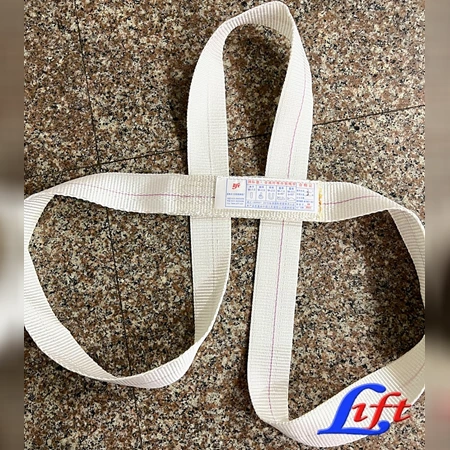
Endless flat slings are colour coded following BS EN 1492-1 so that a storekeeper or a rigger can pick the right sling at a glance, and each sling carries a blue label with the working load limit, ogologo, safety factor and batch number. Special colours, printed logos and customer labels are available on OEM orders.
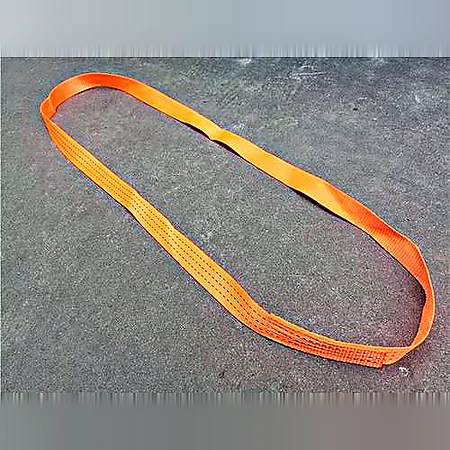
Hitches: how an endless flat sling is used
Vertical hitch
The loop hangs in a straight line and the load is carried on one side of the loop. This is the simplest and the most common way to use an endless sling, and the working load limit printed on the label applies directly.
Choke hitch
The loop is passed around the load and through itself. The webbing grips the load, which is ideal for pipes, poles and drums, but the choked part of the webbing is subject to extra friction — check the label and keep the sling’s own working load limit in mind.
Basket hitch
The loop is passed under the load so that both sides of the endless loop carry the load. Used with a hook or a shackle through the two ends of the loop, the basket hitch doubles the bearing surface and is the gentlest way to lift a finished or coated part without marking it.
Otu mpempe akwụkwọ anaghị agwụ agwụ, double ply endless or round sling?
| Ihe owuwu | Kachasị mma maka | Ihe ndetu |
|---|---|---|
| Otu nkpọk na-enweghị ngwụcha èbè | 1-12 t, general lifting, oghere siri ike, small diameters | Lightest and most flexible; width carries the load |
| Double ply (duplex) èbè dị larịị adịghị agwụ agwụ | Heavier duties at the same width | Two layers of webbing stitched together |
| Extra-wide endless flat sling | Very heavy loads with a wide, soft bearing surface | Made to order in widths well above 300 mm |
| èbè okirikiri na-adịghị agwụ agwụ | Flexible, fabric-sleeved loops for awkward shapes | See our èbè okirikiri adịghị agwụ agwụ |
| Single use endless sling | One-trip packing and one-way exports | See our single use lifting sling with endless loop |
Ngwa
- Igwe igwe, stainless and aluminium parts that must not be marked — sheet, efere, machined components, coils and bundles.
- Ọkpọkpọ, tubes and poles, using the choke hitch to stop the load slipping.
- Ogwe aka nke precast, kerbs and blocks, lifted on a soft bearing surface.
- Painted and powder-coated fabrications, ụgbọ mmiri ma mechaa mgbakọ.
- Ngwa igwe, moulds and dies where a chain would damage a ground or scraped surface.
- General factory and warehouse lifting, and as an economical replacement for worn eye-and-eye slings.
-
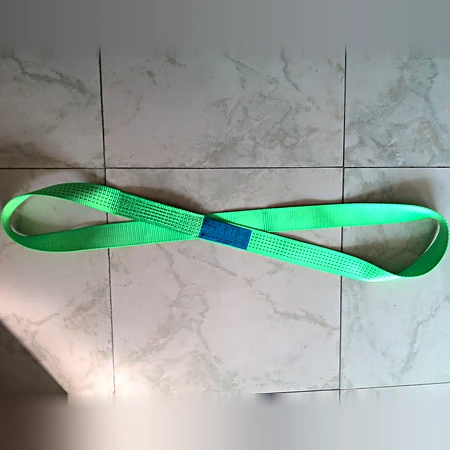
Single ply endless flat sling in green webbing with a blue working load limit label
Safe use and inspection
- Check the label is legible and that the sling’s working load limit covers the lift before every use.
- Inspect the webbing for cuts, snags, oghere, abrasion, kemịkalụ ntụpọ, mmebi okpomọkụ, broken stitches and any deformation of the loop; withdraw the sling from service if the webbing is damaged through more than a minor surface mark.
- Protect the sling from sharp edges, hot surfaces and welding spatter with an edge sleeve or a padded protector.
- Do not exceed the working load limit and do not use the sling at an angle wider than your lifting plan allows — the load in each leg rises as the included angle opens.
- Never shorten a sling with a knot or join two slings by knotting them, ma ghara ịrụkwa webbing site na stitching, ịgbado ọkụ ma ọ bụ kpo oku.
- Store slings clean and dry, off the ground and away from sunlight, chemicals and heat.
Why buy endless flat slings from Lift
- 40 afọ nke èbè n'ichepụta - tọrọ ntọala na 1985 na Taizhou, Jiangsu, now one of China’s leading rigging manufacturers, na ihe karịrị 200 ndị ọrụ.
- Ụlọ nyocha nke onwe na 1000 t igwe nyocha — every sling is proof tested and documented, na akụrụngwa anyị na-ejide CNAS, CE na DNV asambodo.
- Ịkpa akwa, stitching na ule n'okpuru otu ụlọ — we weave our own webbing, ya mere obosara, colour and safety factor are under our control rather than bought in.
- Full documentation - akwụkwọ nyocha, blue working load limit label and packing list with each order.
- One supplier for the whole lifting range - endless flat webbing slings, flat lifting slings, èbè gburugburu, endless type webbing slings, eriri rachet, eriri eriri slings and rigging hardware.
- OEM na ODM - akara akara nke onwe, ebipụta webbing, special colours and customer packing for distributors.
Ajụjụ a na-ajụkarị
- What is a single ply endless flat sling?
- It is a continuous loop of flat woven webbing made from a single layer of webbing — one ply, with no sewn eye and no end fitting. The whole loop is the load-bearing element, so a different part of the webbing can be rotated into position on each lift.
- What sizes are available?
- Oke ibu ọrụ site na 1 t ka 12 t dị ka ọkọlọtọ, n'ime 4 mm thick webbing. Web width runs from 25 mm na 1 t ka 300 mm na 12 t, depending on the safety factor, and finished loop lengths are made from 0.5 m na 100 m, with longer lengths to order.
- What safety factor should I choose — 5:1, 6:1 ma ọ bụ 7:1?
- 7:1 is the most common choice for industrial lifting and is the factor used with colour coded slings under BS EN 1492-1. A 7:1 sling is slightly wider and heavier than a 5:1 sling of the same working load limit. Gwa anyị ọkọlọtọ saịtị gị na-arụ ọrụ na anyị ga-enye ya.
- Can the sling be used in a choke hitch?
- Ee. An endless sling works in vertical, choke and basket hitches. The choke hitch grips pipes and poles well, but friction and the reduced bearing area mean you should allow for the choke when you select the working load limit.
- Is single ply or double ply better?
- Single ply is lighter, more flexible and more economical, and is the right choice for most lifts up to 12 t. Choose double ply (duplex) when you need a higher working load limit at the same width, or when the load has to be lifted with a wider, stiffer bearing surface.
- Ndi èbè na-abịa na akwụkwọ?
- Ee. Each order is supplied with a test certificate, and every sling carries a blue label with its working load limit, ogologo, safety factor and batch number. Akara akara nke onwe na mbukota ndị ahịa dị na iwu OEM.
Request a single ply endless flat sling quotation
Zitere anyị oke oke ọrụ, ihe nchekwa (5:1, 6:1 ma ọ bụ 7:1), the webbing width and the loop length — or simply describe what you are lifting. Our engineers will confirm the width, the finished weight and the delivery time, and we can produce a sample sling for trial before a batch order.
Ụlọ ọrụ Lift Sling Rigging - TaiZhou City, JiangSu Province, China
Tel / WhatsApp: +86 180 6600 2268 | E-mail: 702461526@qq.com
Kpọtụrụ anyị maka nkwupụta okwu
Ibe ndị metụtara: èbè ebuli na-adịghị agwụ agwụ · èbè na-adịghị agwụ agwụ · Èbè na-ebuli elu dị larịị · èbè webụ na-adịghị agwụ agwụ · eriri eriri adịghị agwụ agwụ na-ebuli èbè · èbè dị larịị na-adịghị agwụ agwụ · èbè na-adịghị agwụ agwụ ụdị webbing · èbè okirikiri na-adịghị agwụ agwụ