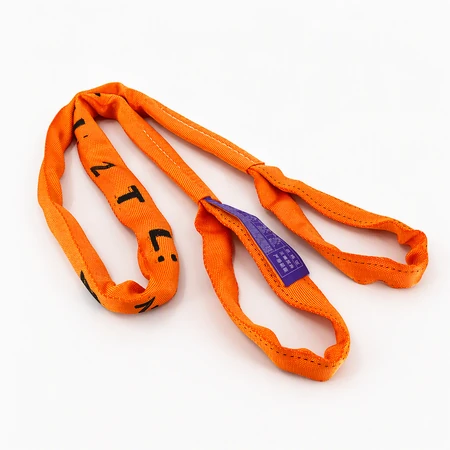
A round sling is a soft sling in its most forgiving form: a load-bearing core of continuous synthetic fibre, enclosed in a woven protective sleeve and closed into an endless loop. There is no metal anywhere on the article and no flat face to concentrate pressure, so it conforms to whatever it is wrapped around — which is why it is the sling usually chosen for large, heavy and awkward plant, and for machinery whose machined surfaces, coatings or paint must come out of the lift untouched.
This category covers the sleeved round sling in polyester, nylon and UHMWPE cores, in the capacity, effective length and sleeve the job needs, for use in the vertical, basket and choker arrangements and with the shackles, hooks and beams of the rest of the lifting set. Tell us the machine, its lifting points and the arrangement you will use, and we will confirm the sling and its marking.
Why a round sling is chosen for large and heavy plant
Heavy equipment is awkward in a way that weight alone does not describe. It has lifting points that are often small eyes or trunnions rather than wide flat surfaces; its surfaces are frequently machined, painted or coated; and it is handled by people who cannot simply drag it into a better position. Four properties of a round sling answer those conditions at once.
- It is soft and conforming. The sleeve moulds to the load and to the eye it passes through, so the contact is distributed rather than concentrated at a hard edge.
- It carries high capacity for its weight. Compared with chain or wire rope of the same capacity, a round sling is much lighter, which matters both to the crane and to whoever has to carry it to the machine.
- There is no metal on the article. Nothing on the sling can bruise a machined face, and there is no fitting to match against a lifting eye.
- It wraps rather than hooks. The loop goes around what is there — a trunnion, a bundle, a frame, a mould — instead of requiring an eye of the right shape to be presented to a hook.
The sleeve and the core: what each one does
A round sling is two articles in one, and its service life is decided by the outer of the two. The core is the continuous fibre that carries the whole load; the sleeve protects the core from abrasion, from the load, and from daylight and dirt, and it carries the marking the person making the lift reads. Two consequences follow that are worth stating on a category page, because they explain most retirements: a sleeve that has been cut through so that the core is visible is a sling to be taken out of service even if the core itself looks sound, and a sling that has been dragged across a rough floor has spent its strength in the dragging rather than in the lifting.
The same sling carries differently in each arrangement
The three working arrangements, and what each one asks of the same round sling
| Arrangement |
How the load enters the sling |
What to write on the order |
| Vertical |
The loop hangs doubled from the hook and takes the load at the bottom of the loop. |
The load at each leg, and whether the legs will work at an angle to each other. |
| Basket |
The sling passes under the load and both parts are taken to the hook, so two parts of the sling share the load. |
The girth of the load and the width that has to be spanned. |
| Choker |
The sling passes around the load and back through itself, gripping the article as it lifts. |
That a choker is intended, because the article is loaded differently and the angle of choke matters. |
Each arrangement has its own working figure for the same sling, and the figure is published for the arrangement rather than assumed from the tonnage on the sleeve. If the lift uses two arrangements at once — a basket on one end and a choker on the other, which is common on machinery — say so, and the sling is chosen for the pair rather than for one of them.
Capacity for weight is only half of the comparison
Where a round sling sits among the alternatives
| Property |
Round sling |
Chain or wire rope |
| Contact with the load |
Soft and conforming; no metal touches the load. |
Hard; concentrated contact that marks machined and painted surfaces. |
| Weight for the same capacity |
Light, and easily carried by hand to the machine. |
Heavy, and handled with assistance. |
| Sharp edges |
A limit rather than a strength: an edge that can cut has to be protected against. |
More tolerant of an edge, at the cost of marking what it touches. |
| Heat |
Has a working range, and hot surfaces have to be stated on the enquiry. |
Higher tolerance to heat. |
| Where it wins |
Finished, machined and painted plant; awkward shapes; tight access; lifts where the sling must conform. |
Foundry and hot work, and lifting where abrasion cannot be controlled. |
What to send for a round sling quote
- The machine, and its lifting points: how many, and what shape each one is — an eye, a trunnion, a frame corner or a bundle.
- The load at each point: the mass and its distribution, with the centre of gravity if it is not obvious.
- The arrangement: vertical, basket or choker, and whether a beam or spreader is used above the load to keep the legs vertical.
- The effective length, and the convention it is quoted in: a closed article is quoted under more than one convention, and the difference is a real distance.
- The core fibre, and the environment: temperature, chemistry, water, daylight, and how long the sling stays on the machine.
- Edge protection and any sleeve requirement: where the sling meets a sharp corner, and whether a heavier sleeve is warranted.
- Marking: the capacity and identification the receiving site needs to read.
Inspection and care
A round sling is inspected before each use, and the check is nearly all on the outside: the sleeve for cuts, abrasion, chemical staining and heat glazing; the loop ends where the core turns; and the label. Store it dry and off the floor, keep it off sharp edges with proper protection, and never drag a loaded sling sideways. A sling that has been exposed to a chemical or to a heat source should be taken out of service pending a decision rather than pressed back into use because it looks intact.
Frequently asked
Is a round sling stronger than a flat webbing sling? They differ in shape rather than in kind. A round sling conforms and presents a soft, rounded contact; a flat sling presents a wide face. Which one suits a machine depends on the contact you are protecting and the space you have around the lifting point.
Can it be used in the rain or outdoors? Synthetic fibre handles water well; daylight and abrasion are the longer-term concerns, and the fibre and sleeve can be chosen with that in mind.
What happens if the sleeve is damaged but the core is intact? It comes out of service. The sleeve is what protects the core and carries the marking; without it the sling can no longer be judged, and a sling that cannot be judged cannot be used.
Can the capacity be identified at a glance? Yes — the working load limit is printed on the sleeve and carried by the cover colour, which is why the sleeve has to be legible for the whole of the sling’s life.
Where to go next
Related categories: lifting sling, lifting beam, lifting hook, lifting chain, steel coil lifting device. For the closed forms themselves see endless round sling, endless sling, circular sling and circular flexible lifting belt; for a heavy lift in service see railway rescue lifting equipment.
Contact
Lift Sling Rigging Co., Ltd — telephone and WeChat 18066002268, e-mail 702461526@qq.com, Lifute Industrial Park, Taizhou City, Jiangsu Province, China. HS code 630790. Send the machine, its lifting points and the arrangement, and we will confirm the capacity, the length and the sleeve before the sling is made.
 702461526