

Lift sling rigging company produce Flat Lifting Sling.
Eslinga u líik'il táats' che'
Flat Woven Webbing Slings to EN 1492-1 — Polyester, Nylon or Polypropylene, 1–30 t, Eye and Eye or Endless
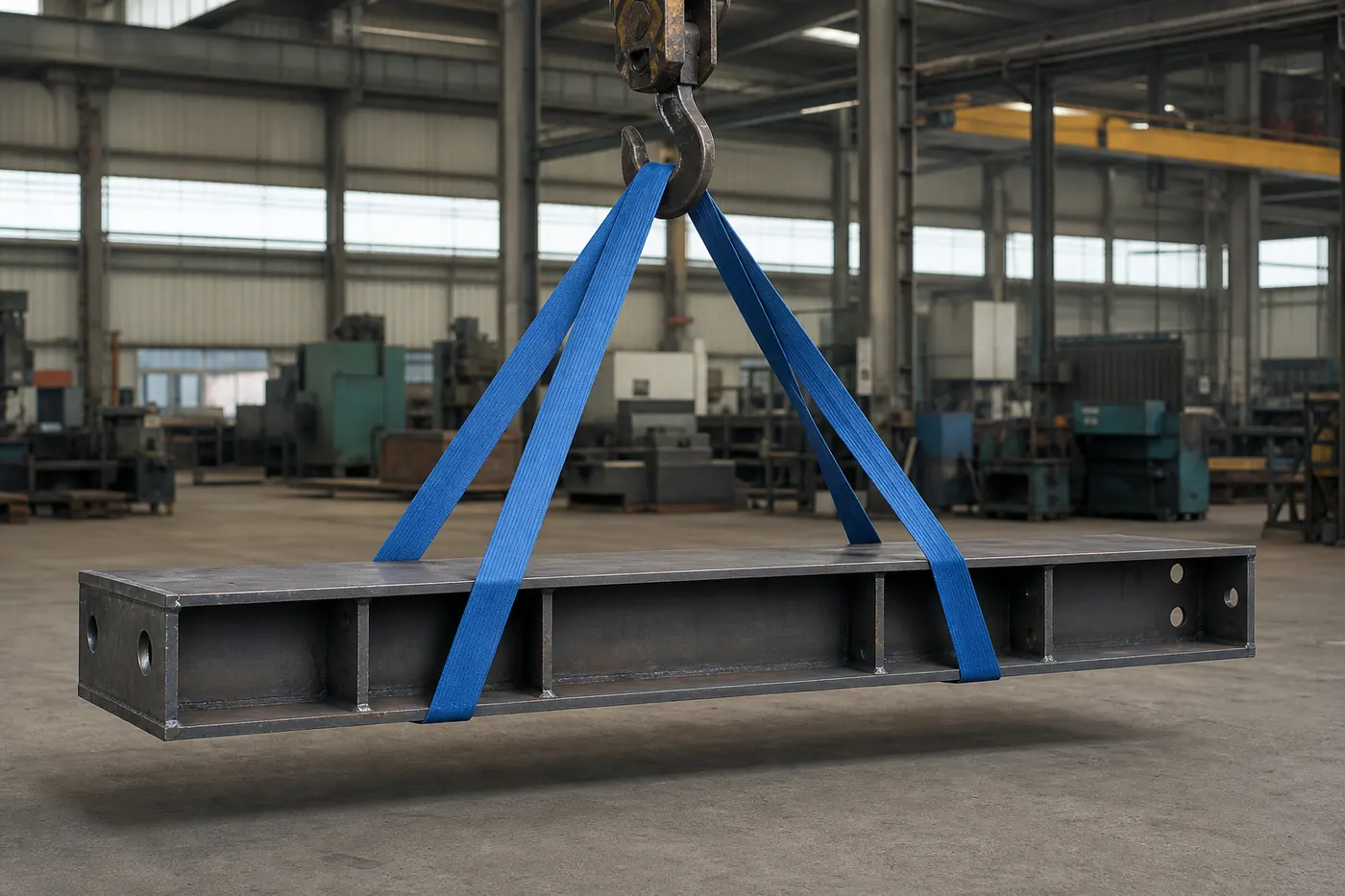
JUNTÚUL eslinga u líik'il táats' che' is defined by one thing and one thing only: its cross-section. The load-bearing element is a band of woven webbing with a rectangular section, so it bears on the load across a broad, flat face rather than a line. That single property is what everything else follows from — a flat band lies against a flat face and does not concentrate the load, it wraps a section without creasing, it needs no fittings because its ends can be formed from the webbing itself, and it can be coiled, folded and carried by one person at capacities where a steel sling would need two. “Páats” says nothing about the fibre, the ends or the capacity; those are three separate decisions, and this page takes them in turn. Get the cross-section right and you have chosen the family. Get the láaj jo'ochiko'obe' wrong and you will still fail — heat, acid, alkali and shock are what actually destroy a flat sling, and each fibre answers a different one.
- Broad, cojinete táats' che' — spreads the load over a face instead of a line
- No fittings on the load path — the ends are formed from the webbing itself
- Three fibres, óoxp'éel meyajo'ob — poliéster, nylon and polypropylene answer different hazards
- Light and safe to handle — a fraction of the weight of the steel it replaces
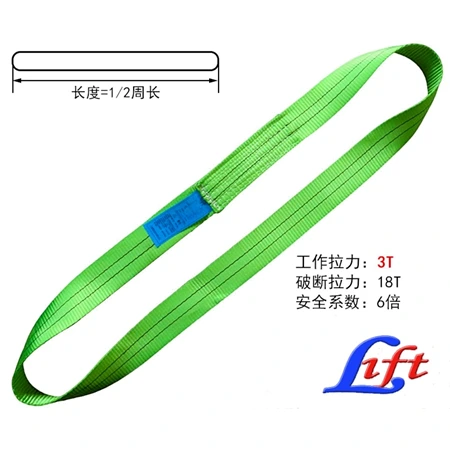
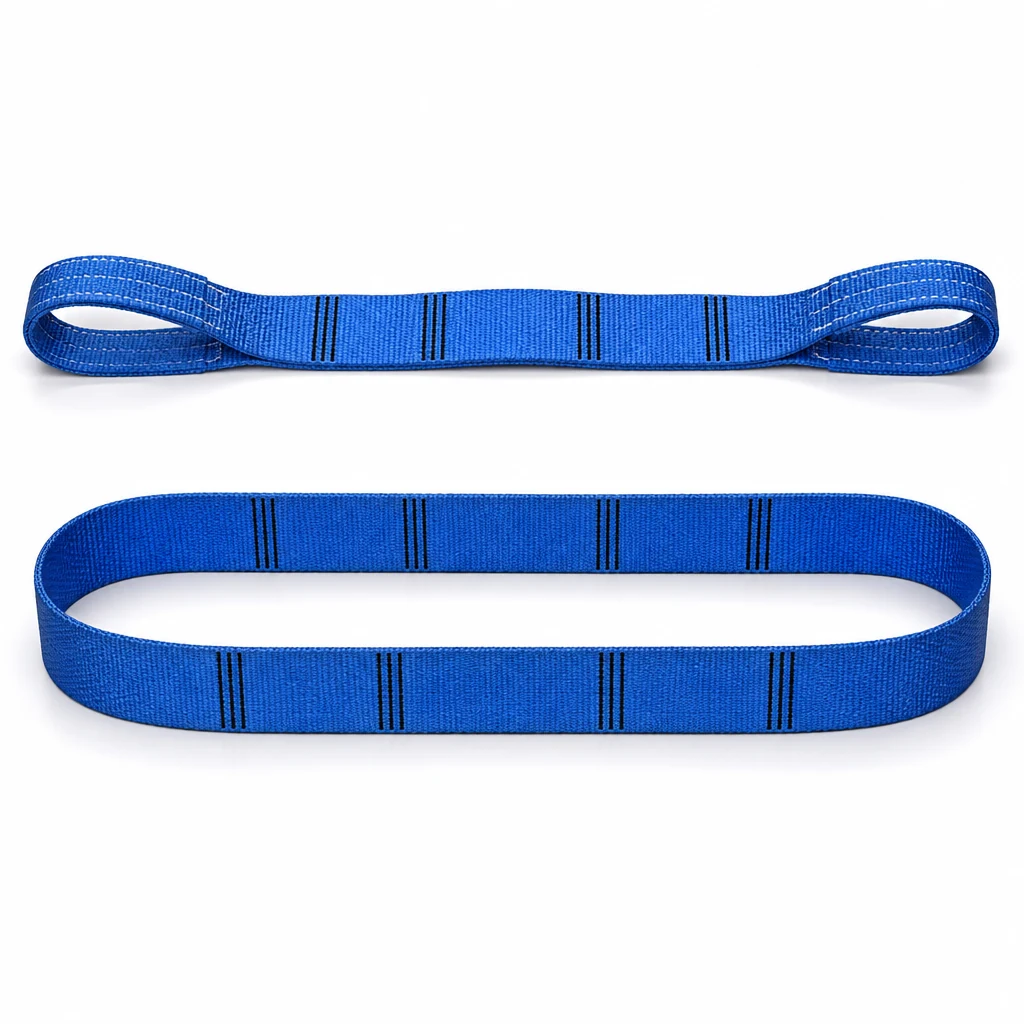
Yáantajo'ob k'ajle'
A Face, Not a Line
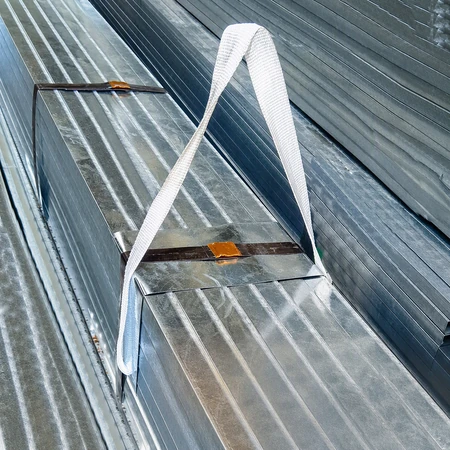
A flat band spreads the load across its whole width. That is why a flat sling will pick up a crate, a machine base or a section and leave it unmarked where a wire rope would cut in.
Ends Made From the Webbing
There is no hardware on the load path. The webbing is folded back on itself and stitched, so nothing can be lost, seized or distorted — and the construction sits on the outside, tu'ux je'el u páajtal u yila'al.
O'olkij xu'ullsa'al le kuuch
Woven webbing conforms instead of biting. pintado, recubierto, polished and powder-coated surfaces survive a flat sling that a chain or wire rope would mark.
Sáasil, and Kind to Your Crew
A flat sling of a given capacity weighs a fraction of the steel it replaces, and a shock load is not stored in it and released back into the lift.
Will Not Rust, Will Not Rot
Synthetic webbing is unaffected by water and does not corrode or support rot or mildew, which is why flat slings dominate yards, ports and wash-down environments.
Ma' conductor
With no metal in the load path, a flat sling does not conduct — an advantage anywhere near live plant or overhead lines.
Ba'ax “Eslinga u líik'il táats' che'” Covers — and What It Does Not
Buyers reach this family through several words, and the words do not mean the same thing. Sorting them out takes a minute and saves a wrong order.
| Le t'aano' | Ba'ax u jaajile' u k'aaba' | Ba'ax ku p'atik je'ek'ab |
|---|---|---|
| Eslinga u líik'il táats' che' | The cross-section — a band with a rectangular section | Le láaj jo'ochiko'obo', the ends and the capacity |
| Eslinga u correa / flat woven sling | The same article, named after the material it is woven from | Everything above |
| Correa / belt / baanda | The webbing itself, as a material with a width and a weave | Whether it is rated for lifting at all — a strap is a material, not a specification |
| Nylon sling / polyester sling | Le láaj jo'ochiko'obo' | The section, the ends and the capacity |
| Eslinga wóolis | A different family — a parallel fibre core in a tubular sleeve | Not a flat sling at all, whatever colour the sleeve is |
The Three Types You Can Buy
The cross-section is fixed by the family. What varies is how the article is finished — and that decides how the load enters it, and therefore what you can and cannot do with it.
| Tiipo | Ba'ax leti' | The load enters at | Yéey uti'al |
|---|---|---|---|
| wich yéetel wich | A flat band with a formed, folded and stitched eye at each end | Two defined points, juntúul ti' Amal xuul | Any lift where the pick-up points must be known and repeated, and where a defined length is part of the method |
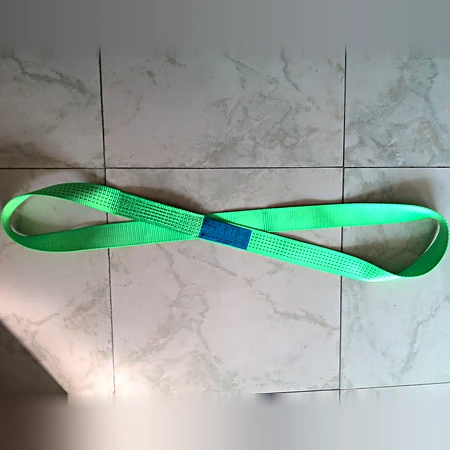
| mina'an u xuul (wóolis) flat sling | The same flat band, closed into a continuous loop with no ends and no eyes | Wherever the band happens to bear, and through the loop itself | Ascensores chocados, paquetes, and any job where one sling has to serve several different rigs — the loop can also be turned to move the wear |
| Sleeved or padded | Either of the above with an extra protective layer at the bearing areas | Je'el bix ka'anal, but through a sacrificial layer | Coated or finished loads, abrasive loads, and any bearing point where the webbing must not touch the load directly |
Choosing the Fibre — Polyester, Nylon or Polypropylene
This is the decision that actually decides whether your sling survives, and it is the one buyers most often make by accident. The three fibres look much the same in a photograph, carry the same capacity ladder and are distinguished on the article only by the colour of the sewn label. They behave very differently against heat, acid, alkali, shock and stretch.
| Láaj jo'ochiko'obe' | Label colour | Typical temperature range | Saats | Chemicals | Yéey ba'ax k'iin |
|---|---|---|---|---|---|
| Poliéster (PES) | Ch'ooj | −40 °C u +100 °C | Low — around 3% ti' le límite kuuch meyaj | Good against most acids; attacked by strong alkalis | The general-purpose answer, and the default. Lowest stretch for its strength, best all-round value, and the fibre most of the standard capacity ladder is published in. |
| Poliamida / nylon (PA) | Ya'ax | Typically to about +90 °C | High — it stretches further before it breaks | Attacked by acids; better than polyester against alkalis | Shock loading, and where the load must be caught rather than held rigidly. It gives where polyester would pass the load straight on. Also the better choice in very cold conditions. |
| Polipropileno (PP) | Chukwa | Typically to about +80 °C | Moderado | Good against both acids and alkalis | Chemical and coating environments. It is the lightest of the three and it floats, which makes it the fibre of choice for wet and chemical duty — and for the large-tonnage white belts used on coated products. |
Páajtalil, Boon, Width and Ply — Reading the Ladder
Yáanal EN 1492-1 le colour of the webbing certifies the capacity band, ti' levantamiento recto, yéetel mixba'al u láak'. Alongside it the band carries one black transverse stripe per tonne, so the two markings can be cross-checked against each other.
| WLL (líik'il toj) | u boonil le correa | Rayas negras | Kóoch u k'a'ana'anil | choqueado (× 0.8) | MBL at 7:1 |
|---|---|---|---|---|---|
| 1 t | Violeta | 1 | Confirm | 0.8 t | 7 t |
| 2 t | Ya'ax | 2 | 50 mm | 1.6 t | 14 t |
| 3 t | K'an | 3 | 75 mm | 2.4 t | 21 t |
| 4 t | Sak éek | 4 | 100 mm | 3.2 t | 28 t |
| 5 t | Chak | 5 | 125 mm | 4.0 t | 35 t |
| 6 t | Chukwa | 6 | 150 mm | 4.8 t | 42 t |
| 8 t | Ch'ooj | 8 | 200 mm | 6.4 t | 56 t |
| 10 t | Pak'aal | 10 | 250 mm | 8.0 t | 70 t |
| 30 t | Mina'an código u boonil | 30 | Confirm | 24.0 t | 210 t |
Yóok'ol 10 u boonil ts'o'ok ma' u k'ajóoltik le eslinga, so the working load limit printed on the sewn label governs. Xook le etiquetao', ma' u boonil.
Width and ply — why two slings of the same capacity are not the same sling
Two flat slings can carry exactly the same working load limit and still be different articles, because the same capacity can be built at different widths and in different numbers of layers.
- Kóoch decides the bearing area. A wider band spreads the same load over more of the load’s surface, which matters wherever the surface must not be marked.
- Ply decides stiffness and edge tolerance. A single-layer band is lighter and more flexible; juntúul duplex or double-layer band is stiffer, sits flatter under a load, and lasts longer where the band runs over an edge.
- Kóochil matters in the hook. A very thick band occupies more of the hook bowl, which can limit how many slings you can gather onto one hook.
The Formed Eye — Where the Load Enters
On a flat sling with ends, the load enters at the eyes. The webbing is folded back on itself and closed with several dense parallel rows of stitching, and that fold is the one place in the whole article where the load passes through a made connection rather than through continuous weave.
- The construction sits on the outside. That is the flat sling’s quiet advantage over a sleeved round sling: everything that carries the load — the weave and the stitches — is on the surface, tu'ux je'el u páajtal a wilik.
- The eyes are fixed wear points. Unlike an endless loop, an eye and eye sling always wears at the same two places — the eyes and the two bearing points. When they wear out, the sling is spent even if the rest of the band is sound.
- Protect the eye at the hook. A rough hook bowl or an undersized hook will abrade the eye far faster than the load will. Check the hook as well as the sling.
- wicho'ob mu'uk'a'an are available where the same eyes are repeatedly hooked or the hook bowl is rough.
Hitches and Mode Factors
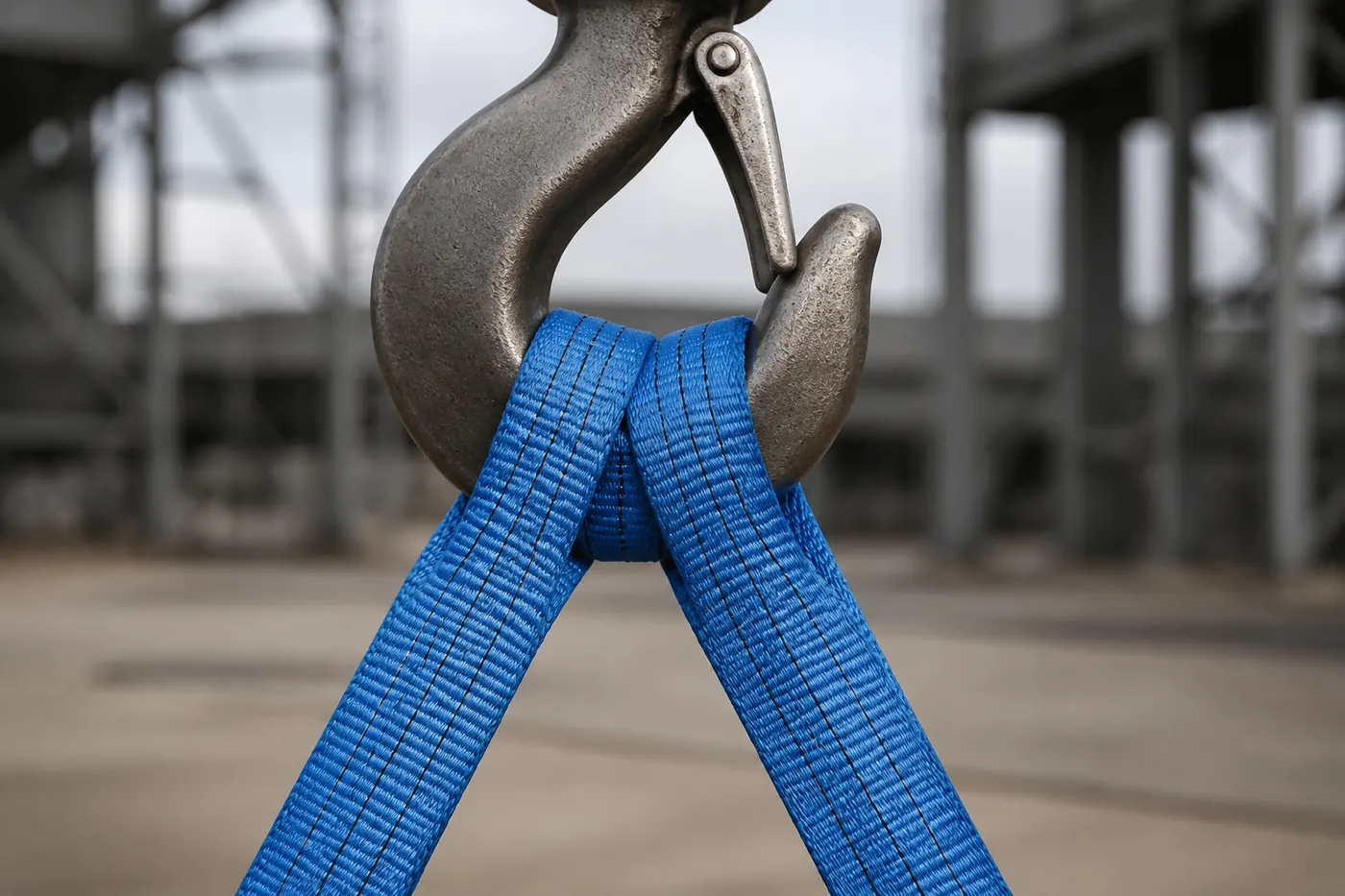
The label figure is the líik'il toj calificación. Every other hitch is derived from it by a mode factor.
| Hitch or mode | Mode factor M | Ba'ax u k'áat u ya'al |
|---|---|---|
| líik'il toj | 1.0 | Le figura etiqueta. Both parts of the sling hang to the hook. |
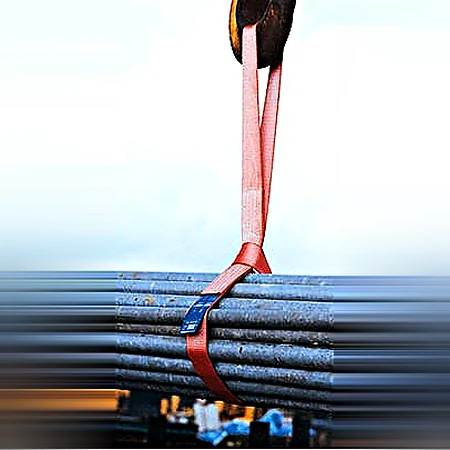
| choqueado | 0.8 | The band passes round the load and back through itself so it grips as it takes the weight. |
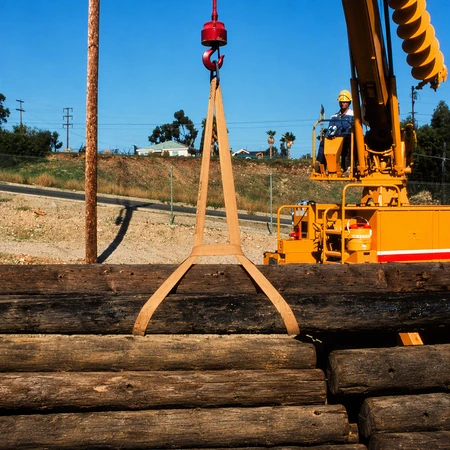
| Canasta, 0–7° | 2.0 | The band passes under the load with both legs on the hook, legs within 7° of vertical. |
| Canasta, 7–45° | 1.4 | Bix u je'ek'abta'al u yooko'ob, le tensión ti' jujuntúulal ku na'akal yéetel le Buka'aj u ba'al utilizable ku lúubul. |
| Canasta, 45–60° | 1.0 | Ti' le k'i'itpajal le canasta ma' ku ts'aik asab ti' jump'éel líik'il recto. |
| Choke angular ti' 45° | 0.7 | choqueado, yéetel le yooko'obo' ku je'ebel náach ti' le verticales. jump'éel estrangulador colocado recto yóok'ol le gancho mantiene 0.8. |
| Choke angular ti' 60° | 0.5 | The most heavily reduced arrangement in common use — check it before the lift, ma' ka'. |
Two flat-specific habits, neither of which applies to a round sling: keep the band flat and untwisted in the hitch, because a flat band twisted into a rope concentrates the load on one edge and loses the contact area that is its whole advantage; yéetel protect the band at edges, because on a sheared or machined edge a flat sling fails at the edge long before it fails at the load.
Technical Specifications and How to Specify
| K'aaba' le producto | Eslinga u líik'il táats' che' / eslinga u correa táats' che' / eslinga u correa tejida táats' che' / webbing lifting sling |
|---|---|
| Tiipo | Flat woven webbing sling to EN 1492-1; wich yéetel wich wa mina'an u xuul (wóolis) form |
| Láaj jo'ochiko'obe' | Poliéster (blue label) bey estándar; poliamida / nylon (green label); polipropileno (brown label) |
| Límite u kuuch meyaj | 1 t u 30 t in the published ladder, and intermediate capacities to order |
| Factor ti' seguridad | 7:1 ka'ap'éel JUNTÚUL 1492-1 bey estándar; 5:1 u ASME B30.9 yéetel 8:1 u AS 1353 beeta'an uti'al u ya'ala'al |
| Ply | jump'éel chéen capa bey estándar; duplex and double layer on request |
| Kóoch | Matched to the capacity and the load surface — the reference series is 2 t = 50 mm, 3 t = 75 mm, 4 t = 100 mm, 5 t = 125 mm, 6 t = 150 mm, 8 t = 200 mm, 10 t = 250 mm; final width on the order acknowledgement |
| Chowakil | Manufactured to order; state the length between the bearing points of the eyes, or the length that suits your rig |
| Elongación | Máximo 3% at the working load limit for polyester; máximo 10% ti' le kuuch jaatik |
| Rango u temperatura | −40 °C u +100 °C uti'al u beeta'al poliéster estándar; nylon and polypropylene differ — see the fibre table |
| Kanáanil | Protective sleeves, búukinta'al almohadillas, edge protectors and reinforced eyes on request |
| Marcado | ICHIL 1492-1 capacity colour with one black stripe per tonne; sewn label carrying the straight-lift WLL, le láaj jo'ochiko'obo', le referencia estándar, le fabricante, u chowakil yéetel jump'éel código trazabilidad |
| Prueba | Probado tumen lotes; certificado u prueba suministrado tumen lote ti' j-na'akij |
| MOQ & OEM | MOQ t'okik uti'al u órdenes u prueba; k'iini' OEM — Buka'aj u ba'al, láaj jo'ochiko'obe', kóoch, ply, ts'o'oks, boon, diseño u etiqueta yéetel embalaje |
How to specify one — in this order
- Le kuuch, and its shape. The shape decides whether a flat band can lie against it at all, or whether you need a round section instead.
- The hitch you will actually rig. Not the one in the method statement — the one the crew will use. Then apply the mode factor and size the capacity from that figure.
- Le ka'a jeets'elo'. Chokoj ooxolil, acid, alkali, ja', grit. This decides the fibre, and getting it wrong is the failure you will not see coming.
- U yich. Whether the load may be marked decides the width and whether you need a sleeve or a pad.
- U xuul. Eye and eye if the pick-up points must be defined; endless if the sling must serve many rigs and you want to rotate the wear.
- U chowakil, the marking and the standard. Length between bearing points; the label layout and language your market needs; yéetel le k'íiwiko' estándar yéetel destino le eslinga k'a'ana'an u construido u.
Manejo, Inspección yéetel limitaciones
A flat sling is the easiest of all the synthetic slings to inspect, because the load path is on the surface. Inspect in this order.
- The eyes first. Every stitch row across the fold, the webbing immediately behind the eye, and the fold itself. K'aas, le chuuy slack wa tirada condena le eslinga.
- Le ti'its u cojinete. Where the band has wrapped the load — cuts, abrasión, glazing or a worn edge.
- tuláakal le bandao'. jump'éel banda táats' che' ku bisik le kuuch tuláakal u kóochil, bey u jump'éel corte je'el tu'ux importa. Run it through your hands.
- Edges and ends. Cuts from the load’s own corners are the classic flat sling failure.
- Acristalamiento yéetel endurecimiento. A band gone shiny or stiff has met heat or sustained friction, yéetel le láaj jo'ochiko'obo' ma' leti' le ba'ax ka'ach.
- Contaminación. Acid or alkali attack leaves little visible on the outside and destroys the fibre within. If the sling has been exposed, take it out of service and ask.
- An eye and eye sling cannot be rotated. Its wear points are fixed for life. This is the honest trade-off against an endless sling, and if you find yourself condemning slings while the middle of the band is still sound, that is the signal to move to the endless form.
- Keep it flat, keep it off edges, keep it off heat. Those three account for most premature failures.
- Ma' a wutskintik jump'éel eslinga. Ma' chuuy, ma' empalme, ma' u nudos. A knot in a webbing sling can lose half its capacity.
- Store it clean, tikin yéetel mina'an u sáasil le k'iino', and never on a concrete floor where it can pick up grit.
- Grabarte. Registre le ascensores, the hitches, the loads and any damage.
Aplicaciones
- Plant, maquinaria, deslizamientos, dies and castings — anywhere the surface must not be marked
- Structural steel sections, vigas yéetel fabricaciones soldadas, choqueado wa ti' jump'éel canasta
- Cajones, stillages, paletas yéetel mercancías en cajas
- Precast concrete units where a broad bearing is wanted
- Coated, painted and powder-coated products — the large-tonnage white polypropylene band is used on coated work exactly for this reason
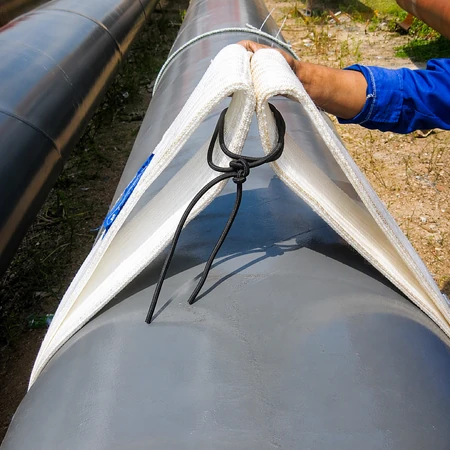
- Paquetes u tubo, tubo yéetel jaatso'ob
- Químico, wet and wash-down environments, where polypropylene is the fibre of choice
- Cold stores and cold-climate sites, where nylon keeps its composure
- Yardas, ports, depots and site work where one sling has to serve many different lifts
Personalización yéetel mayaj OEM
A flat sling is built to order more often than it is bought off a rack, because the length, the width and the fibre all follow from the lift.
- Páajtalil — 1 t u 30 t in the published ladder, and intermediate capacities
- Láaj jo'ochiko'obe' — poliéster, nylon wa polipropileno, chosen against heat, chemical or shock duty
- Width and ply — matched to the load surface and the edge condition, chéen wa ka'ap'éel capa
- Ts'o'okol — wich yéetel wich wa mina'an u xuul; reinforced eyes where the hook duty is hard
- Chowakil — to your rig, stated between the bearing points of the eyes
- Kanáanil — sleeves, pads and edge protectors
- Marcado —le EN 1492-1 boonil yéetel rayas u páajtalil, wa a kajnáalo'ob esquema tu'ux ku cha'ik le k'íiwiko'; u diseño u etiqueta, t'aan yéetel figuras
- Embalaje — coiled, bagged or baled; embalaje u jo'osa'al bisbil ba'alche'obo' personalizado
Kaambalil yo'osal u calidad
Amal longitud le correa ku comprueba utia'al u tejido, u kóochil yéetel u boonil táanil ti' u ch'akta'al. Every formed eye is checked on its fold and on the number and continuity of its stitch rows. Every finished sling is checked on its length, its capacity marking, its label and its traceability code before packing, and each batch is tested. Ts'o'ok k meentik eslingas, yik'áalil correas yéetel suumo'ob uti'al industrial, seguridad yéetel jo'osa'al bisbil ba'alche'obo' u clientes tumen naats'il ti' óoxp'éel décadas, yéetel k mantener le tuukula' visible: ti' le k'áat chi'o' k ts'áaik le certificado webbing, le figuras prueba tumen lotes yéetel jump'éel eslinga muestra utia'al u tech béeyak manejar yéetel probar bey ma' u producción volumen Káaj.
k'áat chi'oba' suuk u beeta'al
What is a flat lifting sling?
A flat woven webbing sling: a rated lifting sling whose load-bearing element is a band of woven webbing with a rectangular cross-section, beeta'an u EN 1492-1. It is called flat to describe that cross-section, ma' le láaj jo'ochiko', the ends or the capacity — a flat sling can be polyester, nylon wa polipropileno, can have a formed eye at each end or be closed into an endless loop, and can be built from 1 t u 30 t. Its defining advantage is that it bears across a broad, flat face rather than a line, and that it needs no fittings on the load path.
Is a flat lifting sling the same as a webbing sling?
Effectively yes — flat sling and webbing sling name the same family from two directions. “Webbing” names the material it is woven from; “páats'” names the shape of its cross-section. Both distinguish it from a round sling, which is a different family: a parallel fibre core inside a tubular sleeve, with a circular section.
Should I choose a flat sling or a round sling?
Choose flat when the band can lie flat against the load and the load has a wide face or edges — plate, jaatso'ob, cajas, maquinaria, boxy and flat things. Choose round when the load is round, tightly curved or awkward, where a flat band cannot lie flat and would crease or bear on a single corner. The flat form also has the inspection advantage: everything that carries the load is on the outside, tu'ux je'el u páajtal a wilik.
Poliéster, nylon or polypropylene — which should I buy?
Polyester unless you have a reason not to: it has the lowest stretch for its strength and is the best all-round value, and it is what most of the capacity ladder is published in. Nylon if the sling will be shock-loaded or has to stretch to catch a load, and it also behaves better in very cold conditions. Polypropylene if the environment is wet, chemical or both, because it resists acids and alkalis better than either of the others. The fibre is identified by the colour of the sewn label, not by the colour of the webbing.
How do I know what a flat sling will lift in a choke or a basket?
The label gives the straight-lift working load limit. jump'éel choke ku xu'ulsik u 0.8 u téenel le cifrao'. A basket at a narrow angle increases it to 2 Óoxten, lúubul ti' 1.4 k'iin ichil 7 yéetel 45 grados yéetel u 1 k'iin ichil 45 yéetel 60 grados. jump'éel estrangulador angulado ku xu'ulul asab, ti' 0.7 ti' 45 grados yéetel 0.5 ti' 60 grados. JUNTÚUL 4 t kuuch ti' jump'éel gargantilla k'a'abet jump'éel 5 t sling, tumen 4 ÷ 0.8 = 5.
Why are two flat slings of the same capacity different prices?
Because capacity is only one of four dimensions. The same working load limit can be built at different widths, in different numbers of layers, and in three different fibres. A wider band spreads the bearing over more of the load; a double-layer band is stiffer and lasts longer over an edge; nylon and polypropylene cost more than polyester. When you compare two quotations for “juntúul 5 t flat sling”, compare the width, the ply and the fibre as well.
Meent “double buckle” mean the sling has a metal buckle?
Almost certainly not. In this trade buckle and double buckle are normally names for an end formed by folding the webbing back on itself and stitching it — the same construction as any other formed eye, with no metal anywhere. It is the commonest misreading in the whole flat sling family, so if a quotation says buckle, ask which it is before the goods ship.
Can I get a custom capacity, láaj jo'ochiko'obe', kóoch, u chowakil yéetel u marca?
Jaaj. k beetik tak 1 t u 30 t in the published ladder and in intermediate capacities, ti' poliéster, nylon wa polipropileno, at the width and ply your load and edges require, in eye and eye or endless form, to the length your rig needs, yéetel le EN 1492-1 capacity colour and stripes or your own marking scheme where the market allows. A'al to'on le kuuch, le enganche, the environment and the destination market and we will work the specification out with you.
Request a Quote for Flat Lifting Slings
Túuxt to'on le kuuch yéetel u beyo', the hitch you will actually rig, the environment the sling will work in, whether the surface may be marked, the length your rig needs, yéetel le k'íiwiko' estándar yéetel destino le eslinga k'a'ana'an u construido u. We will come back with a fibre, jump'éel kóochil, a ply, jump'éel chowakil, jump'éel muestra yéetel jump'éel tojol directo ti' le fábrica.
Yik'áalil yaan ba'al u yilo'ob
- The Whole Catalogue, Sorted by Fibre, Bixil, Ends and Capacity
- Endless Type Webbing Sling — the flat band with no ends
- Steel Pipe Lifting Strap — wide bands and sleeves for pipe
- Sling u correa u ka'anal temperatura — uti'al u kuuch chokoj
- Aramid Webbing Sling — le opción resistente ti' le corte
- Round Slings — the round-section family