

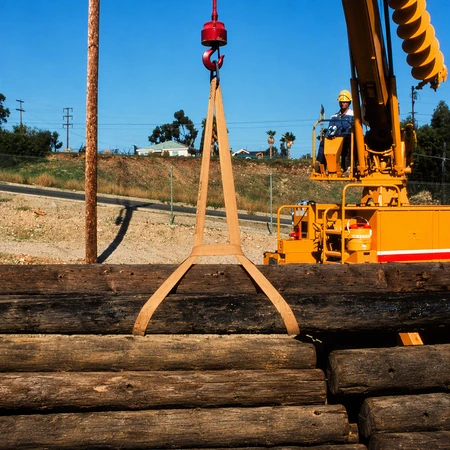
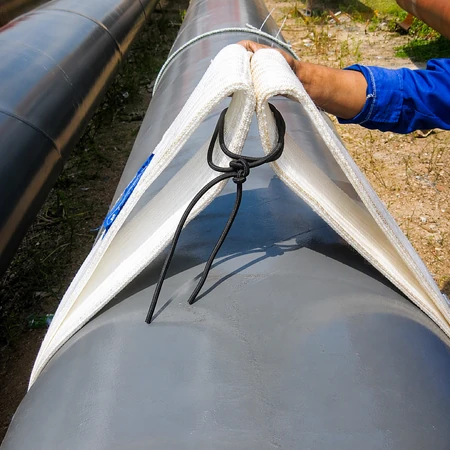
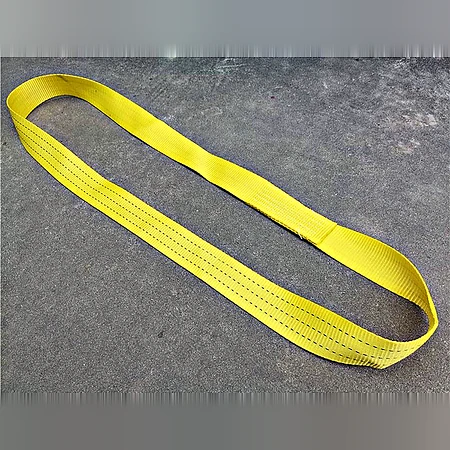
Lift sling rigging company produce Endless Type Webbing Sling.
Endless Type Webbing Sling
An endless type webbing sling is the form with no ends at all: a length of flat woven webbing is lapped back over itself and stitched to close the loop, so what comes off the shelf is one continuous band with no eyes to hook and no fittings to lose. Labẹ EN 1492-1 it is the endless type A flat woven webbing sling, made from one or two layers of webbing, rated from 1 t lati 24 t ṣiṣẹ fifuye iye to. Because nothing is fixed on it, the loop can be turned after every lift, so the wear point, the hook contact point and the joint keep moving instead of staying in one place.
Endless Means One Joint, Not None
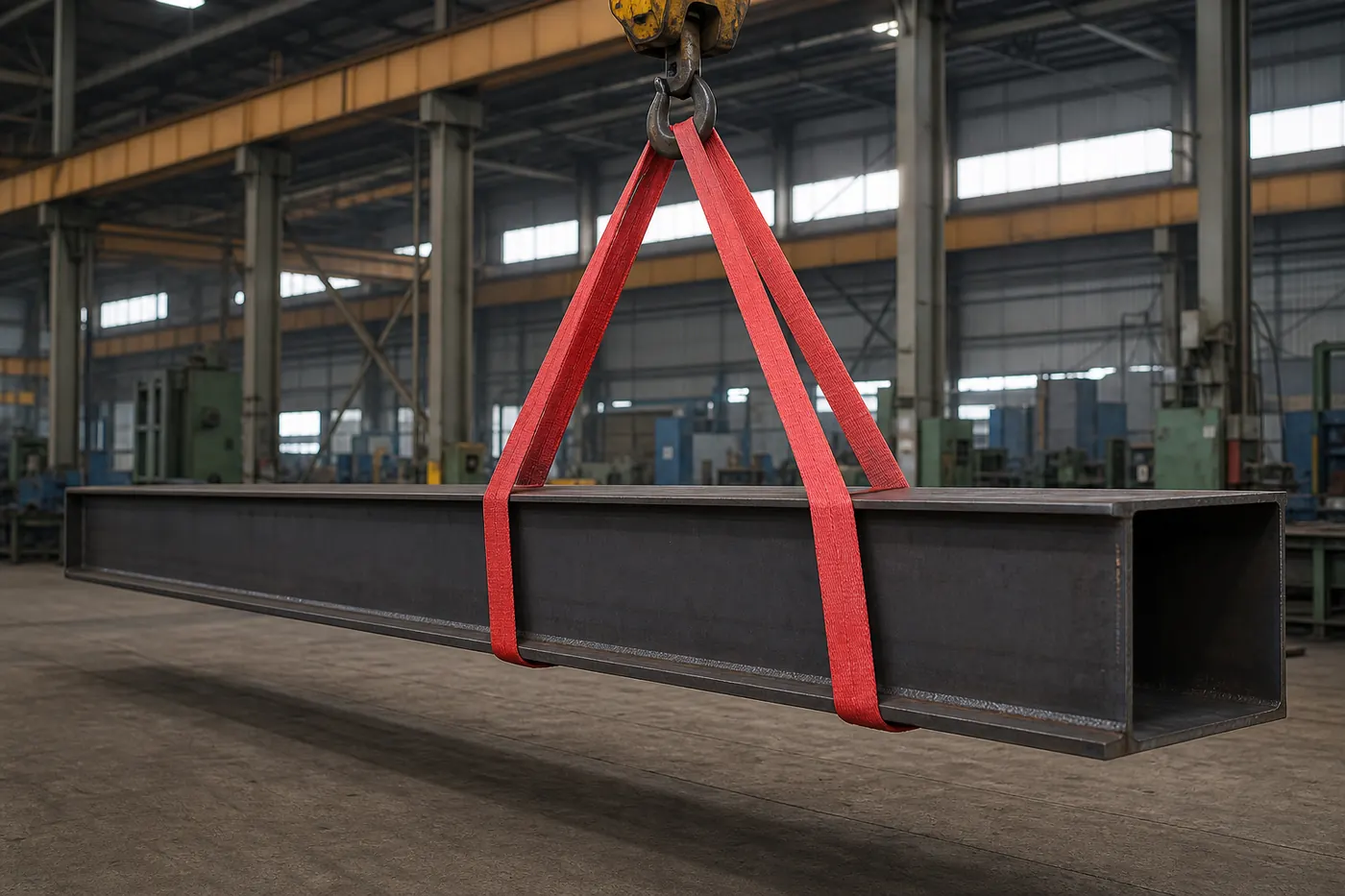
“Ailopin” is used loosely in the trade, and it is worth being precise, because two very different articles answer to the word. This sling is endless in use — no ends, no fittings — but it is not seamless. It has exactly one joint: the lap where the two ends are laid over each other and closed across the full width by several dense rows of stitching, built to carry the rated load.
That single fact decides how the sling is used and inspected. The lap is the one place where the load passes through a made connection, so it earns the first thirty seconds of every inspection — every stitch row, the step at each end of the lap, and whether the two layers still lie flat and parallel. It can also be rotated out of the bearing area and out of the hook contact area, so it is not repeatedly crushed in the same spot. If you need a loop with no joint in the load path at all, iyẹn ni ailopin yika sling, where the core is continuous and only the sleeve is a tube.
Imọ ni pato
| Paramita | Sipesifikesonu |
|---|---|
| Ọja | Ailopin iru webbing sling / endless type A flat woven webbing sling / circular webbing sling |
| Standard | IN 1492-1 (7:1 jara); AS 1353 referenced for Australian supply |
| Ohun elo | 100% poliesita ti o ga; polyamide ati polypropylene lori ìbéèrè |
| WLL range | 1 t – 12 t single ply standard; 2 t – 24 t ė ply; multi-ply to 50 t lori ìbéèrè |
| Oniru ifosiwewe | 7:1 meji ỌKAN 1492-1; 6:1 ati 8:1 engineered to specification |
| Ply | Ẹyọ ẹyọkan (7.5 mm webbing) bi bošewa; ilọpo meji (2 × 7.5 mm = 15 mm) lori ìbéèrè |
| Wẹẹbu wẹẹbu iwọn | 25 mm – 300 mm, matched to the band |
| Gigun | Quoted by circumference or by effective working length; standard to 12 m, aṣa soke si 200 m |
| Ilọsiwaju | O pọju 3% ni WLL; max 10% at breaking load |
| Iwọn otutu | -40 °C si +100 °C (poliesita) |
| Siṣamisi | IN 1492-1 awọ agbara, one black stripe per tonne, sewn aami: WLL, ohun elo, boṣewa, alagidi, ipari, batch code |
| Wear protection | Reinforced sleeves or coatings at wear points |
| Awọn iwe aṣẹ | Batch MTC, test reports and DoC with each shipment; CE to 2006/42/EC on the 7:1 jara |
| Iṣakojọpọ | PE bag, paali, pallet; wooden cases for heavy or multi-leg sets |
Standard Sizes – Nikan Ply
Seven-and-a-half millimetre polyester webbing, one layer. Pick by the vertical WLL you need, then read across for the width, the minimum length and the weight per metre.
| Awoṣe | Àwọ̀ | WLL inaro | WLL choker | WLL agbọn | Ìbú | Sisanra | Ipari min | Iwọn |
|---|---|---|---|---|---|---|---|---|
| EWS-1T | Awọ aro | 1,000 kg | 800 kg | 2,000 kg | 30 mm | 7.5 mm | 1.1 m | 0.22 kg/m |
| EWS-2T | Alawọ ewe | 2,000 kg | 1,600 kg | 4,000 kg | 60 mm | 7.5 mm | 1.2 m | 0.45 kg/m |
| EWS-3T | Yellow | 3,000 kg | 2,400 kg | 6,000 kg | 90 mm | 7.5 mm | 1.3 m | 0.71 kg/m |
| EWS-4T | Grẹy | 4,000 kg | 3,200 kg | 8,000 kg | 120 mm | 7.5 mm | 1.4 m | 1.02 kg/m |
| EWS-5T | Pupa | 5,000 kg | 4,000 kg | 10,000 kg | 150 mm | 7.5 mm | 2 m | 1.21 kg/m |
| EWS-6T | Brown | 6,000 kg | 4,800 kg | 12,000 kg | 180 mm | 7.5 mm | 2 m | 1.42 kg/m |
| EWS-8T | Buluu | 8,000 kg | 6,400 kg | 16,000 kg | 240 mm | 7.5 mm | 2 m | 1.89 kg/m |
| EWS-10T | ọsan | 10,000 kg | 8,000 kg | 20,000 kg | 300 mm | 7.5 mm | 3 m | 2.34 kg/m |
| EWS-12T | – | 12,000 kg | 9,600 kg | 24,000 kg | 300 mm | 7.5 mm | 3 m | 2.98 kg/m |
Standard Sizes – Double Ply
Meji 7.5 mm plies sewn into a 15 mm apapo. Double ply buys capacity at the same width, and a band that resists cutting and abrasion better — which is why it is specified where the sling runs over an edge or does repeated choker work.
| Awoṣe | Àwọ̀ | WLL inaro | WLL choker | WLL agbọn | Ìbú | Sisanra | Ipari min | Iwọn |
|---|---|---|---|---|---|---|---|---|
| EWSD-2T | Alawọ ewe | 2,000 kg | 1,600 kg | 4,000 kg | 30 mm | 15 mm | 1.5 m | 0.50 kg/m |
| EWSD-4T | Grẹy | 4,000 kg | 3,200 kg | 8,000 kg | 60 mm | 15 mm | 1.5 m | 0.86 kg/m |
| EWSD-6T | Brown | 6,000 kg | 4,800 kg | 12,000 kg | 90 mm | 15 mm | 1.5 m | 1.50 kg/m |
| EWSD-8T | Buluu | 8,000 kg | 6,400 kg | 16,000 kg | 120 mm | 15 mm | 2 m | 1.96 kg/m |
| EWSD-10T | ọsan | 10,000 kg | 8,000 kg | 20,000 kg | 150 mm | 15 mm | 2 m | 2.62 kg/m |
| EWSD-12T | – | 12,000 kg | 9,600 kg | 24,000 kg | 180 mm | 15 mm | 3 m | 2.86 kg/m |
| EWSD-16T | – | 16,000 kg | 12,800 kg | 32,000 kg | 240 mm | 15 mm | 3 m | 4.10 kg/m |
| EWSD-20T | – | 20,000 kg | 16,000 kg | 40,000 kg | 300 mm | 15 mm | 3 m | 5.46 kg/m |
| EWSD-24T | – | 24,000 kg | 19,200 kg | 48,000 kg | 300 mm | 15 mm | 3 m | 6.10 kg/m |
Ik WLL wa ni idasilẹ fun pipe sling ikole, stitching and rated configuration. Mefa tọkasi awọn boṣewa sling body; the optional protective sleeve increases the outer dimension slightly. Awọn ipari gigun ati awọn agbara ti o ga julọ ni a ṣe atunṣe lati paṣẹ. Loke 10 t EN 1492-1 colour code no longer applies — the label and the black stripes govern.
Colour and Stripes – What the Marking Certifies
The webbing colour certifies one thing only: a working load limit band, in straight lift. It says nothing about the material, awọn ipari, the safety factor or the condition of the sling. Alongside it, one black transverse stripe per tonne lets the two markings be cross-checked. The label colour is separate again and tells you the fibre: blue for polyester, green for polyamide, brown for polypropylene — so green webbing is a 2 t band while a green label means nylon.
Hitch Mode Factors
The label figure is the straight lift. Every other arrangement is derived from it, and these factors reduce it — a basket does not give the sling a second, higher rating, it puts two parts of the same webbing into the load path.
| Hitch | Ipo ifosiwewe | Ni iṣe |
|---|---|---|
| Straight lift | 1.0 | The label figure; loop hangs as a U, both parts on the hook |
| Ti parun | 0.8 | Loop passes round the load and back through itself — a 4 t fifuye nilo a 5 t sling |
| Agbọn, legs 0-7° | 2.0 | Two parts share the load, ese nitosi inaro |
| Agbọn, legs 7-45° | 1.4 | Tension rises as the legs open out |
| Agbọn, ẹsẹ 45-60 ° | 1.0 | No more than a straight lift at this spread |
| Angled choke, 45° | 0.7 | Ti parun, with the legs opening away from vertical |
| Angled choke, 60° | 0.5 | The most heavily reduced arrangement in common use |
Specifying the Length
An endless sling has no ends to measure between, so it is quoted one of two ways — and the two differ by about a factor of two, which is the commonest reason a sling arrives at the wrong length. Circumference is the total perimeter, i.e. the webbing in the finished sling. Effective working length is the usable height you actually get, aijọju idaji ayipo, nitori awọn lupu ti wa ni ti ilọpo meji nigbati o kọorí.
| Circumference ordered | Isunmọ. working length | Aṣoju lilo |
|---|---|---|
| 2 m | 1 m | Chokes and short lifts, tight rigging |
| 4 m | 2 m | The general-purpose size |
| 6 m | 3 m | Basket lifts on plant and fabrications |
| 8 m | 4 m | Awọn apakan gigun, bundles and pipework |
| 10 m | 5 m | Structure and large plant |
| 12 m | 6 m | Standard longest; gun lati paṣẹ |
The relationship is the point, not the exact figure: it depends on ply, band thickness and bend radius. State which convention your number is in, or simply give the distance from hook to load and we will size the loop to it.
Endless or Eye and Eye?
| Ohun ini | Iru ailopin | Oju ati oju |
|---|---|---|
| Ipari | None — one continuous loop | Two flat eyes, one at each end |
| Gigun | Not fixed; can be doubled or taken up by another turn | Fixed between two pick-up points |
| Wear points | None fixed — the whole loop rotates | The same two bearing points and eyes |
| Igbesi aye iṣẹ | Siwaju sii, because wear and the joint move around the loop | Condemned when the fixed points wear out |
| Ti o dara ju fun | Choked gbe soke, awọn edidi, general yard and site work | Lifts with defined, repeated pick-up points |
Most sites carry both. If the method statement has to state where the sling attaches, awọn eye and eye webbing sling makes that explicit; if crews rig whatever is in front of them, the endless type is the better general-purpose article.
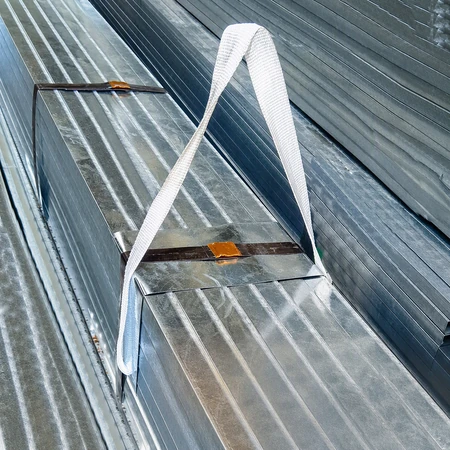
Mimu, Inspection and the Rotation Habit
An endless sling is easier to inspect than a round sling, because the load path is the webbing itself and everything you need to see is on the surface. Work through it in this order.
- Apapọ ipele akọkọ - gbogbo aranpo kana, the step at each end, and whether the two layers still lie flat and parallel. Baje, ọlẹ tabi fa stitching lẹbi awọn sling.
- Awọn aaye gbigbe where the band has wrapped on loads — cuts, abrasion, glazing, a worn edge.
- Aaye olubasọrọ kio, where the loop sits in the hook bowl and folds over itself.
- The whole band — a flat band carries load across its full width, ki a ge nibikibi ọrọ.
- Heat and chemical damage — shiny, stiff or discoloured fibre means it has met heat, edekoyede, acid or solvent.
Yiyi bi eto imulo, kii ṣe bi atunṣe: turn the loop after every lift so the bearing point, ojuami kio ati awọn isẹpo pa gbigbe. Keep the band flat and untwisted — a flat sling twisted into a rope concentrates the load on one edge and loses the contact area that is its whole advantage. Protect the band at edges and keep it within -40 °C si +100 °C, away from weld spatter.
Awọn ohun elo
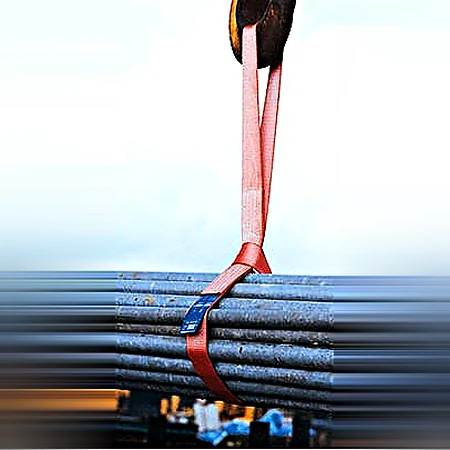
- Choked lifts on structural steel, beams and welded fabrications
- Basket lifts on plant, ẹrọ, skids, ku ati simẹnti
- Bundles of tube, pipe and sections, choked or double wrapped
- Precast concrete units where a flat, broad bearing is wanted
- Crates, stillages ati boxed de; general yard and depot work
- Cold stores and cold-climate work down to -40 °C; wet conditions where a rust-free sling is wanted
For hot loads or sharp, unpadded edges the polyester build is the wrong choice — see the ga otutu webbing sling or a wire rope sling instead.
Awọn ibeere Nigbagbogbo
What is an endless type webbing sling?
Labẹ EN 1492-1 o jẹ awọn ailopin iru A alapin hun webbing sling: a length of webbing whose two ends are lapped back over one another and stitched to close the loop. One continuous band, no eyes to hook, no fittings to lose, one joint built to carry the rated load.
Is it really seamless?
Rara. It is endless in use, but there is one made connection — the lapped and stitched joint — and it is the first thing to inspect. If you need no joint at all in the load-bearing element, that is an endless round sling.
Elo ni o le gbe ni choke tabi agbọn kan?
The label gives the straight lift. A choke gba o lati 0.8, a basket at a narrow angle to 2.0, then 1.4 laarin 7 ati 45 iwọn ati ki o 1.0 laarin 45 ati 60. An angled choke is reduced further, si 0.7 ni 45 iwọn ati ki o 0.5 ni 60. Confirm the hitch and the angle before the lift.
Single ply or double ply?
Double ply gives more capacity at the same width and better resistance to cutting and abrasion; single ply is lighter and more flexible for general duty. Pick by the WLL you need and the working conditions, not by layer count alone.
Kini ipari wo ni MO gbọdọ paṣẹ?
Say which convention your figure is in — circumference or effective working length; they differ by about a factor of two. If you know how far the hook will be from the load, send that instead and we will size the loop to it.
Does the colour tell me everything?
Rara. The webbing colour certifies the WLL band in straight lift only. The stripes give the tonne figure, and the label colour separately tells you the fibre: blue polyester, green polyamide, brown polypropylene.
Beere kan Quotation
Firanṣẹ fifuye ati apẹrẹ rẹ, the hitch you intend to use, whether your length is a circumference or a working length, okun, and the standard and destination market. We confirm the band, ply, igboro, ipari, marking and test documentation before the webbing is cut — 1 t lati 24 t, nikan tabi ė ply, 7:1 meji ỌKAN 1492-1 bi bošewa.
Send your lift details for an endless sling quotation
Tẹlifoonu / WeChat: +86 180 6600 2268 | Imeeli: 702461526@qq.com
Adirẹsi: Lifute Industrial Park, Ilu Taizhou, Agbegbe Jiangsu, China