

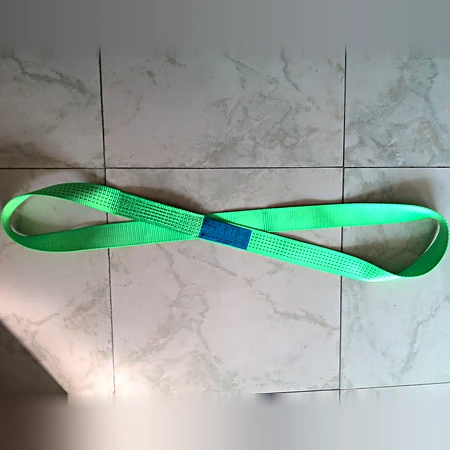
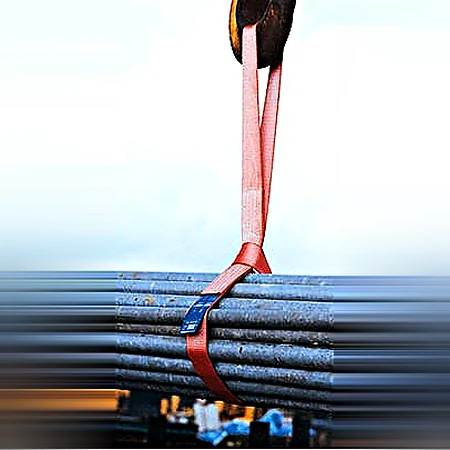
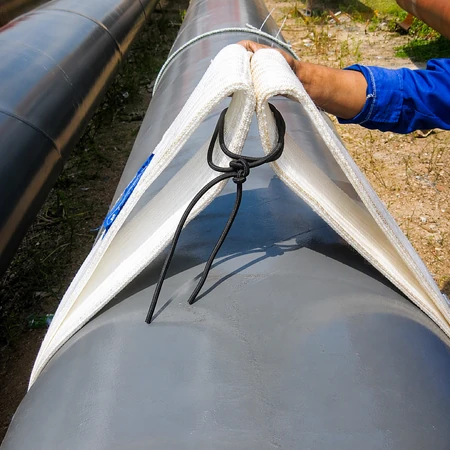
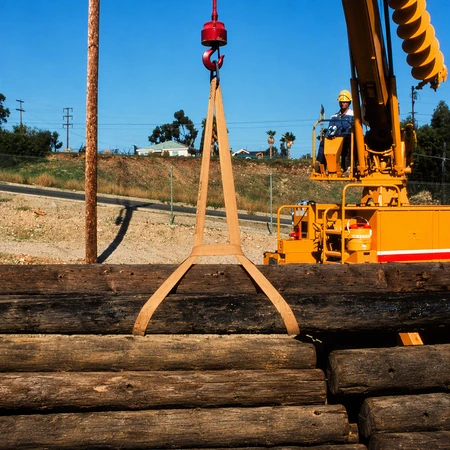
Lift sling rigging company produce Flat Lifting Sling.
Flat Lifting Sling
Flat Woven Webbing Slings to EN 1492-1 — Polyester, Nylon or Polypropylene, 1–30 ה, Eye and Eye or Endless
א פלאַך ליפטינג וואַרפלקע is defined by one thing and one thing only: its cross-section. The load-bearing element is a band of woven webbing with a rectangular section, so it bears on the load across a broad, flat face rather than a line. That single property is what everything else follows from — a flat band lies against a flat face and does not concentrate the load, it wraps a section without creasing, it needs no fittings because its ends can be formed from the webbing itself, and it can be coiled, folded and carried by one person at capacities where a steel sling would need two. “פלאַך” says nothing about the fibre, the ends or the capacity; those are three separate decisions, and this page takes them in turn. Get the cross-section right and you have chosen the family. Get the פיברע wrong and you will still fail — heat, acid, alkali and shock are what actually destroy a flat sling, and each fibre answers a different one.
- Broad, פלאַך שייַכעס — spreads the load over a face instead of a line
- No fittings on the load path — the ends are formed from the webbing itself
- Three fibres, דריי פליכטן — פּאַליעסטער, nylon and polypropylene answer different hazards
- Light and safe to handle — a fraction of the weight of the steel it replaces
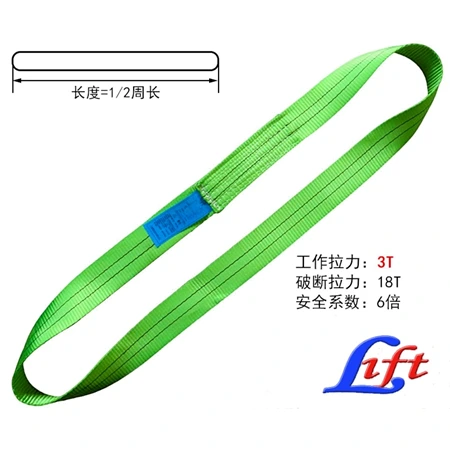
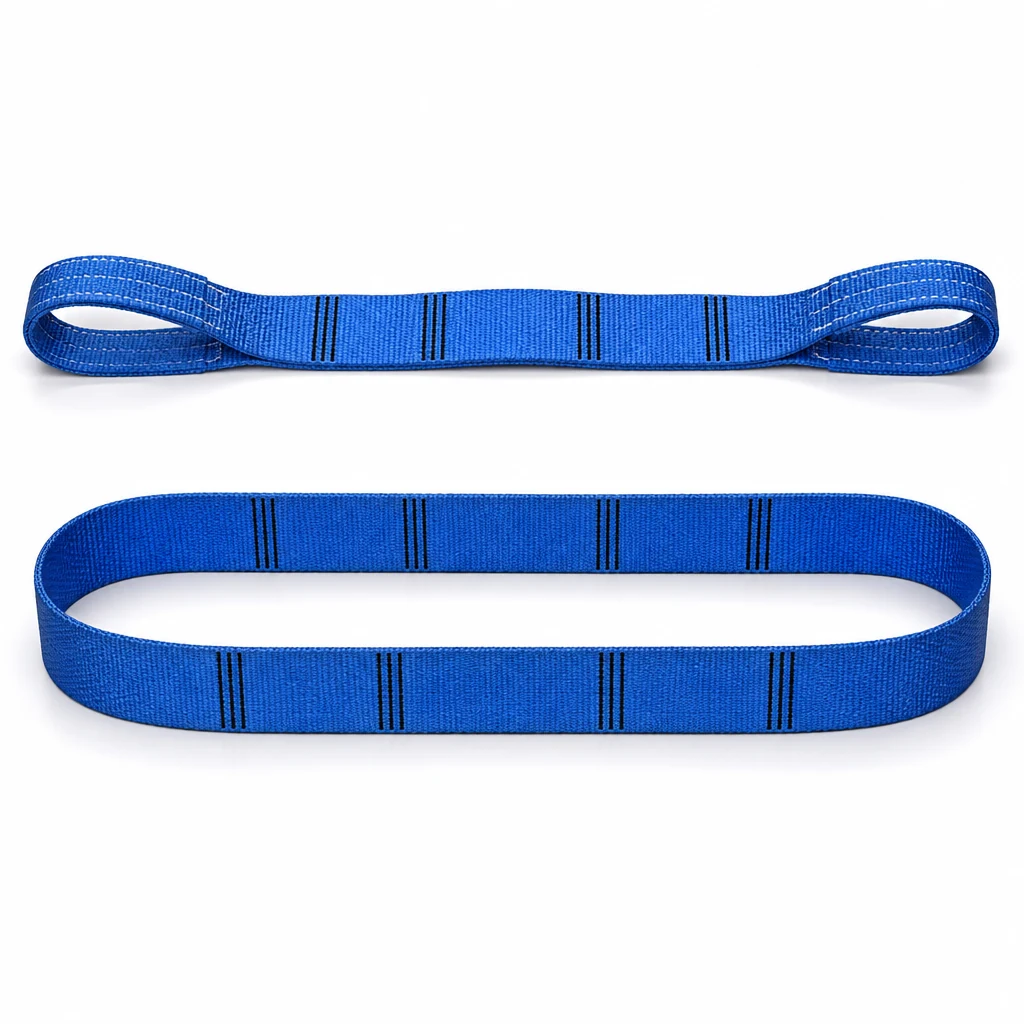
שליסל פֿעיִקייטן
A Face, Not a Line
A flat band spreads the load across its whole width. That is why a flat sling will pick up a crate, a machine base or a section and leave it unmarked where a wire rope would cut in.
Ends Made From the Webbing
There is no hardware on the load path. The webbing is folded back on itself and stitched, so nothing can be lost, seized or distorted — and the construction sits on the outside, ווו עס קענען זיין ינספּעקטיד.
Soft Against the Load
Woven webbing conforms instead of biting. פּאַינטעד, coated, polished and powder-coated surfaces survive a flat sling that a chain or wire rope would mark.
ליכט, and Kind to Your Crew
A flat sling of a given capacity weighs a fraction of the steel it replaces, and a shock load is not stored in it and released back into the lift.
Will Not Rust, Will Not Rot
Synthetic webbing is unaffected by water and does not corrode or support rot or mildew, which is why flat slings dominate yards, ports and wash-down environments.
ניט-קאָנדוקטיווע
With no metal in the load path, a flat sling does not conduct — an advantage anywhere near live plant or overhead lines.
וואָס “Flat Lifting Sling” Covers — and What It Does Not
Buyers reach this family through several words, and the words do not mean the same thing. Sorting them out takes a minute and saves a wrong order.
| דאָס וואָרט | וואָס עס פאקטיש נעמען | וואָס עס לאָזט אָפֿן |
|---|---|---|
| פלאַך ליפטינג וואַרפלקע | The cross-section — a band with a rectangular section | די פיברע, the ends and the capacity |
| וועבבינג וואַרפלקע / flat woven sling | The same article, named after the material it is woven from | Everything above |
| רימען / belt / באַנד | The webbing itself, as a material with a width and a weave | Whether it is rated for lifting at all — a strap is a material, not a specification |
| Nylon sling / polyester sling | די פיברע | The section, the ends and the capacity |
| קייַלעכיק וואַרפלקע | A different family — a parallel fibre core in a tubular sleeve | Not a flat sling at all, whatever colour the sleeve is |
The Three Types You Can Buy
The cross-section is fixed by the family. What varies is how the article is finished — and that decides how the load enters it, and therefore what you can and cannot do with it.
| טיפּ | וואָס עס איז | The load enters at | קלייַבן עס פֿאַר |
|---|---|---|---|
| אויג און אויג | A flat band with a formed, folded and stitched eye at each end | Two defined points, איינער אין יעדער סוף | Any lift where the pick-up points must be known and repeated, און ווו אַ דיפיינד לענג איז טייל פון דעם אופֿן |
| סאָף (קייַלעכיק) פלאַך וואַרפלקע | The same flat band, closed into a continuous loop with no ends and no eyes | Wherever the band happens to bear, and through the loop itself | דערשטיקט ליפט, פּעקלעך, and any job where one sling has to serve several different rigs — the loop can also be turned to move the wear |
| Sleeved or padded | Either of the above with an extra protective layer at the bearing areas | As above, but through a sacrificial layer | Coated or finished loads, אַברייסיוו לאָודז, and any bearing point where the webbing must not touch the load directly |
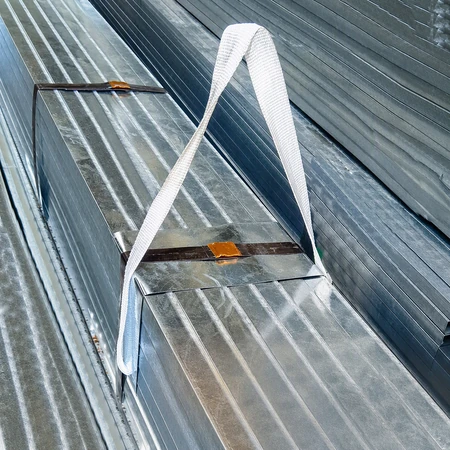
Choosing the Fibre — Polyester, Nylon or Polypropylene
This is the decision that actually decides whether your sling survives, and it is the one buyers most often make by accident. The three fibres look much the same in a photograph, carry the same capacity ladder and are distinguished on the article only by the colour of the sewn label. They behave very differently against heat, acid, alkali, shock and stretch.
| פיברע | Label colour | Typical temperature range | אויסשטרעקן | קעמיקאַלז | קלייַבן עס ווען |
|---|---|---|---|---|---|
| פּאָליעסטער (PES) | בלוי | -40 °C צו +100 °C | Low — around 3% אין די אַרבעט מאַסע שיעור | Good against most acids; attacked by strong alkalis | The general-purpose answer, and the default. Lowest stretch for its strength, best all-round value, and the fibre most of the standard capacity ladder is published in. |
| פּאָליאַמידע / ניילאָן (PA) | גרין | Typically to about +90 °C | High — it stretches further before it breaks | Attacked by acids; better than polyester against alkalis | קלאַפּ לאָודינג, and where the load must be caught rather than held rigidly. It gives where polyester would pass the load straight on. Also the better choice in very cold conditions. |
| פּאָליפּראָפּילענע (PP) | ברוין | Typically to about +80 °C | מעסיק | Good against both acids and alkalis | Chemical and coating environments. It is the lightest of the three and it floats, which makes it the fibre of choice for wet and chemical duty — and for the large-tonnage white belts used on coated products. |
קאַפּאַציטעט, קאָליר, Width and Ply — Reading the Ladder
אונטער EN 1492-1 די colour of the webbing certifies the capacity band, אין גלייַך הייבן, און גאָרנישט אַנדערש. Alongside it the band carries one black transverse stripe per tonne, אַזוי די צוויי מאַרקינגז קענען זיין קרייַז-אָפּגעשטעלט קעגן יעדער אנדערער.
| WLL (גלייַך הייבן) | וועבבינג קאָליר | שוואַרץ מלקות | רעפערענץ ברייט | דערשטיקט (× 0.8) | MBL בייַ 7:1 |
|---|---|---|---|---|---|
| 1 ה | פיאַלקע | 1 | באַשטעטיקן | 0.8 ה | 7 ה |
| 2 ה | גרין | 2 | 50 mm | 1.6 ה | 14 ה |
| 3 ה | געל | 3 | 75 mm | 2.4 ה | 21 ה |
| 4 ה | גרוי | 4 | 100 mm | 3.2 ה | 28 ה |
| 5 ה | רויט | 5 | 125 mm | 4.0 ה | 35 ה |
| 6 ה | ברוין | 6 | 150 mm | 4.8 ה | 42 ה |
| 8 ה | בלוי | 8 | 200 mm | 6.4 ה | 56 ה |
| 10 ה | מאַראַנץ | 10 | 250 mm | 8.0 ה | 70 ה |
| 30 ה | קיין קאָליר קאָד | 30 | באַשטעטיקן | 24.0 ה | 210 ה |
אויבן 10 די קאָליר ניט מער יידענאַפייד די וואַרפלקע, so the working load limit printed on the sewn label governs. לייענען די פירמע, נישט די קאָליר.
Width and ply — why two slings of the same capacity are not the same sling
Two flat slings can carry exactly the same working load limit and still be different articles, because the same capacity can be built at different widths and in different numbers of layers.
- ברייט decides the bearing area. A wider band spreads the same load over more of the load’s surface, which matters wherever the surface must not be marked.
- פלי decides stiffness and edge tolerance. A single-layer band is lighter and more flexible; א דופּלעקס or double-layer band is stiffer, sits flatter under a load, and lasts longer where the band runs over an edge.
- גרעב matters in the hook. A very thick band occupies more of the hook bowl, which can limit how many slings you can gather onto one hook.
The Formed Eye — Where the Load Enters
On a flat sling with ends, the load enters at the eyes. The webbing is folded back on itself and closed with several dense parallel rows of stitching, and that fold is the one place in the whole article where the load passes through a made connection rather than through continuous weave.
- The construction sits on the outside. That is the flat sling’s quiet advantage over a sleeved round sling: everything that carries the load — the weave and the stitches — is on the surface, where you can see it.
- The eyes are fixed wear points. Unlike an endless loop, an eye and eye sling always wears at the same two places — the eyes and the two bearing points. When they wear out, the sling is spent even if the rest of the band is sound.
- Protect the eye at the hook. A rough hook bowl or an undersized hook will abrade the eye far faster than the load will. Check the hook as well as the sling.
- פארשטארקטע אויגן are available where the same eyes are repeatedly hooked or the hook bowl is rough.
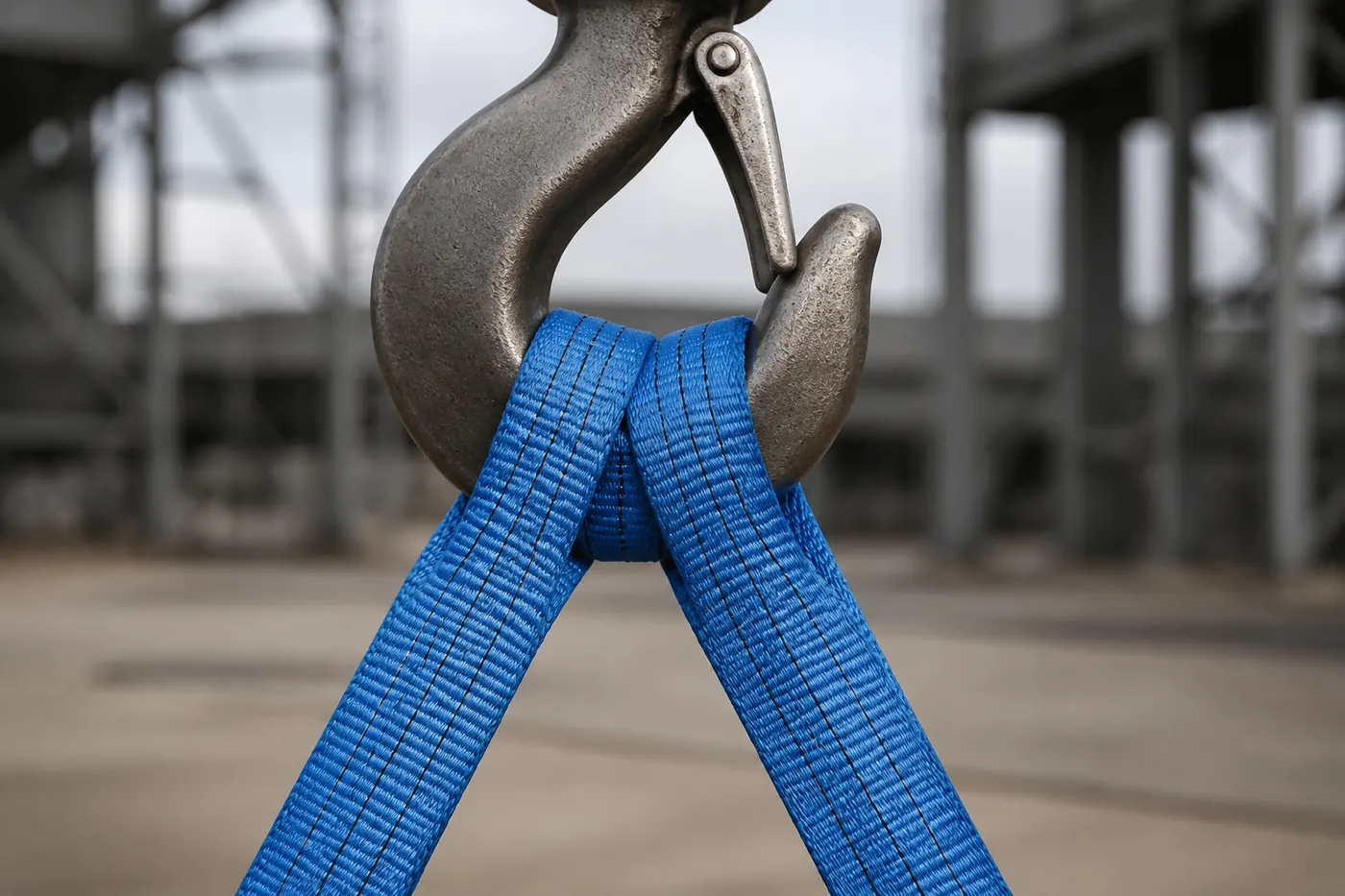
Hitches and Mode Factors
די פירמע פיגור איז די גלייַך הייבן שאַץ. Every other hitch is derived from it by a mode factor.
| צוטשעפּען אָדער מאָדע | מאָדע פאַקטאָר מ | וואָס עס מיטל |
|---|---|---|
| גלייַך הייבן | 1.0 | די פירמע פיגור. Both parts of the sling hang to the hook. |
| דערשטיקט | 0.8 | The band passes round the load and back through itself so it grips as it takes the weight. |
| קאָרב, 0–7° | 2.0 | The band passes under the load with both legs on the hook, לעגס ין 7 ° פון ווערטיקאַל. |
| קאָרב, 7–45° | 1.4 | ווי די לעגס עפענען אויס, די שפּאַנונג אין יעדער ריסעס און די ניצלעך קאַפּאַציטעט פאלס. |
| קאָרב, 45–60° | 1.0 | ביי דעם פארשפרייטן גיט די קארב נישט מער ווי א גלייך הייבן. |
| אַנגגאַלד דערשטיקן בייַ 45 ° | 0.7 | דערשטיקט, און די לעגס דעמאָלט עפענען אַוועק פון ווערטיקאַל. א דערשטיק געשטעלט גלייַך אַנטו די קרוק האלט 0.8. |
| אַנגגאַלד דערשטיקן בייַ 60 ° | 0.5 | The most heavily reduced arrangement in common use — check it before the lift, נישט נאָך. |
Two flat-specific habits, neither of which applies to a round sling: keep the band flat and untwisted אין די היכל, because a flat band twisted into a rope concentrates the load on one edge and loses the contact area that is its whole advantage; און באַשיצן די באַנדע ביי עדזשאַז, because on a sheared or machined edge a flat sling fails at the edge long before it fails at the load.
Technical Specifications and How to Specify
| פּראָדוקט נאָמען | פלאַך ליפטינג וואַרפלקע / פלאַך וועבינג וואַרפלקע / פלאַך וואָווען וועבינג וואַרפלקע / webbing lifting sling |
|---|---|
| טיפּ | Flat woven webbing sling to EN 1492-1; eye and eye or endless (קייַלעכיק) פאָרעם |
| פיברע | פּאָליעסטער (בלוי פירמע) ווי נאָרמאַל; פּאָליאַמידע / ניילאָן (גרין פירמע); פּאַליפּראָופּאַלין (ברוין פירמע) |
| אַרבעט מאַסע שיעור | 1 ה צו 30 ה אין די ארויס לייטער, and intermediate capacities to order |
| זיכערקייַט פאַקטאָר | 7:1 צוויי איין 1492-1 ווי נאָרמאַל; 5:1 צו ASME B30.9 און 8:1 צו AS 1353 געבויט צו סדר |
| פלי | איין שיכטע ווי נאָרמאַל; duplex and double layer on request |
| ברייט | Matched to the capacity and the load surface — the reference series is 2 ה = 50 mm, 3 ה = 75 mm, 4 ה = 100 mm, 5 ה = 125 mm, 6 ה = 150 mm, 8 ה = 200 mm, 10 ה = 250 mm; final width on the order acknowledgement |
| לענג | Manufactured to order; state the length between the bearing points of the eyes, or the length that suits your rig |
| ילאָנגגיישאַן | מאַקסימום 3% at the working load limit for polyester; מאַקסימום 10% ביי די ברייקינג מאַסע |
| טעמפּעראַטור קייט | -40 °C צו +100 °C פֿאַר נאָרמאַל פּאַליעסטער בויען; nylon and polypropylene differ — see the fibre table |
| שוץ | Protective sleeves, טראָגן פּאַדס, edge protectors and reinforced eyes on request |
| מאַרקינג | אין 1492-1 capacity colour with one black stripe per tonne; סעוון פירמע קעריינג די גלייך הייבן WLL, די פיברע, דער נאָרמאַל רעפֿערענץ, דער פאַבריקאַנט, די לענג און אַ טרייסאַביליטי קאָד |
| טעסטינג | פּעקל טעסטעד; פּרובירן באַווייַזן סאַפּלייד פּער פּעקל אויף בעטן |
| MOQ & אָעם | נידעריק מאָק פֿאַר פּראָצעס אָרדערס; פול אָעם - קאַפּאַציטעט, פיברע, ברייט, פּלאַ, ענדס, קאָליר, פירמע אויסלייג און פּאַקינג |
How to specify one — in this order
- די מאַסע, and its shape. The shape decides whether a flat band can lie against it at all, or whether you need a round section instead.
- The hitch you will actually rig. Not the one in the method statement — the one the crew will use. Then apply the mode factor and size the capacity from that figure.
- די סביבה. היץ, acid, alkali, וואַסער, גריט. This decides the fibre, and getting it wrong is the failure you will not see coming.
- די ייבערפלאַך. Whether the load may be marked decides the width and whether you need a sleeve or a pad.
- די ענדס. Eye and eye if the pick-up points must be defined; endless if the sling must serve many rigs and you want to rotate the wear.
- די לענג, the marking and the standard. Length between bearing points; the label layout and language your market needs; און דער נאָרמאַל און דעסטיניישאַן מאַרק די וואַרפלקע מוזן זיין געבויט צו.
האַנדלינג, דורכקוק און לימיטיישאַנז
A flat sling is the easiest of all the synthetic slings to inspect, because the load path is on the surface. דורכקוקן אין דעם סדר.
- The eyes first. Every stitch row across the fold, the webbing immediately behind the eye, and the fold itself. צעבראכן, לויז אָדער פּולד סטיטשינג קאַנדעמז די וואַרפלקע.
- די שייַכעס פונקטן. Where the band has wrapped the load — cuts, אַברייזשאַן, גלייזינג אָדער אַ וואָרן ברעג.
- The whole band. א פלאַך באַנד טראגט די מאַסע איבער זייַן גאנצע ברייט, so a cut anywhere matters. Run it through your hands.
- Edges and ends. Cuts from the load’s own corners are the classic flat sling failure.
- גלייזינג און כאַרדאַנינג. A band gone shiny or stiff has met heat or sustained friction, and the fibre is not what it was.
- קאַנטאַמאַניישאַן. Acid or alkali attack leaves little visible on the outside and destroys the fibre within. If the sling has been exposed, take it out of service and ask.
- An eye and eye sling cannot be rotated. Its wear points are fixed for life. This is the honest trade-off against an endless sling, and if you find yourself condemning slings while the middle of the band is still sound, that is the signal to move to the endless form.
- Keep it flat, keep it off edges, keep it off heat. Those three account for most premature failures.
- קיינמאָל פאַרריכטן אַ וואַרפלקע. קיין סטיטשינג, קיין ספּלייסינג, קיין קנופּן. א קנופּ אין אַ וועבינג וואַרפלקע קענען פאַרלירן האַלב זייַן קאַפּאַציטעט.
- Store it clean, טרוקן און אויס פון זונשייַן, און קיינמאָל אויף אַ באַטאָנען שטאָק ווו עס קענען קלייַבן זיך גריט.
- רעקאָרד עס. קלאָץ די ליפץ, די כיטשעס, די לאָודז און קיין שעדיקן.
אַפּפּליקאַטיאָנס
- פּלאַנט, מאַשינערי, סקידס, dies and castings — anywhere the surface must not be marked
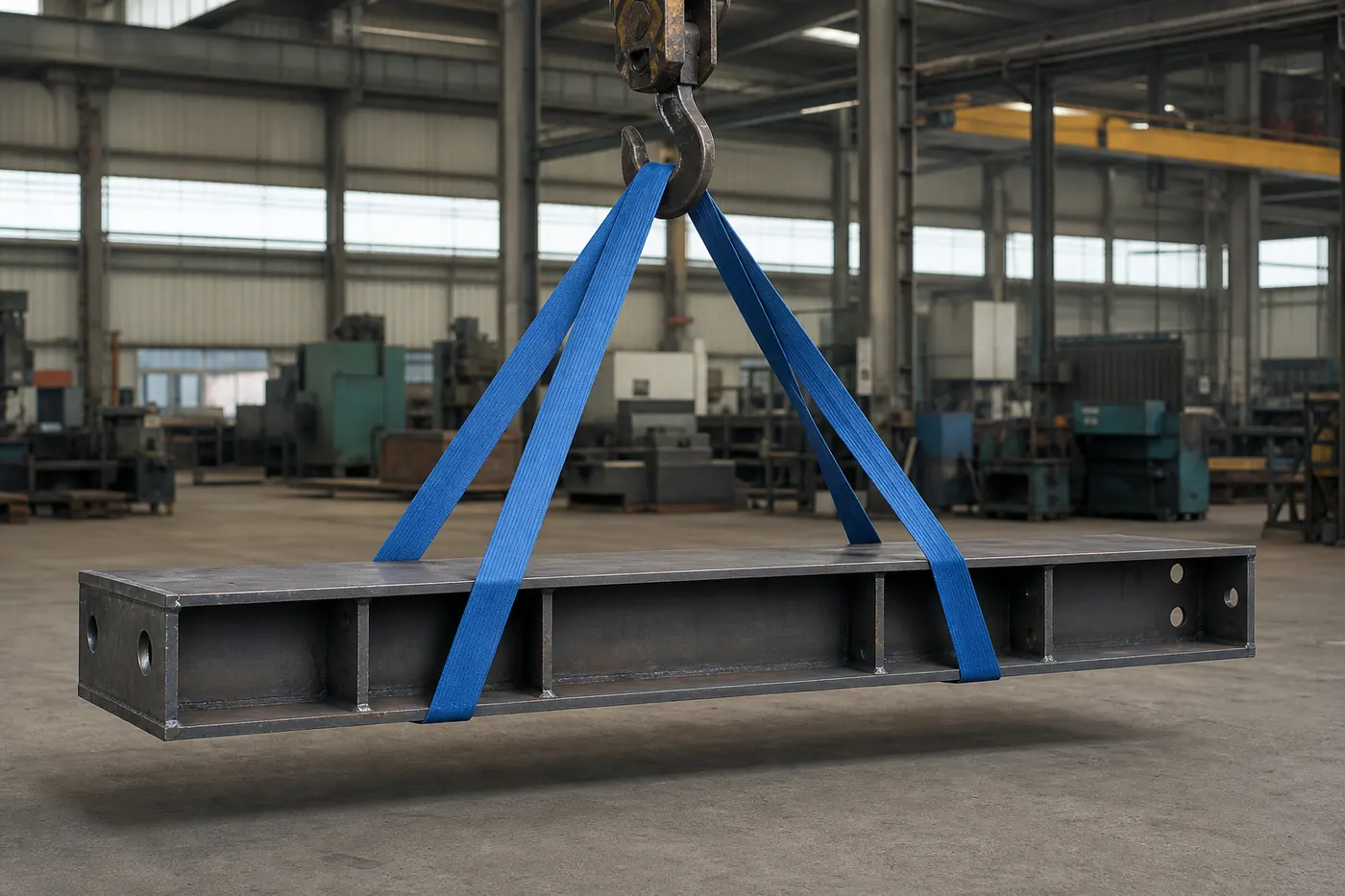
- Structural steel sections, בימז און וועלדעד פאַבריקיישאַנז, choked or in a basket
- קרייץ, סטילאַגעס, פּאַלאַץ און קעסטל סכוירע
- Precast concrete units where a broad bearing is wanted
- קאָוטאַד, painted and powder-coated products — the large-tonnage white polypropylene band is used on coated work exactly for this reason
- בונדלעס פון רער, רער און סעקשאַנז
- כעמישער, wet and wash-down environments, where polypropylene is the fibre of choice
- Cold stores and cold-climate sites, where nylon keeps its composure
- יאַרדס, פּאָרץ, depots and site work where one sling has to serve many different lifts
קוסטאָמיזאַטיאָן און אָעם סערוויס
A flat sling is built to order more often than it is bought off a rack, ווייַל די לענג, the width and the fibre all follow from the lift.
- קאַפּאַציטעט — 1 ה צו 30 ה אין די ארויס לייטער, and intermediate capacities
- פיברע — פּאַליעסטער, ניילאָן אָדער פּאַליפּראָופּאַלין, chosen against heat, chemical or shock duty
- Width and ply — matched to the load surface and the edge condition, איין אָדער טאָפּל שיכטע
- ענדס — eye and eye or endless; reinforced eyes where the hook duty is hard
- לענג — to your rig, stated between the bearing points of the eyes
- שוץ — sleeves, pads and edge protectors
- מאַרקינג — די ען 1492-1 קאַפּאַציטעט קאָליר און מלקות, אָדער דיין אייגענע סכעמע ווו דער מאַרק אַלאַוז; דיין פירמע אויסלייג, שפּראַך און פיגיערז
- פּאַקינג — coiled, bagged or baled; מנהג אַרויספירן פּאַקינג
קוואַליטי קאָנטראָל
יעדער לענג פון וועבינג איז אָפּגעשטעלט פֿאַר וויוו, ברייט און קאָליר איידער עס איז שנייַדן. Every formed eye is checked on its fold and on the number and continuity of its stitch rows. Every finished sling is checked on its length, its capacity marking, זייַן פירמע און זייַן טרייסאַביליטי קאָד איידער פּאַקינג, און יעדער פּעקל איז טעסטעד. מיר האָבן מאַניאַפאַקטשערד סלינגז, וועבינג און שטריק פּראָדוקטן פֿאַר ינדאַסטרי, זיכערקייַט און אַרויספירן קאַסטאַמערז פֿאַר נאָענט צו דרייַ דעקאַדעס, און מיר האַלטן דעם פּראָצעס קענטיק: אויף בעטן מיר צושטעלן די וועבינג באַווייַזן, די פּעקל פּרובירן פיגיערז און אַ מוסטער וואַרפלקע פֿאַר איר צו שעפּן און פּרובירן איידער באַנד פּראָדוקציע הייבט.
אָפט געשטעלטע פֿראגן
What is a flat lifting sling?
A flat woven webbing sling: a rated lifting sling whose load-bearing element is a band of woven webbing with a rectangular cross-section, געבויט צו ען 1492-1. It is called flat to describe that cross-section, נישט די פיברע, the ends or the capacity — a flat sling can be polyester, ניילאָן אָדער פּאַליפּראָופּאַלין, can have a formed eye at each end or be closed into an endless loop, and can be built from 1 ה צו 30 ה. Its defining advantage is that it bears across a broad, flat face rather than a line, and that it needs no fittings on the load path.
Is a flat lifting sling the same as a webbing sling?
Effectively yes — flat sling and webbing sling name the same family from two directions. “וועבינג” names the material it is woven from; “פלאַך” names the shape of its cross-section. Both distinguish it from a round sling, which is a different family: a parallel fibre core inside a tubular sleeve, with a circular section.
Should I choose a flat sling or a round sling?
Choose flat when the band can lie flat against the load and the load has a wide face or edges — plate, סעקשאַנז, קרייץ, מאַשינערי, boxy and flat things. Choose round when the load is round, tightly curved or awkward, where a flat band cannot lie flat and would crease or bear on a single corner. The flat form also has the inspection advantage: everything that carries the load is on the outside, where you can see it.
פּאָליעסטער, nylon or polypropylene — which should I buy?
Polyester unless you have a reason not to: it has the lowest stretch for its strength and is the best all-round value, and it is what most of the capacity ladder is published in. Nylon if the sling will be shock-loaded or has to stretch to catch a load, and it also behaves better in very cold conditions. Polypropylene if the environment is wet, chemical or both, because it resists acids and alkalis better than either of the others. The fibre is identified by the colour of the sewn label, not by the colour of the webbing.
How do I know what a flat sling will lift in a choke or a basket?
דער פירמע גיט די גלייך-הייבן אַרבעט מאַסע שיעור. א דערשטיקן ראַדוסאַז עס צו 0.8 מאל אַז פיגור. א קאָרב אין אַ שמאָל ווינקל ינקריסיז עס צו 2 מאל, פאַללינג צו 1.4 מאל צווישן 7 און 45 דיגריז און צו 1 מאל צווישן 45 און 60 דיגריז. An angled choke is reduced further, צו 0.7 בייַ 45 דיגריז און 0.5 בייַ 60 דיגריז. א 4 ה לאָדן אין אַ טשאָקער דאַרף אַ 5 ה וואַרפלקע, ווייַל 4 ÷ 0.8 = 5.
Why are two flat slings of the same capacity different prices?
Because capacity is only one of four dimensions. The same working load limit can be built at different widths, in different numbers of layers, and in three different fibres. A wider band spreads the bearing over more of the load; a double-layer band is stiffer and lasts longer over an edge; nylon and polypropylene cost more than polyester. When you compare two quotations for “א 5 t flat sling”, compare the width, the ply and the fibre as well.
טוט “double buckle” mean the sling has a metal buckle?
Almost certainly not. In this trade buckle and double buckle are normally names for an end formed by folding the webbing back on itself and stitching it — the same construction as any other formed eye, with no metal anywhere. It is the commonest misreading in the whole flat sling family, so if a quotation says buckle, ask which it is before the goods ship.
קען איך באַקומען אַ מנהג קאַפּאַציטעט, פיברע, ברייט, לענג און מאַרקינג?
יא. מיר בויען פון 1 ה צו 30 t in the published ladder and in intermediate capacities, אין פּאַליעסטער, ניילאָן אָדער פּאַליפּראָופּאַלין, at the width and ply your load and edges require, in eye and eye or endless form, to the length your rig needs, with the EN 1492-1 capacity colour and stripes or your own marking scheme where the market allows. דערציילן אונדז די מאַסע, די צוטשעפּען, the environment and the destination market and we will work the specification out with you.
Request a Quote for Flat Lifting Slings
שיקן אונדז די מאַסע און זייַן פאָרעם, the hitch you will actually rig, the environment the sling will work in, whether the surface may be marked, the length your rig needs, און דער נאָרמאַל און דעסטיניישאַן מאַרק די וואַרפלקע מוזן זיין געבויט צו. We will come back with a fibre, אַ ברייט, אַ פּלאַטע, אַ לענג, אַ מוסטער און אַ פאַבריק-דירעקט פּרייַז.
פֿאַרבונדענע פּראָדוקטן
- The Whole Catalogue, Sorted by Fibre, פאָרעם, Ends and Capacity
- Endless Type Webbing Sling — the flat band with no ends
- שטאָל רער ליפטינג רימען - ברייט באַנדס און סליווז פֿאַר רער
- הויך טעמפּעראַטור וועבבינג סלינג - פֿאַר הייס לאָודז
- Aramid Webbing Sling - די שניט-קעגנשטעליק אָפּציע
- Round Slings — the round-section family