 702461526@qq.com

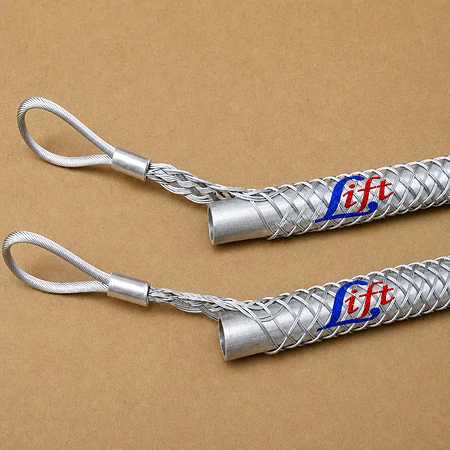


Lift sling rigging company produce Cable Pulling Socks Grip,Wire Mesh Puller Socks Grip,Anti-Slip Single eye Cable Pulling Sock,Galvanized Steel Cable Pulling Grip Socks.
Lifet cable pulling socks — also called wire mesh pulling grips, cable socks, cable pulling grips or mesh grips — are flexible steel wire mesh sleeves that grip a cable, pipe or duct rod tightly while you pull it. The mesh tightens around the load as tension rises, so a pulling sock needs no clamps, bolts or tools: slide it on, pull, and the grip locks on. Every sock is braided in our own factory from galvanised steel wire, with single eye, double eye or flexible eye options, for cable diameters from 9 mm to 160 mm.
What Is a Cable Pulling Sock?
A cable pulling sock is a tubular, double-layer woven wire mesh that slips over the end of a cable and grips it by friction alone. The open end of the mesh closes on the cable, the closed end carries a braided eye or swaged eye, and the pulling line is attached to that eye. Because the grip increases with the pull, the sock holds the cable without crushing the insulation, the conductor or the pipe wall.
Typical names for the same tool in different trades: cable pulling sock, wire mesh pulling grip, cable sock, pulling grip, mesh grip, wire grip, cable stocking, support grip and Kellems-style grip.

How a Wire Mesh Cable Pulling Grip Works
- Slide on — the mesh is expanded and pushed over the cable end. It must be long enough to cover the whole gripping length, not just the cable tip.
- Grip — as the pulling line tensions the eye, the weave contracts radially. Pulling force is converted into a uniform radial clamping force along the entire mesh length, so the load is spread over a long section of cable instead of one point.
- Release — slacken the line and push the mesh forward; the weave opens and the sock slides off. No tools, no damage to the cable jacket.
The same principle lets a pulling sock be used to lift, hold or support a smooth cylindrical load — pipes, ducts, conduit bundles, rods, cable drums and hoses.
Key Features of Lift Cable Pulling Socks
- Galvanised steel wire mesh — high-tensile, corrosion-resistant wire braided in a double-layer cross weave; AISI 304 / 316 stainless steel available on request.
- Grip increases with load — no clamp, no bolt, no cable deformation; ideal for fragile insulation, lead sheaths, fibre and copper.
- Single eye, double eye or flexible eye — braided rope eye, swaged aluminium ferrule eye, rotating eye and offset eye versions.
- Wide size range — cable diameter 9–160 mm, mesh length 300–1500 mm as standard; longer and larger sizes made to order.
- Optional protective coating — PVC / rubber coated mesh for painted, stainless or polished pipe where surface marking must be avoided.
- OEM and private label — your logo, mesh length, eye type and packing; factory-direct pricing and fast lead time from Jiangsu, China.
Typical Applications
- Pulling LV, MV and HV power cables, control and fibre optic cable through ducts and trenches
- Pulling cable bundles, wire ropes and rods with cable winches and pullers
- Handling steel pipe, PVC/PE pipe, conduit, hose and ducting
- Supporting or lowering smooth cylindrical loads where clamps or hooks must not mark the surface
- Telecom, utility, offshore and tunnel installation work
Cable Pulling Sock Specifications
Standard specification of Lifet cable pulling socks / wire mesh pulling grips
Selection chart (cable diameter → sock size)
Values are typical for the standard galvanised range. Final capacity depends on cable surface, mesh length and number of layers — please confirm the rating for your application with our engineers before use.
How to Select the Right Cable Pulling Sock
- Measure the outside diameter of the cable, pipe or bundle at the point it will be gripped — not the nominal size. For bundles, use the overall diameter.
- Check the diameter range — a sock must be expanded to grip, so choose a model whose range covers your measured diameter. Too large will slip, too small will not slide on.
- Match the mesh length to the load — longer socks spread the grip and support higher pulling forces; as a rule, use at least 4–5 × the cable diameter of mesh engagement.
- Choose the eye type — single eye for straight pulls, double / flexible eye where the line must swivel, rotating eye for long duct runs.
- Consider the surface — for painted, stainless or plastic pipe, choose a PVC or rubber coated mesh to prevent marking.
Installation & Safe Use
- Inspect the mesh, eye and ferrule before every use; discard any sock with broken wires, a deformed eye or a slipped ferrule.
- Expand the mesh fully and slide it on until the cable end reaches the eye — never pull with the cable only half inserted.
- Keep the pull in line with the mesh axis; side loading reduces capacity and can damage the weave.
- Never exceed the rated pulling capacity, and never use a cable pulling sock for overhead lifting unless the model has been rated and marked for lifting use.
- Store dry and clean; wipe and re-check galvanised socks after use in wet or salty environments.
-

Lift sling rigging company produce Double Eye Split Mesh Lace Closing Support Grips
Quality Control at Lift
Lift Sling Rigging Co., Ltd has produced wire rope and mesh rigging in Taizhou, Jiangsu for nearly thirty years. Each cable pulling sock is braided from wire we select, the eye is braided or swaged to a controlled length, and samples are proof-loaded before despatch. Pre-shipment inspection reports and third-party testing can be arranged on request.
Frequently Asked Questions
What is a cable pulling sock used for?
It grips a cable, pipe, rod or duct so it can be pulled with a winch or by hand. The wire mesh tightens as tension rises, which spreads the gripping force along the cable and avoids clamps that could crush or mark it.
How do I choose the correct size?
Measure the true outer diameter of the cable or bundle and pick the model whose range covers it, then choose the mesh length from the pulling load. Our selection chart above gives standard models from 9 mm to 160 mm.
Single eye or double eye — what is the difference?
A single eye has one braided loop for a straight pull. A double or flexible eye gives two loops (or a swivel point) so the sock can align with the winch line in bends, manholes and long duct runs.
Can the mesh be stainless steel or coated?
Yes. Galvanised wire is standard; AISI 304 or 316 stainless steel is available for corrosive or offshore work, and PVC or rubber coated mesh is available where the cable or pipe surface must not be marked.
What is the safety factor?
Standard socks are rated at a 5:1 safety factor on the breaking strength. Tell us your required pulling load and we will specify the mesh wire diameter and length to suit.
Can you make custom lengths and put our brand on it?
Yes — custom mesh lengths up to 3000 mm, custom eye types, colour coding and your own logo or private label packing are all produced to order at our factory.
Request a Cable Pulling Sock Quotation
Send us your cable diameter, mesh length, eye type and required pulling load, and our engineers will confirm the correct model and price within one working day.
Phone / WhatsApp: +86 180 6600 2268 E-mail: 702461526@qq.com Address: Lifute Industrial Park, Taizhou City, Jiangsu Province, China
Related products
- Wire rope slings — full range
- Lifting slings and lifting belts
- Cargo nets and lifting nets
- Contact Lifet for a quotation
| Parameter | Specification |
| Product name | Cable pulling sock / wire mesh pulling grip / cable pulling grip |
| Material | Galvanised high-tensile steel wire (AISI 304 / 316 stainless steel optional) |
| Structure | Double-layer cross-woven tubular mesh with braided or swaged eye |
| Mesh wire diameter | 1.5 mm / 2.0 mm / 2.5 mm / 3.0 mm (selected by cable diameter and pulling load) |
| Cable diameter range | 9–16 mm up to 130–160 mm in standard models; larger sizes made to order |
| Mesh (sock) length | 300 mm, 450 mm, 600 mm, 900 mm, 1200 mm, 1500 mm; custom up to 3000 mm |
| Eye / head type | Single eye, double eye, flexible eye, rotating eye, offset eye |
| Eye fitting | Braided rope eye or swaged aluminium ferrule (thin, low build-up profile) |
| Breaking strength | Model dependent — see selection chart below |
| Safety factor | 5:1 on the rated breaking strength |
| Coating options | Plain galvanised; PVC / rubber coated mesh; coloured coating for coding |
| Working temperature | −40 °C to +120 °C (coated versions to +70 °C) |
| Customisation | Custom mesh length, custom eye, logo print, private label packing |
| Origin | Lift Sling Rigging Co., Ltd — Taizhou, Jiangsu, China |
| Model | Cable Ø range (mm) | Mesh length (mm) | Mesh wire Ø (mm) | Pulling capacity (kg) |
| CPS-16 | 9–16 | 300 | 1.5 | 750 |
| CPS-25 | 16–25 | 450 | 2.0 | 1,300 |
| CPS-38 | 25–38 | 600 | 2.0 | 1,800 |
| CPS-50 | 38–50 | 700 | 2.5 | 2,500 |
| CPS-75 | 50–75 | 900 | 2.5 | 3,500 |
| CPS-100 | 75–100 | 1200 | 3.0 | 5,000 |
| CPS-160 | 130–160 | 1500 | 3.0 | 8,000 |