 702461526
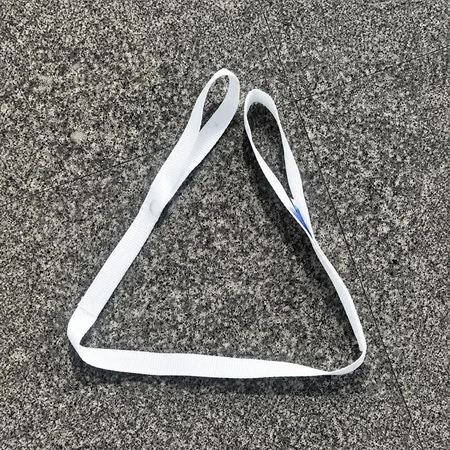

Lift sling rigging company producec Single-Use Lifting Slings Endless Loop,Single Use Endless Lifting Sling,Single Use or Disposable Sling,Disposable Pre-Slung Cargo Sling.
Single-Use Lifting Slings Endless Loop
Flat Woven Polyester Endless Loop Sling — 1 t to 24 t · 25 mm to 300 mm Wide · 5:1 · 6:1 · 7:1 Safety Factor
A single-use lifting sling in endless loop form is a flat woven polyester band joined to itself into a closed ring. There is no eye at either end, no hook, no thimble and no hardware of any kind: the load enters by passing the band around the article and back through itself. That single absence is what the form is bought for. Nothing on the sling can catch, nothing can be fitted wrongly, and there is no end to thread through a hook — which is exactly what a one-trip export lift needs. We weave the band in 4 mm and 7.5 mm thickness, close the loop with a multi-row stitched join, and publish the working load limit for the three safety factors the market asks for: 5:1, 6:1 and 7:1.
- No ends, no fittings — a closed ring with nothing to assemble and nothing to lose
- 1 t to 24 t across two webbing thicknesses, 25 mm to 300 mm wide
- Flat woven polyester — soft, non-marking and light against the load
- Any length to order — 0.5 m minimum, 100 m maximum, cut to your line


Key Features
Bought for One Journey
Made to make a single trip with an export load and not come back. It is a purchase decision about the journey — it is never a licence to overload, and the working load limit still governs.
Nothing to Rig Wrongly
No eyes to place, no fittings to inspect, no shackle to pin. The loop either passes around the load or it does not, which removes most of the ways a sling assembly goes wrong.
Even Wear by Rotation
A closed ring has no fixed wear point. The contact area can be rotated between lifts, so the same band does not take all the abrasion in one place against a sharp edge.
Soft and Non-Marking
Flat polyester webbing spreads the load over the band width and will not bruise a painted, polished or coated surface the way chain or wire rope does.
Low Stretch
Polyester webbing stretches less than nylon under the same load, which keeps a bundled load level and stops the band creeping while it is being set down.
Three Safety Factors
The same tonnage is published at 5:1, 6:1 and 7:1 so the band width can be matched to whichever design factor your market or project specifies.
What “Endless Loop” Means — and What It Does Not
The word endless describes the form, not the length. The band is woven flat, then overlapped on itself and closed with several rows of stitching to form a continuous ring. Because there is no end, the article has no attachment point at which a load can be hooked — and equally, no end at which a routine inspection of a fitting would normally start.
| Endless loop flat webbing sling | A flat woven band of polyester, polyamide or polypropylene webbing closed on itself into a ring. The band itself carries the load. This is the article on this page. |
|---|---|
| Eye-and-eye webbing sling | The same flat webbing, but with a formed eye at each end instead of a closed loop. It has ends, so it is rigged differently and is a different article. |
| Endless round sling | Often mistaken for this product. A round sling is a load-bearing core of parallel polyester yarn inside a separate woven tubular cover — a sleeve over a core, not a single load-carrying band. Different construction, different handling, different standard. |
| Single-use / one-way / disposable | All three words describe the same purchase decision: the sling is bought for one journey. None of them describes the form of the ends, the fibre, the safety factor or the rated capacity. |
Technical Specifications
| Product name | Single-use lifting slings endless loop / one-way sling / circular disposable sling / endless webbing sling |
|---|---|
| Construction | Flat woven webbing band joined to itself into a closed loop with a multi-row stitched overlap |
| Webbing material | 100 % high-tenacity polyester (polyamide and polypropylene on request) |
| Webbing thickness | 4 mm and 7.5 mm bands (the two blocks of the parameter table below) |
| Band width | 25 mm to 300 mm — the width is set by the working load limit and the safety factor, not chosen freely |
| Working load limit | 1 t to 24 t (1–12 t on the 4 mm band, 2–24 t on the 7.5 mm band) |
| Safety factor | 5:1 · 6:1 · 7:1 — three published factor columns |
| Length range | Minimum 0.5 m to 2.0 m depending on width; maximum 100 m |
| Weight | Published per metre for every row and every factor (see the table below) |
| Colour | White · green · blue · orange · red, with or without a printed size or capacity marking |
| Ends | None — a closed ring, with no fittings of any kind |
| Elongation | Low-stretch polyester webbing; working elongation stays well below nylon under the same load |
| Packing | Coil or bundle, labelled bale or carton, custom export packaging with your own label |
| MOQ & OEM | Low MOQ for trial orders; full OEM — width, thickness, length, colour, printed marking and packaging |
Working Load Limit, Webbing Width and Safety Factor
This is the parameter table for the endless loop sling. It is published as one ladder of band widths at two webbing thicknesses, and each row gives the width and the weight per metre for the three safety factors. Read the two blocks together and the logic is simple: a 7.5 mm band carries exactly double the working load limit of a 4 mm band at the same widths, and it costs roughly two to two and three quarter times the weight per metre to do it.
| Working load limit | Thickness | Width at 5:1 | Width at 6:1 | Width at 7:1 | Min. length | Max. length | kg/m at 5:1 | kg/m at 6:1 | kg/m at 7:1 |
|---|---|---|---|---|---|---|---|---|---|
| 4 mm Webbing Band | |||||||||
| 1 t | 4 mm | 25 mm | 50 mm | 30 mm | 0.5 m | 100 m | 0.16 | 0.18 | 0.20 |
| 2 t | 4 mm | 50 mm | 100 mm | 60 mm | 1.0 m | 100 m | 0.35 | 0.39 | 0.60 |
| 3 t | 4 mm | 75 mm | 150 mm | 90 mm | 1.0 m | 100 m | 0.52 | 0.73 | 0.78 |
| 4 t | 4 mm | 100 mm | 200 mm | 120 mm | 1.5 m | 100 m | 0.80 | 0.84 | 0.90 |
| 5 t | 4 mm | 125 mm | 250 mm | 150 mm | 1.5 m | 100 m | 0.85 | 0.96 | 1.14 |
| 6 t | 4 mm | 150 mm | 300 mm | 180 mm | 1.5 m | 100 m | 0.96 | 1.12 | 1.33 |
| 8 t | 4 mm | 200 mm | 200 mm | 240 mm | 2.0 m | 100 m | 1.34 | 1.65 | 1.85 |
| 10 t | 4 mm | 250 mm | 250 mm | 300 mm | 2.0 m | 100 m | 1.64 | 1.84 | 2.05 |
| 12 t | 4 mm | 300 mm | 300 mm | 300 mm | 2.0 m | 100 m | 1.86 | 2.06 | 2.70 |
| 7.5 mm Webbing Band | |||||||||
| 2 t | 7.5 mm | 25 mm | 50 mm | 30 mm | 0.5 m | 100 m | 0.38 | 0.44 | 0.50 |
| 4 t | 7.5 mm | 50 mm | 100 mm | 60 mm | 1.0 m | 100 m | 0.68 | 0.74 | 0.86 |
| 6 t | 7.5 mm | 75 mm | 150 mm | 90 mm | 1.0 m | 100 m | 1.28 | 1.42 | 1.50 |
| 8 t | 7.5 mm | 100 mm | 200 mm | 120 mm | 1.5 m | 100 m | 1.61 | 1.80 | 1.96 |
| 10 t | 7.5 mm | 125 mm | 250 mm | 150 mm | 1.5 m | 100 m | 2.04 | 2.42 | 2.62 |
| 12 t | 7.5 mm | 150 mm | 300 mm | 180 mm | 1.5 m | 100 m | 2.32 | 2.68 | 2.86 |
| 16 t | 7.5 mm | 200 mm | 200 mm | 240 mm | 2.0 m | 100 m | 3.30 | 3.70 | 4.10 |
| 20 t | 7.5 mm | 250 mm | 250 mm | 300 mm | 2.0 m | 100 m | 4.62 | 5.02 | 5.46 |
| 24 t | 7.5 mm | 300 mm | 300 mm | 300 mm | 2.0 m | 100 m | 5.12 | 5.62 | 6.10 |
Choosing the Safety Factor: 5:1, 6:1 or 7:1
The safety factor is the ratio between the band’s breaking strength and the working load limit printed on it. The higher the factor, the wider the band must be to carry the same tonnage — which is why the table above publishes three different widths for every load.
- 7:1 — the design factor used for general-purpose flat woven webbing slings under European practice. Choose it when the sling must match a European or UK project specification.
- 5:1 — the design factor customary under North American practice for synthetic webbing slings. Choose it for a North American project or where a lighter, narrower band is preferred.
- 6:1 — the middle of the ladder, used where a specification calls for a higher factor than 5:1 but does not require the full European figure.
Rigging an Endless Loop Sling
Because the loop has no ends, it can be arranged in four ways. The arrangement changes the load on the band, so the working load limit that applies is the one for the hitch you actually use.
Webbing and Construction
The band is woven from high-tenacity polyester, so the load-bearing capacity sits in the warp yarns that run the length of the sling, with the weft holding them in place. That is why a flat webbing sling shows fine longitudinal lines along its face: those lines are the load path. The two selvedge edges are woven closed, and the join is made by overlapping the band on itself and closing the overlap with several rows of dense stitching, so the load is transferred through the stitching rather than through a knot.

- Wider band, not thicker stitch — the width of the band is what spreads the bearing pressure against the load, so a delicate surface calls for a wider band at the same tonnage.
- Polyester by default — lower stretch than nylon and good resistance to water, oils and most chemicals. Polyamide and polypropylene are available where the environment calls for them.
- Recognisable by colour — a colour band makes a sling visually identifiable on site; we can also print the size or the working load limit along the band on request.
Applications
- Export steel pipe and tube bundles — slung at two points and lifted level
- Steel plate, sheet and coil packs loaded into containers
- Stone blocks, slabs and kerb sections where a marking-free band is required
- Timber, plywood and panel packs
- Machinery and fabricated steel where fittings would foul the lifting points
- Single-trip lifting where the sling travels with the consignment and is not returned


Customisation and OEM Service
Because an endless sling is built to the line rather than stocked, the enquiry is where the article is actually designed. Give us the load, the number of lifting points, the arrangement, the headroom and the width of the load and we will come back with a width, thickness, length and safety factor that fits.
- Width and thickness — 25 mm to 300 mm band, 4 mm or 7.5 mm, matched to your working load limit and factor
- Length — any length to order between the minimum for that width and 100 m
- Safety factor — published at 5:1, 6:1 or 7:1 to suit the specification you are working to
- Colour and marking — plain colour or printed size, working load limit, or your own reference along the band
- Packing for export — banded bales, cartons or labelled packs, sized for container loading
- Related items — matching eye-and-eye slings, round slings and wire rope slings for the same consignment
Quality Control
Every batch of webbing is checked for width, thickness, weave density and colour, and the finished loop is checked on its join and its overall length before packing. We have manufactured slings, webbing and rope products for industrial, safety and export customers for close to three decades, and we keep the process visible: on request we supply the webbing report, the batch test figures and a sample loop for you to handle and load-test before volume production begins.
Frequently Asked Questions
What is a single-use lifting sling with an endless loop?
A flat woven polyester band joined to itself into a closed ring, so it has no ends and no fittings. It is bought for one journey with an export load and not returned. The endless loop is the form of the article; single-use, one-way and disposable all describe the same purchase decision.
Is an endless loop sling the same as a round sling?
No. An endless loop flat webbing sling is a single woven band that carries the load itself. An endless round sling is a load-bearing core of parallel polyester yarn inside a separate woven tubular cover — a sleeve over a core. They look similar in use but they are different constructions with different handling and different pricing. Tell us which one your enquiry is for.
Which safety factor should I order — 5:1, 6:1 or 7:1?
Match it to the specification your market or project calls for. 7:1 is the design factor used for general-purpose flat woven webbing slings under European practice, 5:1 is the customary North American design factor for synthetic webbing slings, and 6:1 sits between them. The factor changes the band width required for the same tonnage, so it must be decided before the sling is made.
How do I choose the band width?
Start from the working load limit and the safety factor, which the parameter table converts into a width. Then check that width against the load: a wider band spreads the bearing pressure over a bigger area, so a painted, polished or otherwise delicate surface calls for a wider band even where a narrow one would carry the weight.
How do I measure the length of an endless loop sling?
A closed loop has no ends, so the length is a property of the ring as it is made rather than something you measure between two eyes. Give us the arrangement you intend to use, the load diameter and the available headroom, and we will size the loop so it rigs correctly; the minimum length for each width is set out in the parameter table.
Can a single-use sling be used more than once?
A single-use sling is designed and priced around one journey, and its working load limit still applies on that journey. Whether a particular sling may be used again is a decision for the competent person on site after inspection, taking account of what it has been subjected to. It is never a reason to exceed the marked working load limit, and it does not convert the sling into an inspected and certified reusable one.
Request a Quote for Endless Loop Single-Use Slings
Send us the working load limit, the safety factor your specification requires, the arrangement you intend to use and the length you need. We will come back with a width, thickness and loop length, plus a sample for you to handle before volume production.