

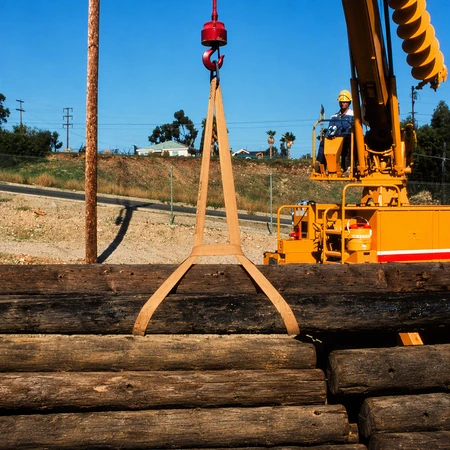
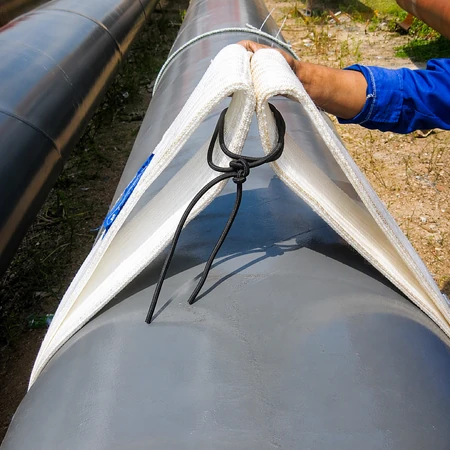
Te hamani nei te taiete faateitei i te mau Sling Webbing Sling hope ore.
Sling Webbing hope ore
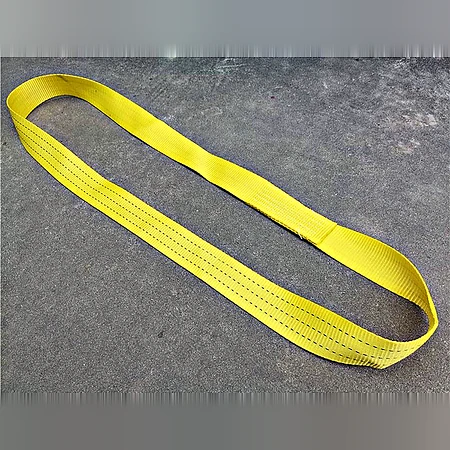
Te hoê huru webbing hope ore, o te hoho'a ïa e aita roa ' tu e hopea: E tapo'ihia te hoê arapoa papai i nia ia ' na iho e e tuituihia no te opani i te taura, no reira, te mea e noaa mai i nia i te vairaa, o te hoê ïa pǔpǔ tamau aita e mata no te matau e aita e tao'a no te ere. I raro a'e i te EN 1492-1 o te huru hope ore A Sling webbing papa'i, Ua hamanihia mai te hoê aore ra e piti ahu, mai 1 t 24 t te otia o te hopoi'a. No te mea aita e mea papû i ni'a i te reira, E nehenehe te loop e fariuhia i muri a'e i te mau faateiteiraa atoa, no reira, te vahi o te ahu, Maoti i te faaea noa i te hoê vahi, e tamau noa te vahi tapearaa matau e te amuiraa i te haere.
Endless Means One Joint, Not None
“Aita e hopearaa” is used loosely in the trade, and it is worth being precise, because two very different articles answer to the word. This sling is endless in use — no ends, no fittings — but it is not seamless. It has exactly one joint: the lap where the two ends are laid over each other and closed across the full width by several dense rows of stitching, built to carry the rated load.
That single fact decides how the sling is used and inspected. The lap is the one place where the load passes through a made connection, so it earns the first thirty seconds of every inspection — every stitch row, the step at each end of the lap, and whether the two layers still lie flat and parallel. It can also be rotated out of the bearing area and out of the hook contact area, so it is not repeatedly crushed in the same spot. If you need a loop with no joint in the load path at all, o te Sling porotiti hope ore, where the core is continuous and only the sleeve is a tube.
Te mau haamaramaramaraa no ni'a i te rave'a aravihi
| Parameter | Te mau faataaraa |
|---|---|
| Hoa | Sling webbing hope ore / endly type Te hoê tapo'i webbing papa'i / circular webbing sling |
| Ha'api'ira'a | I ROTO 1492-1 (7:1 faahoro); I 1353 referenced for Australian supply |
| I hea 'oe | 100% polyester teitei; polyamide e polypropylene i ni'a i te aniraa |
| WLL range | 1 t – 12 t single ply standard; 2 t – 24 t ply piti; multi-ply to 50 t i ni'a i te aniraa |
| Te hoê hoho'a | 7:1 e piti ONE 1492-1; 6:1 e 8:1 engineered to specification |
| Ply | Ply hoê (7.5 mm) ei faito; ply piti (2 × 7.5 mm = 15 mm) i ni'a i te aniraa |
| Te rahi o te webbing | 25 mm – 300 mm, matched to the band |
| Raʻa | Quoted by circumference or by effective working length; standard to 12 m, peu matauhia 200 m |
| Te faaroaraa | Max 3% i WLL; max 10% at breaking load |
| Mā'i'i | -40 °C e tae atu +100 °C (polyester) |
| Te tapa'oraa | I ROTO 1492-1 tae, one black stripe per tonne, sewn label: WLL, i hea 'oe, ha'api'ira'a, taata hamani, Raʻa, batch code |
| Wear protection | Te mau rima aore ra te mau ahu i te mau vahi ahu |
| Te mau papa'iraa | MTC, te mau parau faataa hi'opo'araa e te DoC i ni'a i te mau tonoraa atoa; CE e tae atu i te 2006/42/CE i nia i te 7:1 faahoro |
| Te tapo'iraa | PE pute, carton, pallet; Te mau afata raau no te mau tao'a teimaha e aore râ, te mau avae rau |
Te mau rahi tu'ati – Ply hoê
Te hoê taura polyester e hitu e te afa mirimetera, hoê ahu. A maiti i te WLL faati'a ta outou e hinaaro, i muri iho a tai'o no te rahi, te roa iti roa ' ' e e te poihâ i te metera.
| Mā'ohii | Tae | WLL faati'a | WLL | Te ete WLL | Hohoa | Te matotoru | Min te roaraa | Manawa |
|---|---|---|---|---|---|---|---|---|
| EWS-1T | Violet | 1,000 kg | 800 kg | 2,000 kg | 30 mm | 7.5 mm | 1.1 m | 0.22 kg/m |
| EWS-2T | Matie | 2,000 kg | 1,600 kg | 4,000 kg | 60 mm | 7.5 mm | 1.2 m | 0.45 kg/m |
| EWS-3T | Ō'ō | 3,000 kg | 2,400 kg | 6,000 kg | 90 mm | 7.5 mm | 1.3 m | 0.71 kg/m |
| EWS-4T | Kekeu | 4,000 kg | 3,200 kg | 8,000 kg | 120 mm | 7.5 mm | 1.4 m | 1.02 kg/m |
| EWS-5T | Ura | 5,000 kg | 4,000 kg | 10,000 kg | 150 mm | 7.5 mm | 2 m | 1.21 kg/m |
| EWS-6T | Puraunu | 6,000 kg | 4,800 kg | 12,000 kg | 180 mm | 7.5 mm | 2 m | 1.42 kg/m |
| EWS-8T | Uriuri | 8,000 kg | 6,400 kg | 16,000 kg | 240 mm | 7.5 mm | 2 m | 1.89 kg/m |
| EWS-10T | Kāpā | 10,000 kg | 8,000 kg | 20,000 kg | 300 mm | 7.5 mm | 3 m | 2.34 kg/m |
| EWS-12T | – | 12,000 kg | 9,600 kg | 24,000 kg | 300 mm | 7.5 mm | 3 m | 2.98 kg/m |
Te mau rahi tu'ati – Ply piti
Piti 7.5 mm plies i roto i te hoê 15 mm. E hoo mai na ply piti i te hoê â rahi, e te hoê pǔpǔ o te patoi maitai a'e i te taparahiraa e te vavahiraa, o te tumu ïa e faataahia ai te vahi i reira te ofa'i e haere ai i nia i te hoê hiti aore ra e rave pinepine i te ohipa choker.
| Mā'ohii | Tae | WLL faati'a | WLL | Te ete WLL | Hohoa | Te matotoru | Min te roaraa | Manawa |
|---|---|---|---|---|---|---|---|---|
| EWSD-2T | Matie | 2,000 kg | 1,600 kg | 4,000 kg | 30 mm | 15 mm | 1.5 m | 0.50 kg/m |
| EWSD-4T | Kekeu | 4,000 kg | 3,200 kg | 8,000 kg | 60 mm | 15 mm | 1.5 m | 0.86 kg/m |
| EWSD-6T | Puraunu | 6,000 kg | 4,800 kg | 12,000 kg | 90 mm | 15 mm | 1.5 m | 1.50 kg/m |
| EWSD-8T | Uriuri | 8,000 kg | 6,400 kg | 16,000 kg | 120 mm | 15 mm | 2 m | 1.96 kg/m |
| EWSD-10T | Kāpā | 10,000 kg | 8,000 kg | 20,000 kg | 150 mm | 15 mm | 2 m | 2.62 kg/m |
| EWSD-12T | – | 12,000 kg | 9,600 kg | 24,000 kg | 180 mm | 15 mm | 3 m | 2.86 kg/m |
| EWSD-16T | – | 16,000 kg | 12,800 kg | 32,000 kg | 240 mm | 15 mm | 3 m | 4.10 kg/m |
| EWSD-20T | – | 20,000 kg | 16,000 kg | 40,000 kg | 300 mm | 15 mm | 3 m | 5.46 kg/m |
| EWSD-24T | – | 24,000 kg | 19,200 kg | 48,000 kg | 300 mm | 15 mm | 3 m | 6.10 kg/m |
Ua haamauhia te WLL hopea no te paturaa taatoa o te sling, te tuituiraa e te haamauraa. Te faataa ra te mau faito i te tino o te sling au noa; the optional protective sleeve increases the outer dimension slightly. E hamanihia te mau roaraa roa a'e e te mau faito teitei a'e no te faaue. I ni'a 10 t te EN 1492-1 colour code no longer applies — the label and the black stripes govern.
Colour and Stripes – What the Marking Certifies
The webbing colour certifies one thing only: a working load limit band, i roto i te faateiteiraa ti'a. It says nothing about the material, te roaraa, the safety factor or the condition of the sling. Alongside it, one black transverse stripe per tonne lets the two markings be cross-checked. The label colour is separate again and tells you the fibre: blue for polyester, green for polyamide, brown for polypropylene — so green webbing is a 2 t band while a green label means nylon.
Hitch Mode Factors
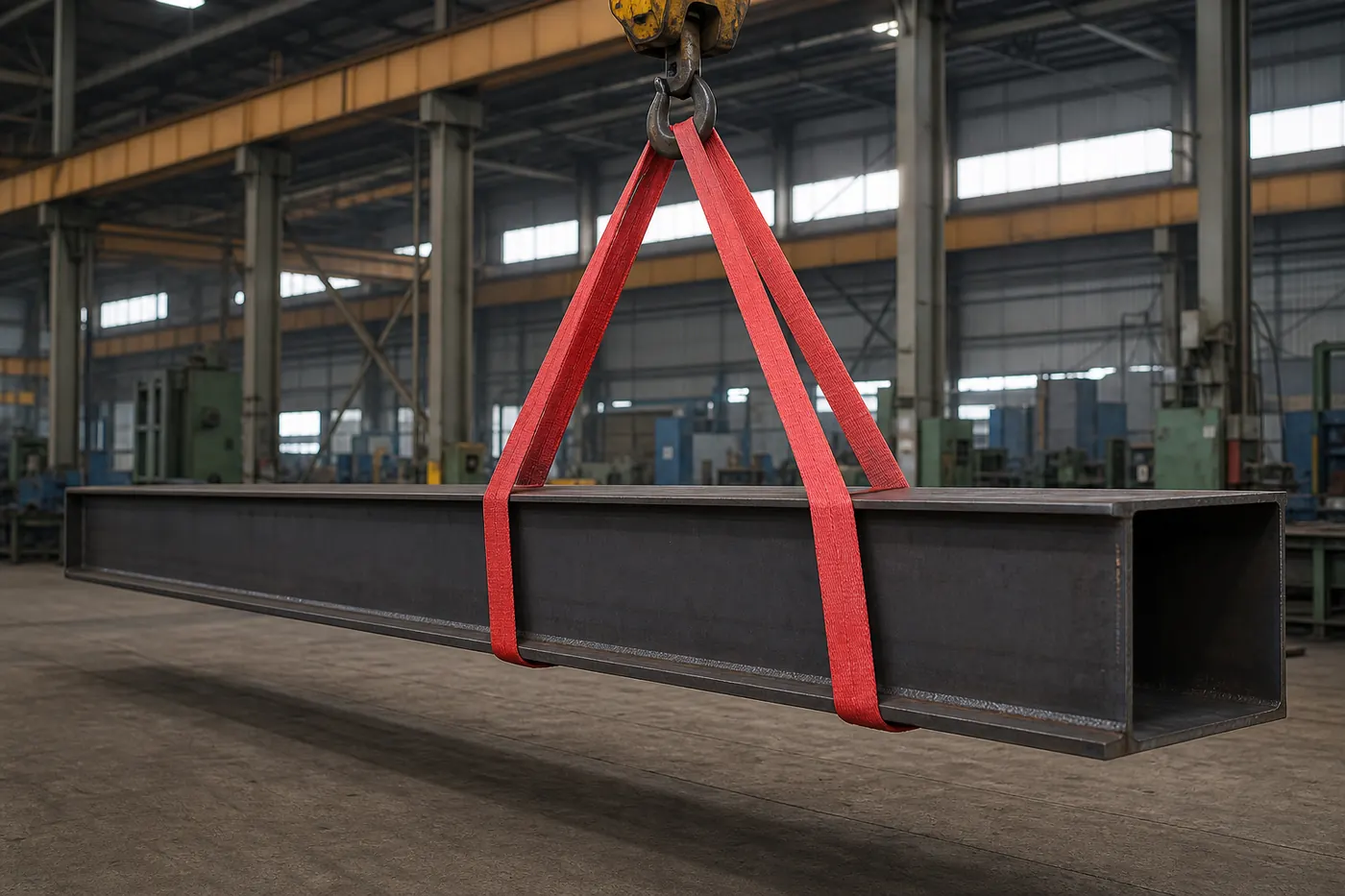
The label figure is the straight lift. Every other arrangement is derived from it, e e faaiti teie mau mea i te reira—eita te hoê ete e horoa i te hoê piti o te taime, faito teitei, E tuu oia e piti tuhaa o te hoê â webbing i nia i te e'a teimaha.
| Hitch | Te huru | I roto i te ohipa |
|---|---|---|
| Te faateiteiraa ti'a | 1.0 | Te hoho'a tapa'o; te loop mai te hoê U, i ni'a i te matau |
| Choked | 0.8 | E haaati te loop i te hopoi'a e e ho'i mai na roto ia'na iho — te hoê 4 t e titauhia te hoê 5 t sling |
| Te ete, avae 0-7° | 2.0 | E piti tuhaa o te hopoi'a, avae piri atu |
| Te ete, avae 7-45° | 1.4 | E maraa te hepohepo a matara ai te mau avae |
| Te ete, avae 45-60° | 1.0 | Eiaha e hau atu i te hoê faateiteiraa ti'a i teie parareraa |
| Choke Angled, 45° | 0.7 | Choked, e te mau avae e matara mai i te vertical |
| Choke Angled, 60° | 0.5 | Te faanahoraa iti roa ' ' e o te faaohipa-pinepine-hia ra |
Te faataaraa i te roaraa
Aita e hopearaa to te hoê ofa'i hope ore no te faito i rotopu i te, no reira, te faahitihia ra te reira i roto i te hoê o te na ravea e piti, e te taa ê ra na ravea e piti fatata e piti, o te tumu matau roa ' ' e ïa e tae ai te hoê sling i te roaraa hape. Te taato'araa o te perimeter ïa, i.e. the webbing in the finished sling. Effective working length is the usable height you actually get, fatata te afaraa o te poro, no te mea e tataipiti te loop ia tarenahia te reira.
| Ua faauehia te haaatiraa | Fatata. working length | Faaohiparaa matauhia |
|---|---|---|
| 2 m | 1 m | Chokes e te mau hi'opo'araa poto, rigging |
| 4 m | 2 m | Te rahi o te opuaraa rahi |
| 6 m | 3 m | Te mau ete i ni'a i te mau tumu raau e te mau hamaniraa |
| 8 m | 4 m | Te mau tuhaa roroa, te mau hu'ahu'a e te mau pipework |
| 10 m | 5 m | Te hamaniraa e te tumu raau rahi |
| 12 m | 6 m | Te faito roa roa a'e; mea roa a'e ia faaue |
The relationship is the point, not the exact figure: it depends on ply, band thickness and bend radius. State which convention your number is in, or simply give the distance from hook to load and we will size the loop to it.
Mata e mata aita e hope?
| Atiʻi | Te huru hope ore | Mata e mata |
|---|---|---|
| Te hopea | None — one continuous loop | Two flat eyes, hoê i te hopea tata'itahi |
| Raʻa | Not fixed; can be doubled or taken up by another turn | Fixed between two pick-up points |
| Wear points | None fixed — the whole loop rotates | The same two bearing points and eyes |
| Te oraraa taviniraa | Roa a'e, because wear and the joint move around the loop | Condemned when the fixed points wear out |
| Mea maitai roa a'e | Te mau faateitei Choked, Te mau hu'ahu'a, general yard and site work | Lifts with defined, repeated pick-up points |
Most sites carry both. Mai te mea e, e ti'a i te faahitiraa parau no ni'a i te rave'a ia faaite i te vahi e piri ai te ofa'i, te te mata e te mata te faataa ra i te reira; mai te mea e, e faaohipa te mau ihitai i te mau mea atoa i mua ia ratou, o te huru hope ore te tumu parau rahi a'e.
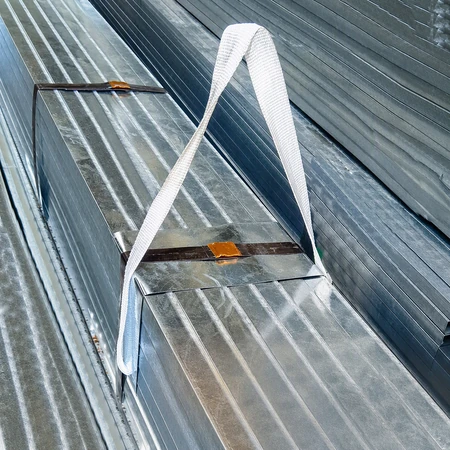
Te faatereraa, Te hi'opo'araa e te peu o te tauiraa
E mea ohie a'e ia hi'opoa i te hoê ofa'i hope ore i te hoê ofa'i porotiti, no te mea ho'i e, te e'a hopoia, o te webbing ïa, e te vai ra te mau mea atoa ta outou e hinaaro e hi'o i ni'a i te fenua. A rave i te reira i roto i teie faanahoraa.
- Te amuiraa matamua — te mau anairaa tuitui atoa, te taahiraa avae i te hopea tata'itahi, and whether the two layers still lie flat and parallel. Ta'ape'ape'a, Te faahapa nei te mau tuituiraa mǎrû aore ra te mau hu'ahu'a i te sling.
- Te mau vahi i reira te pŭpŭ e tapo'i ai i te mau hopoi'a — te mau tapa'o, te vavahiraa, te hi'o, te hoê hiti.
- Te vahi farereiraa matau, i reira te taura e parahi ai i roto i te farii matau e e pe'ape'a ai ia'na iho.
- Te taatoaraa o te pǔpǔ — E amo te hoê pǔpǔ taataahi i te hopoia na roto i to ' na rahi taatoa, no reira, e mea faufaa roa te hoê taparahiraa i te mau vahi atoa.
- Heat and chemical damage — shiny, stiff or discoloured fibre means it has met heat, mârôraa, acid or solvent.
A taui ei politita, eiaha mai te haamaitairaa: turn the loop after every lift so the bearing point, E tere noa te vahi matau e te amuiraa. Keep the band flat and untwisted — a flat sling twisted into a rope concentrates the load on one edge and loses the contact area that is its whole advantage. Protect the band at edges and keep it within -40 °C e tae atu +100 °C, away from weld spatter.
Te mau faaohiparaa
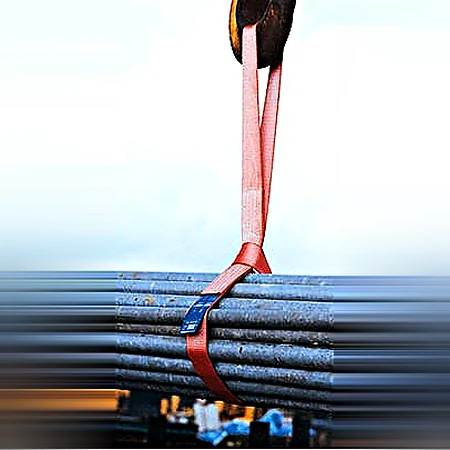
- Choked lifts on structural steel, te mau pou e te mau tao'a hamanihia
- Basket lifts on plant, te mau matini, skids, te mau pohe e te mau hu'ahu'a
- Te mau hu'ahu'a o te tube, pipe e te mau tuhaa, ua tapo'ihia e aore râ, ua tapo'ihia
- Precast concrete units where a flat, broad bearing is wanted
- Te mau afata, Te mau tao'a tahi e te mau tao'a i roto i te afata; general yard and depot work
- Cold stores and cold-climate work down to -40 °C; wet conditions where a rust-free sling is wanted
For hot loads or sharp, unpadded edges the polyester build is the wrong choice — see the te anuvera teitei or a wire rope sling instead.
Te mau uiraa ui-pinepine-hia
What is an endless type webbing sling?
I raro a'e i te EN 1492-1 o te hoê ïa huru hope ore Te hoê ahu tapo'i arapoa: a length of webbing whose two ends are lapped back over one another and stitched to close the loop. One continuous band, no eyes to hook, no fittings to lose, one joint built to carry the rated load.
Is it really seamless?
aita. Eita te reira e hope, but there is one made connection — the lapped and stitched joint — and it is the first thing to inspect. If you need no joint at all in the load-bearing element, that is an endless round sling.
Ehia rahiraa moni ta ' na e nehenehe e huti i roto i te hoê choke aore ra te hoê ete?
The label gives the straight lift. E arata'i te hoê choke i te 0.8, a basket at a narrow angle to 2.0, then 1.4 between 7 e 45 te mau ti'araa e 1.0 between 45 e 60. Ua iti mai te hoê choke angled, a 0.7 i 45 te mau ti'araa e 0.5 i 60. Confirm the hitch and the angle before the lift.
Ply hoê aore ra ply piti?
Double ply gives more capacity at the same width and better resistance to cutting and abrasion; single ply is lighter and more flexible for general duty. Pick by the WLL you need and the working conditions, not by layer count alone.
Eaha te roa e ti'a ia'u ia faaue?
Say which convention your figure is in — circumference or effective working length; they differ by about a factor of two. If you know how far the hook will be from the load, send that instead and we will size the loop to it.
Does the colour tell me everything?
aita. The webbing colour certifies the WLL band in straight lift only. The stripes give the tonne figure, and the label colour separately tells you the fibre: blue polyester, green polyamide, polypropylene re'are'a.
A ani i te hoê parau faahiti
A tono i te hopoi'a e to'na hoho'a, te hitch ta outou e hinaaro e faaohipa, e porohita anei to outou roaraa aore ra e roaraa ohipa, te hu'ahu'a, e te matete faito e te vahi e haerehia. Te haapapu nei matou i te pŭpŭ, ply, hohoa, Raʻa, te tapa'oraa e te hi'opo'araa i te mau papa'iraa hou a tâpûhia'i te webbing — 1 t 24 t, ply hoê aore ra e piti, 7:1 e piti ONE 1492-1 ei faito.
A tono i ta outou mau haamaramaramaraa no te hoê parau faahiti hope ore
Te niuniu / WeChat: +86 180 6600 2268 | Imera: 702461526@qq.com
Tuʻaʻana: Te vahi faaapu no Lifute, Te oire no Taizhou, Mataeinaa no Jiangsu, Te fenua Taina