 702461526


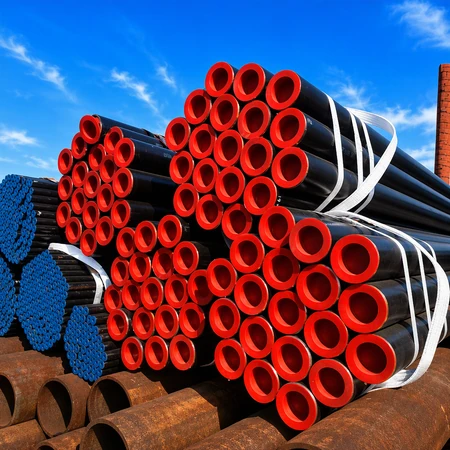


Lift sling rigging company Manufacture Steel Pipe Lifting Strap,Pipe Lifting Sling,Pipe Lifting Belt.
Steel Pipe Lifting Strap
Flat Woven Webbing Straps for Steel Pipe, Tube and Pipe Bundles — Wide Bands, Protective Sleeves, EN 1492-1
A pipe is the most awkward load a flat webbing strap is asked to carry, and it is awkward for reasons of arithmetic rather than strength. It is round, so a band around it can slip or let the pipe roll inside its own wrap. It is long, so it has to be picked at two positions, and the pipe’s own length decides where those positions go. And it is often coated, so the bearing point is not just a place where force is transferred — it is a place where a coating can be marked and a consignment rejected. A steel pipe lifting strap is a flat woven webbing strap built around those three facts: a wide band to spread the load over more of the pipe’s surface, close to the right length so the wrap is snug rather than loose, and a separate protective sleeve at the bearing point that takes the abrasion and the contact instead of the load-bearing webbing.
- Wide band, low surface pressure — the reason a pipe strap is wider than a general sling of the same capacity
- Snug wrap, not a loose one — a loose wrap on a round load is a load that can shift on the way up
- Replaceable protective sleeve — the sacrifical layer sits between the webbing and the pipe
- Two eyes or endless — the same strap configured the way your rigging needs


Key Features
Wide Band to Spread the Load
Surface pressure is force divided by contact area. A wider band takes the same load over more of the pipe, which is what stops a coating being crushed at the pick point.
Holds the Pipe as well as Carrying It
On a round load the band does two jobs: it carries the pipe’s mass downwards and it holds the pipe inwards so it cannot roll out of its own wrap.
Replaceable Protective Sleeve
A separate sleeve slides to the bearing point and takes the abrasion and the edge contact. When it is worn, it is replaced — not the strap.
Soft on the Coating
Woven webbing will not bruise a 3LPE, FBE or painted surface the way a steel sling will, and the sleeve removes even the webbing’s own contact.
Fits a Wide Range of Diameters
One strap design serves small bore tube through to large diameter line pipe, because the wrap adjusts — only the length has to be right.
Endless or Eye and Eye
The same flat webbing is built as an endless loop for choke work, or eye and eye where a defined length and two fixed pick-up points are wanted.
Why a Pipe Needs Its Own Lifting Strap
A general purpose flat sling of the right capacity will pick a pipe up. What it will not necessarily do is pick it up safely and without damage, and there are four reasons why a strap intended for pipe is specified differently.
- A pipe rolls, and a round load can shift inside its own sling. A band that is too long for the pipe it goes round makes a loose wrap. The pipe then sits in a bag of webbing rather than being cradled by it, and on the way up it can rotate or slide inside that wrap. Getting the length close to the pipe’s circumference at the pick position is what makes the wrap grip rather than cradle.
- Two pick positions, and the pipe’s own length sets them. A pipe is a beam. Picked at one point it hinges and swings; picked at two it can be carried level, provided the two positions are placed where the pipe’s balance allows. The spacing then decides how far each band has to reach round the pipe, which decides the strap length. This is why a pipe strap is normally ordered as two straps of a stated length, not as one article.
- The pipe’s ends are usually the sharpest thing in the lift. Cut, bevelled, threaded or capped, a pipe end is a hard edge that will cut a sleeve in one lift if it is allowed to bear. Pick positions are normally set inboard of the ends for exactly this reason — but sleeves and edge protectors are the belt and braces.
- A coated pipe turns marking into a commercial risk. On 3LPE, FBE, epoxy or painted pipe, a witness mark at the pick point can be a rejection, not a cosmetic issue. That is the reason the band is wide and the sleeve is there: not to lift more, but to leave no trace.
Strap Width and Contact Pressure
This is the least understood part of specifying a pipe strap, and it is worth understanding because it decides whether the coating survives.
The force the strap applies to the pipe is concentrated at the bearing point, and the pressure at that point is the load divided by the contact area. A wider band, or a sleeve over the bearing point, increases the contact area and therefore reduces the pressure on the surface. So for a pipe the choice of width is not only about strength — it is about how much of the pipe’s surface shares the load.
| Band width | Contact footprint on the pipe | Relative surface pressure | Normally used for |
|---|---|---|---|
| Narrow, 25–50 mm | A single narrow line along the pipe | Highest | Small bore tube, light loads, bare pipe, lifting only |
| Medium, 50–100 mm | A band across the crown of the pipe | Moderate | General pipe and bundle lifting, bare or primed pipe |
| Wide, 100–150 mm | A broad band wrapping further round the pipe | Low | Coated pipe, finished pipe, large diameter, where marking matters |
| Any width plus a protective sleeve | As above, but spread again by the sleeve | Lowest | Coated pipe, pipe whose surface is a rejection criterion, sharp bearings |
Strap Configurations — Including One-Way Export Straps
| Configuration | What it is | Choose it for |
|---|---|---|
| Eye and eye pipe strap | A flat band with a folded, stitched eye at each end | Lifting a single joint at two positions; the standard pipe strap |
| Endless pipe strap | The same flat band closed into a continuous loop | Choke hitches, double wraps and bundles — and the loop can be rotated to spread wear |
| With protective sleeves | Sleeves fitted at the bearing points | Coated or finished pipe, and any pipe whose surface must not be marked |
| With reinforced eyes | Extra material and extra stitching at the eyes | Where the strap is repeatedly hooked, or the hook bowl is rough |
| With edge protectors | Loose protectors at the pipe end or any hard edge | Bevelled, threaded or capped ends, and any edge the strap could be cut on |
| One-way export pipe strap | A single-use strap, bought with the consignment and consumed with it | Export shipments where the strap travels with the pipe and is not recovered |
The one-way strap deserves a word of its own, because it is easy to misunderstand. It is a rated lifting strap that is used once — not a lifting strap made to a lower standard. The economics work because a whole consignment of pipes moves in one or two lifts and the strap goes with it: there is no return freight, no store, no inspection cycle and nobody to account for it at the far end. That is a genuine saving on an export job, and it is why we build these in packing with the consignment and mark them so that the receiver can see what they are.
Choosing the Pick Positions and the Strap Length
The pipe decides the geometry; the geometry decides the strap. Work in this order and the specification falls out.
- Find the two pick positions first. Measure them from one end of the pipe, not as a length for the whole pipe, because that is how they will be found again at the other end of the journey. Keep them inboard of any bevel, thread or cap.
- Measure the circumference at each pick position, or the outside diameter — a wrapped or coated pipe measures larger than the bare pipe it was made from.
- Add for the reach to the hook. The strap has to go round the pipe and then have enough left for the two legs to work at a sensible angle. Legs that are forced wide lose capacity; legs that are too short bring the hook down onto the load.
- Check the headroom. Long straps mean a high hook. If the crane cannot get that high, the answer is a shorter reach and a wider leg angle — which then costs capacity, and has to be allowed for in the rating.
- Decide the surface requirement last, because it does not change the geometry: band width, sleeve, and whether a witness mark on the coating is a rejection.
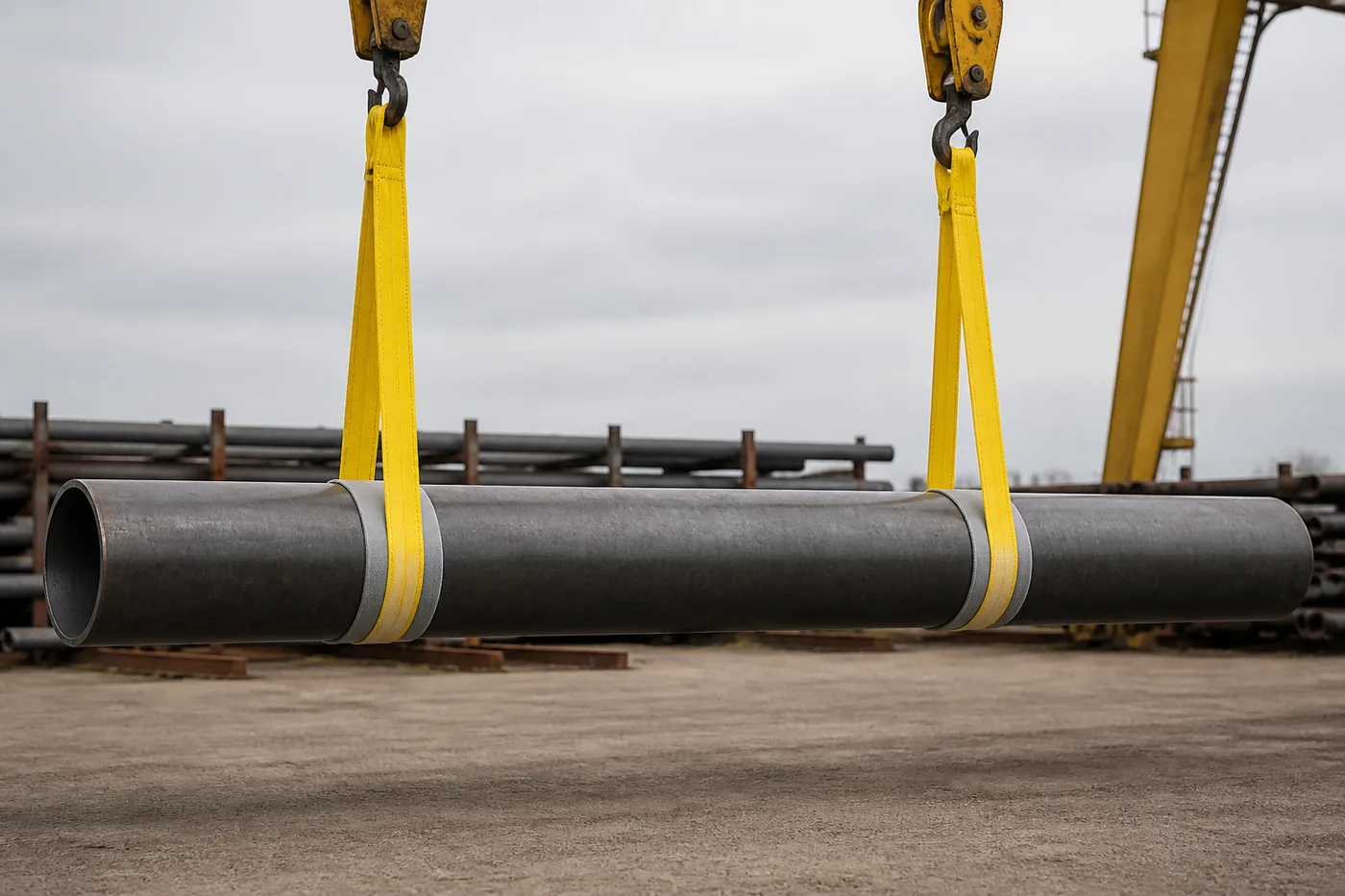
Rigging Steel Pipe — Single Joint, Bundle and Double Wrap
- A single joint. Two straps, one at each pick position, both eyes gathered onto the hook. The band wraps the pipe and holds it as well as carrying it — which is why the wrap has to be snug. The label figure applies to the vertical arrangement; confirm the leg angle before you rely on it.
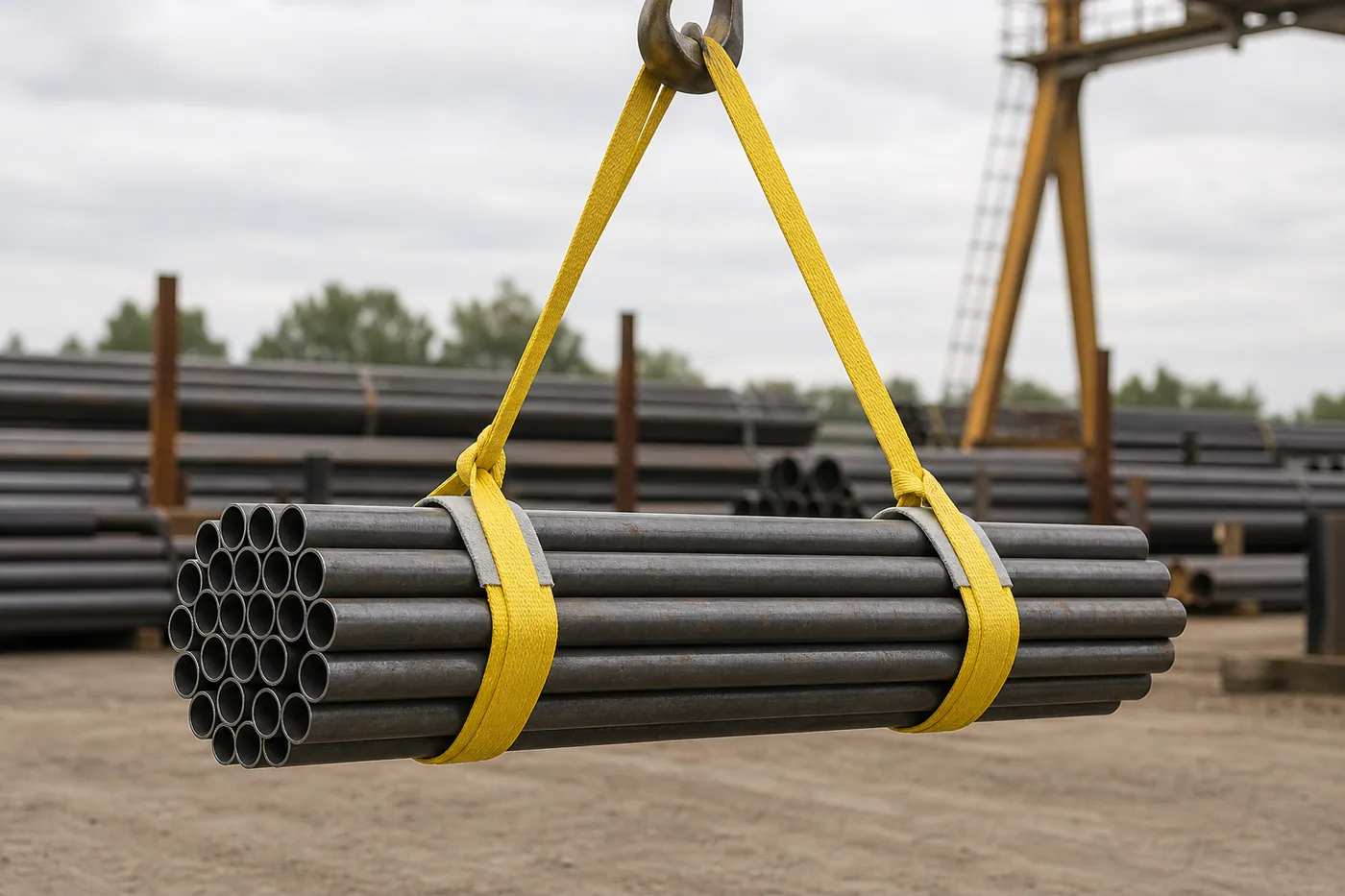
- A bundle. Two straps choked or double wrapped so the bundle is held together and cannot splay. On a bundle the outermost pipes take the bearing, so the protectors belong there, and the bundle must be banded or strapped tight first — a loose bundle inside a tight sling is still a loose bundle.
- A choke hitch. The strap passes round the pipe or bundle and back through its own eye, so it grips as it takes the weight. A choke applies a squeeze, and the capacity is reduced to 0.8 times the vertical figure.
- A double wrap. Wrapped twice before being passed through itself. Treated as two chokes, which roughly doubles the choked figure and grips a smooth or slippery pipe where a single wrap would slip. Confirm the arrangement with us before you rely on it.
- Straight basket under the pipe. Where the geometry allows, two bands running under the pipe as a basket give the softest bearing and the most surface contact — which is the combination coated pipe wants.
Whatever the arrangement, the rules that matter on pipe are these: pick at two positions, keep the wrap snug, keep the ends out of the bearing, and confirm the angle and the factor before the lift.

Working Load Limit, Width and Colour Code
Flat woven webbing slings are EN 1492-1 articles and are colour coded by capacity, so the colour of the band identifies what it can lift. The figure on the label is the vertical rating; other arrangements are derived from it by a mode factor.
| WLL (vertical) | EN 1492-1 colour | Choked (× 0.8) | Basket 0–7° (× 2.0) | Basket 7–45° (× 1.4) | Basket 45–60° (× 1.0) |
|---|---|---|---|---|---|
| 1 t | Purple | 0.8 t | 2.0 t | 1.4 t | 1.0 t |
| 2 t | Green | 1.6 t | 4.0 t | 2.8 t | 2.0 t |
| 3 t | Yellow | 2.4 t | 6.0 t | 4.2 t | 3.0 t |
| 4 t | Grey | 3.2 t | 8.0 t | 5.6 t | 4.0 t |
| 5 t | Red | 4.0 t | 10.0 t | 7.0 t | 5.0 t |
| 6 t | Brown | 4.8 t | 12.0 t | 8.4 t | 6.0 t |
| 8 t | Blue | 6.4 t | 16.0 t | 11.2 t | 8.0 t |
| 10 t | Orange | 8.0 t | 20.0 t | 14.0 t | 10.0 t |
| 12 t | Orange | 9.6 t | 24.0 t | 16.8 t | 12.0 t |
The colour code runs from 1 t to 10 t, with 12 t also orange. Above 12 t the colour no longer identifies the sling, so the working load limit on the sewn label is the figure that governs — read it, do not read the colour.
Technical Specifications
| Product name | Steel pipe lifting strap / pipe lifting sling / pipe sling / steel pipe sling / flat webbing pipe strap |
|---|---|
| Type | Flat woven webbing strap, EN 1492-1 type; eye and eye or endless |
| Webbing material | 100% high-tenacity polyester as standard; other fibres to order |
| Band width | Matched to the capacity and the surface — narrow bands for small bore and bare pipe, wide bands where the load must be spread and the pipe is coated |
| Working load limit | 1 t to 30 t as standard, in the EN 1492-1 steps; higher capacities produced to order |
| Safety factor | EN 1492-1 practice is 7:1; other factors produced to order where your market requires them |
| Length | Specified against the pipe: the two pick positions, the pipe diameter at each, and the reach to the hook. Confirm the geometry before ordering |
| Eyes | Flat folded and stitched eyes as standard; reinforced eyes optional |
| Protection | Separate protective sleeves at the bearing points, edge protectors, and reinforced eyes |
| Colour | EN 1492-1 capacity colours as standard; custom webbing colours to order |
| Marking | Sewn label and printed figures with working load limit, length and batch |
| Packing | Carton or bale; for export consignments, packed with the pipe order so the straps travel with the load |
| MOQ & OEM | Low MOQ for trial orders; full OEM — capacity, width, length, colour, sleeve, label layout and packing |
Handling, Inspection and Limitations
A pipe strap wears in two places, and both of them are predictable: the two eyes, where the hook and the stitches are, and the two bearing points, where the band wraps the steel. Inspect those four places first, then the rest of the band.
- Look at the eyes. Check the stitch rows, the fold where the webbing doubles back, and the webbing immediately behind the eye. Broken, slack or pulled stitching takes the strap out of service.
- Look at the bearing points. This is where the webbing and the sleeve meet the pipe. Check whether the sleeve has been worn through, and whether the webbing behind it has been cut, abraded or glazed.
- Run the whole band through your hands. A cut or a worn edge anywhere matters, because the load path on a flat band is the whole width.
- Look for glazing and hardening — a band that has become shiny or stiff has met heat or sustained friction, and the fibre is not what it was.
- Check for edge cuts from the pipe ends. A cut at the edge of the band is the classic pipe-end injury, and it is why the pick positions belong inboard of the ends.
- Replace the sleeve, not the strap. Worn sleeves are consumables and are supplied separately. A strap whose sleeve has done its job is a strap that worked.
- Never use a one-way strap twice. It was specified and rated for one consignment and one lift. Reusing it is using an article outside the duty it was bought for.
- Record it. Log the lifts, the pipes, the arrangements and any damage, so that a wear pattern is visible before it becomes a failure.
Applications
- Single joints of line pipe, lifted at two positions and carried level
- Bundles and packs of tube, choked or double wrapped to hold the bundle together
- Coated pipe — 3LPE, FBE, epoxy and painted — where a witness mark is a rejection
- Large diameter pipe where a wide band is needed to spread the bearing
- Small bore tube and light pipe where a narrow, quick strap is the right answer
- Export consignments, where a one-way strap travels with the load and is consumed with it
- Yards, quays, mills and coating plants where pipes are moved repeatedly
Customisation and OEM Service
A pipe strap is designed around the pipe, so the enquiry is the design input. Tell us the pipe and the rigging and the strap follows.
- Capacity — 1 t to 30 t as standard, higher on request
- Width — matched to your surface requirement, from narrow bands to wide coated-pipe bands
- Length — specified against your two pick positions and your headroom
- Configuration — eye and eye or endless; with or without sleeves, pads and reinforced eyes
- Webbing colour — the EN 1492-1 capacity colours, or your own for identification on site
- Marking — your label layout, language, length and working load limit figures
- Related items — matching round slings where a round section suits the lift better, and the supporting straps that bear a pipe at rest
Quality Control
Every length of webbing is checked for weave, width and colour before it is cut; every eye is checked on its fold and its stitch rows; and every finished strap is checked on its length, its working load limit marking, its protection and its label before packing. We have manufactured slings, webbing and rope products for industrial, safety and export customers for close to three decades, and we keep the process visible: on request we supply the webbing certificate, the batch test figures and a sample strap for you to handle and test before volume production begins.
Frequently Asked Questions
What is a steel pipe lifting strap?
A flat woven webbing strap configured for lifting steel pipe and tube. It is the same family as any flat webbing sling — polyester webbing, folded and stitched eyes, EN 1492-1 colour coded — but specified around the pipe: a band wide enough to spread the bearing over more of the pipe’s surface, a length close enough to the pipe’s circumference at the pick position to make the wrap snug rather than loose, and usually a separate protective sleeve at the bearing point.
Why not just use a normal flat webbing sling on a pipe?
You can, if the capacity is right and the surface does not matter. What a general sling will not necessarily do is protect the pipe. A pipe is round, so a band that is too long makes a loose wrap and the pipe can shift inside it on the way up. The pipe’s ends are usually the sharpest thing in the lift. And on coated pipe a mark at the pick point can be a rejection. A pipe strap exists to deal with those three things, not to lift more.
How many straps do I need to lift a pipe?
Two, placed at two pick positions inboard of the ends, so that the pipe is carried level instead of hinging about a single point. The spacing of those two positions follows from the pipe’s length and its balance, and it is what decides the length of each strap. This is why pipe straps are normally ordered as a pair to a stated length rather than as a single article.
How do I choose the band width?
By how much surface pressure your pipe will take. Surface pressure is the load divided by the contact area, so a wider band spreads the same force over more of the pipe and reduces the pressure on it. Bare pipe and small bore tube are usually fine with a narrow band; coated, finished or large diameter pipe wants a wide band, and often a sleeve as well. Tell us the coating and the load and we will specify the width against it.
What does the protective sleeve actually protect?
The pipe, and the load-bearing webbing. It sits between the two at the bearing point: it stops the pipe’s surface being marked by the webbing’s own weave, it spreads the bearing over a wider area, and it takes the abrasion and any contact with the pipe’s end so that the webbing behind it is not damaged. It is a separate, replaceable item — when a sleeve is worn out you replace the sleeve, not the strap.
What is a one-way export pipe strap, and is it safe?
It is a rated lifting strap that is used once, bought with an export consignment and consumed with it. It is safe for the lift it is specified for — it is made and marked as lifting equipment, not downgraded. The economics work because there is no return freight and no inspection cycle, which is a genuine saving on an export job. It must not be reused.
Can I get a custom width, length, colour and sleeve?
Yes. We build from 1 t to 30 t as standard and higher on request, in the width your surface needs, at the length your two pick positions and headroom require, eye and eye or endless, with or without sleeves, pads and reinforced eyes, in the EN 1492-1 capacity colours or your own. Tell us the pipe and the rigging and we will work the specification out with you.
Request a Quote for Steel Pipe Lifting Straps
Send us the pipe — length, outside diameter, wall, coating, and where the two pick positions will sit — plus the capacity, the rigging you intend to use and any marking or certification your market requires. We will come back with a band width, a length, a sleeve, a sample and a factory-direct price.