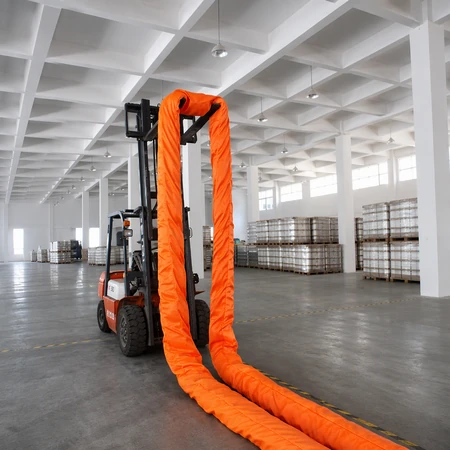
Khampani ea li-sling rigging e hlahisang Endless Round Sling.
Endless Round Sling — Closed-Loop Sling, 1-1000 t
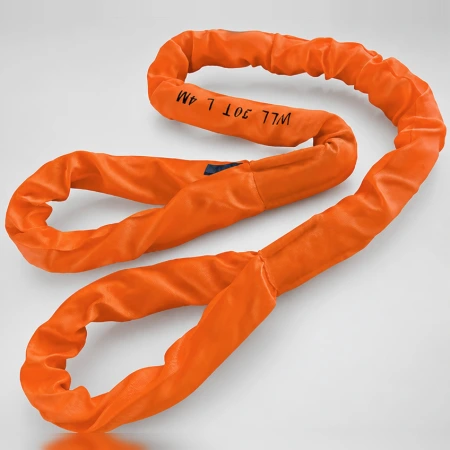
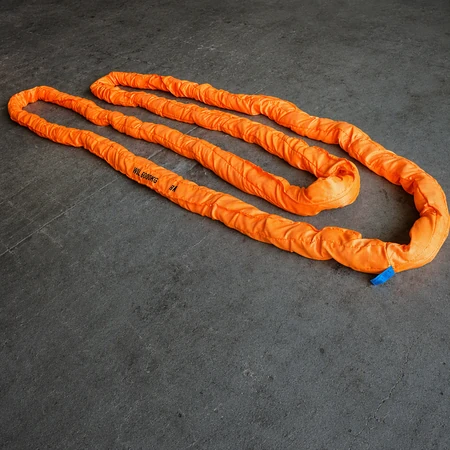
An letjeketjane le sa feleng is a closed loop: the core runs continuously inside the sleeve and is closed on itself, so there is no eye, no thimble, no hook and no stitching anywhere in the load path. It is made in high-tenacity polyester across 27 LFTEERS articles, ho tloha 1,000 kg ho 1,000,000 kg, in bodies from 0.5 m ho 80 m. Because the loop has no ends it can be turned, re-reeved and re-oriented after a lift — which is why it is the usual choice for basket and choke work on plant that must not be marked.
- Moeli oa mojaro o sebetsang1,000 kg ho 1,000,000 kg
- Lethathamo la sengoloaLFTEERS-1 to LFTEERS-1000, 27 boholo
- Litekanyo tsa 'mele15 × 50 mm ho fihlela 610 × 1,060 mm
- Bolelele0.5-80 m, effective or circumference
- Boima ba yuniti0.47 ho 226 kg/m
- Ha ho tšepeNothing on the sling touches the load
What “endless” changes for the rigger
Endless describes the construction of the loop, not the length of the article. Nothing is spliced, sewn or fitted into the load path, and four things follow on site.
- The loop has no direction. Both halves are the same article, so the sling can be turned end for end and re-reeved after a lift. In a basket the two legs are identical, which is not true of a sling with an eye at one end and a fitting at the other.
- Wear can be spread. The contact point moves as the sling is rotated along the loop, so the sleeve is not destroyed in one place while the rest of the body is new.
- There is nothing to mismatch. No eye has to be offered to a hook of the right shape, and no fitting has to be rated with the sling. The hook goes through the loop, or the loop goes round the load.
- The sleeve is the whole inspection. The core cannot be opened and looked at, kahoo letsoho ke fensetere: what it shows is what the core has been through.
Endless Round Sling specifications
| Sehlahisoa | Endless round sling — closed-loop polyester round sling, 1 t ho 1000 t |
|---|---|
| Kaho | Mokotla o sa khaotseng oa filament ka har'a letsoho le lohiloeng la tubula, e koetsoeng ka sekgoqetsane se sa feleng; no metal and no stitching in the load path |
| Ea mantlha | High-tenacity polyester multifilament, parallel lay, boka; UHMWPE or aramid to order |
| Sleeve | Polyester e lohiloeng ka mokhoa o phahameng oa tenacity, maemo a lera le le leng; habeli sleeve ho laela |
| Moeli oa mojaro o sebetsang | 1,000 kg ho 1,000,000 kg, leoto le le leng le otlolohileng - 27 lingoliloeng, LFTEERS-1 to LFTEERS-1000 |
| Mojaro o robehang | 7 × working load limit |
| Tšireletseho ntlha | 7:1 joalo ka maemo; 5:1 to order for markets working to ASME B30.9 |
| Elongation ho WLL | Approximately 2–3 % |
| Mocheso oa tšebeletso | −40 °C ho ea +100 °C, polyester mantlha |
| Bolelele | 0.5 m ho 80 m; minimum rises with the article, maximum is 80 m in every size |
| Mmala | Stock orange kapa blue; IN 1492-2 capacity colour applied when the order asks for the standard code |
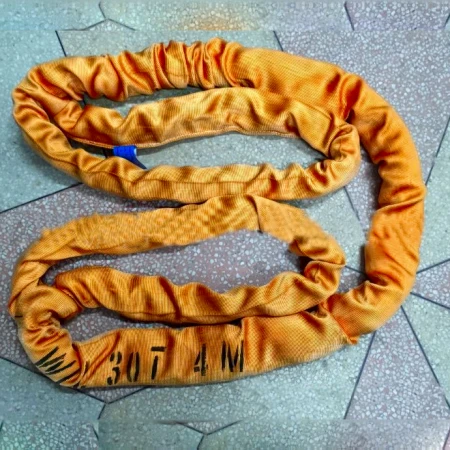
| Ho tshwaya | Working load limit and length printed on the sleeve; sewn label e nang le WLL, bolelele, nomoro ea serial le standard |
| Teko | Bopaki bo kentsoeng pele bo romelloa; rekoto ea teko e tsamaellanang le nomoro ea serial |
| Ho paka | E phuthetsoe ka mokotleng oa poly, lebokose le ngotsoeng; phalete kapa kreiti ka kopo |
| HS khoutu | 630790 - ho phahamisa li-slings tsa thepa ea masela |
| MOQ / OEM | MOQ e tlase bakeng sa taelo ea teko; OEM ka bolelele, mmala wa sleeve, fiber ea mantlha, sebopeho sa leibole le ho paka |
Lethathamo la sengoloa: khetha mohlala
The article number carries the capacity — LFTEERS-10 is the 10,000 kg lesela, LFTEERS-100 the 100,000 kg ngoe. Botenya le bophara bo hlalosa 'mele, the two length columns give the shortest and longest body made in that article, and the unit weight is what you add to the crane load.
| Art.No. | SEBELE (kg) | SEBELE (t) | Botenya (mm) | Bophara (mm) | Min (m) | Max (m) | Boima ba 'mele (kg/m) |
|---|---|---|---|---|---|---|---|
| LFTEERS-1 | 1,000 | 1 | 15 | 50 | 0.5 | 80 | 0.47 |
| LFTEERS-2 | 2,000 | 2 | 16 | 60 | 0.5 | 80 | 0.60 |
| LFTEERS-3 | 3,000 | 3 | 18 | 70 | 0.5 | 80 | 0.82 |
| LFTEERS-4 | 4,000 | 4 | 20 | 75 | 0.5 | 80 | 1.20 |
| LFTEERS-5 | 5,000 | 5 | 25 | 80 | 0.5 | 80 | 1.47 |
| LFTEERS-6 | 6,000 | 6 | 27 | 90 | 1.0 | 80 | 1.70 |
| LFTEERS-8 | 8,000 | 8 | 28 | 100 | 1.0 | 80 | 2.20 |
| LFTEERS-10 | 10,000 | 10 | 29 | 110 | 2.0 | 80 | 3.00 |
| LFTEERS-12 | 12,000 | 12 | 30 | 125 | 2.0 | 80 | 3.40 |
| LFTEERS-15 | 15,000 | 15 | 31 | 150 | 2.0 | 80 | 4.00 |
| LFTEERS-20 | 20,000 | 20 | 32 | 180 | 2.5 | 80 | 5.60 |
| LFTEERS-25 | 25,000 | 25 | 34 | 200 | 2.5 | 80 | 6.80 |
| LFTEERS-30 | 30,000 | 30 | 68 | 220 | 2.5 | 80 | 8.20 |
| LFTEERS-40 | 40,000 | 40 | 75 | 250 | 2.5 | 80 | 10.9 |
| LFTEERS-50 | 50,000 | 50 | 86 | 270 | 2.5 | 80 | 13.8 |
| LFTEERS-60 | 60,000 | 60 | 126 | 280 | 4.0 | 80 | 16.6 |
| LFTEERS-80 | 80,000 | 80 | 138 | 300 | 4.0 | 80 | 22.0 |
| LFTEERS-100 | 100,000 | 100 | 152 | 320 | 4.0 | 80 | 27.0 |
| LFTEERS-200 | 200,000 | 200 | 230 | 460 | 5.0 | 80 | 66.0 |
| LFTEERS-300 | 300,000 | 300 | 310 | 535 | 5.0 | 80 | 82.0 |
| LFTEERS-400 | 400,000 | 400 | 380 | 680 | 5.0 | 80 | 98.0 |
| LFTEERS-500 | 500,000 | 500 | 410 | 760 | 8.0 | 80 | 116.0 |
| LFTEERS-600 | 600,000 | 600 | 460 | 830 | 8.0 | 80 | 139.0 |
| LFTEERS-700 | 700,000 | 700 | 498 | 880 | 8.0 | 80 | 155.0 |
| LFTEERS-800 | 800,000 | 800 | 520 | 940 | 9.0 | 80 | 178.0 |
| LFTEERS-900 | 900,000 | 900 | 580 | 1,000 | 9.0 | 80 | 202.0 |
| LFTEERS-1000 | 1,000,000 | 1,000 | 610 | 1,060 | 9.0 | 80 | 226.0 |
The series code is shown as supplied on the factory sheet. In that sheet the 20,000 kg article carries the code LFTEERS-15 for a second time; it is shown here as LFTEERS-20 so that the code matches the capacity ladder. Thickness and width are the body dimensions specified for the article, and the minimum length is the shortest body that can be closed and sleeved at that capacity. If your price list uses a different prefix, replace it across the table — the rest of the code is the capacity.
Capacity changes with the hitch, not with the tonnage on the sleeve
The figure printed on the sleeve is the working load limit of one leg hanging vertically. It is the number the sling is proof loaded against, and the starting point of a lifting plan — not the tonnage it will pick up in the arrangement you are actually using. Apply the factor for the hitch, and remember that a set of legs is calculated on fewer legs than it has, hobane mojaro oa 'nete ha o lule ka mokhoa o phethahetseng.
| Tokisetso | Ntlha | 5 t tjeka | 20 t tjeka |
|---|---|---|---|
| Lesela le le leng, e otlolohileng | × 1.0 | 5.0 t | 20.0 t |
| Lesela le le leng, khangoa | × 0.8 | 4.0 t | 16.0 t |
| Lesela le le leng, basket 0–7° | × 2.0 | 10.0 t | 40.0 t |
| Lesela le le leng, basket 7–45° | × 1.4 | 7.0 t | 28.0 t |
| Lesela le le leng, basket 45–60° | × 1.0 | 5.0 t | 20.0 t |
| Maoto a mabeli, 0-45° ho tloha ho tse otlolohileng | × 1.4 | 7.0 t | 28.0 t |
| Maoto a mabeli, 45-60 ° ho tloha holimo | × 1.0 | 5.0 t | 20.0 t |
| Maoto a mane, 0-45° ho tloha ho tse otlolohileng | × 2.1 | 10.5 t | 42.0 t |
| Maoto a mane, 45-60 ° ho tloha holimo | × 1.5 | 7.5 t | 30.0 t |
Two lines in that table settle most orders. Ea pele, tse peli 5 t slings ha e etse a 10 t beha: at 0–45° from vertical they carry 7 t together, and past 45° they carry 5 t. Ea bobeli, a four-leg set is worked on three legs, which is why the factor is 2.1 and not 2.8. Where the capacity is close to the limit, the honest answer is usually a phahamiso rather than a bigger sling — keeping the legs vertical recovers the factor that an open leg angle has just spent.
Bolelele: bolelele kapa sedikadikwe se sebetsang
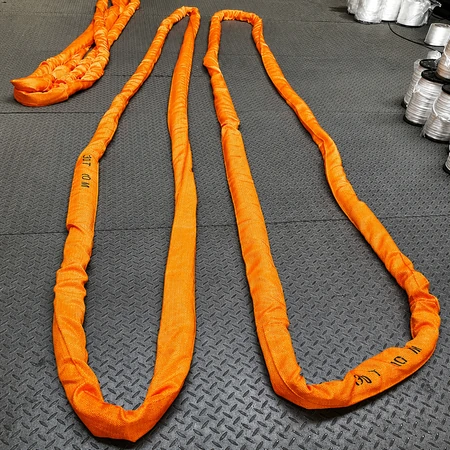
Lejoe le sa feleng ha le fele, kahoo bolelele ba eona bo ka qotsoa ka litsela tse peli, a factor of two apart. This is the most common ordering error on a round sling and the most expensive to correct, because the sling has to be remade rather than adjusted.
| E qotsitsoe joalo ka | Seo u se amohelang | E sebelisoa bakeng sa | Mohlala |
|---|---|---|---|
| Bolelele bo sebetsang bo sebetsang | Halofo ea circumference - hoka ho theosa le mojaro le ho kgutlela morao | Lilifi tse otlolohileng le tse khangoang, moo bophahamo bo leketlileng bo tsejoang | 4 m EWL = 8 m loop |
| Potoloho | Bolelele bo felletseng ba loop | Libaskete li phahamisa, moo girth ea mojaro e tsamaisang bolelele | 8 m loop = 4 m EWL |
On the slings we supply the figure printed on the sleeve is the bolelele bo sebetsang, kahoo mongolo le mantsoe a qotsitsoeng lia lumellana kamehla. Bakeng sa baskete, lekanya girth ya moroalo, eketsa headroom ho hook, 'me u qotse setšoantšo seo: mmele o nka tsela e telele ho potoloha mojaro, and a sling that only just reaches forces the legs wide — the same as buying a smaller sling.
Where an endless loop earns its place
- Mabala a precast le likarolo tsa borokho picked in a basket at each end, where the sleeve protects the formed face and the chamfer.
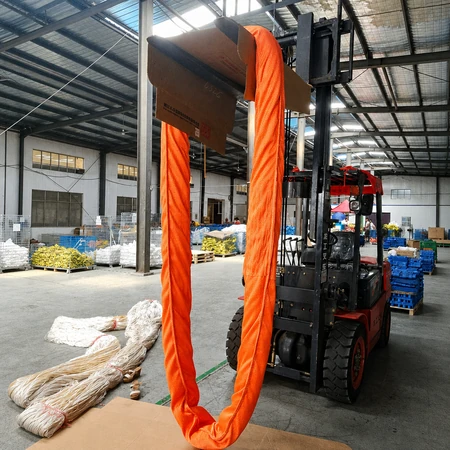
- Steel coils sitting in a basket, where the doubled body gives twice the vertical capacity and follows the curve of the coil instead of bearing on one line.
- Li-transformer, lijenereithara le libethe tsa mochini with small trunnions and painted surfaces — nothing metal touches the load.
- Hlobo le shoa whose lifting holes are drilled, ha e etsetsoe ho lekana, so a soft loop threaded through the hole is the whole method.
- Skids, liforeimi le libaskete tse lebopong la leoatle choked at each corner with 6–12 m bodies, the sleeve taking the corner abrasion so the core does not.
- Stage and studio work around truss and set pieces where a scratch is a re-spray.
E sa feleng, eye-eye or flat webbing
| Criterion | Serapa se chitja se sa feleng | Leihlo-leihlo le chitja | Flat endless webbing sling |
|---|---|---|---|
| Kopana le mojaro | Round body, conforms to curves and corners | Round body with two loaded eyes | Wide flat face, spreads pressure over an area |
| Bolelele | Set by the loop; either convention can be quoted | Fixed between the eyes | Set by the sewn loop |
| Tsela ea mojaro | Tsoelang pele, no termination | Koko e tsoelang pele, eyes formed by the sleeve | Sewn join in the loop |
| Reeving | Can be turned and re-reeved after a lift | One orientation only | Can be turned, but the join takes the wear |
| Molemo ka ho fetisisa bakeng sa | Basket and choke work, awkward plant, mmele o molelele | Repeated lifts on the same two points | Ka bophara, flat and easily marked loads |
None of the three replaces another. For a fixed length and two known pick-up points see the selikalikoe sa mahlo-mahlo; for a wide face and a visible load path see the sa feleng bataletseng webbing letjeketjane. Both round sling forms are built from the same core and sleeve, so the choice is a rigging decision rather than a capacity one. For hard service the letjeketjane la matsoho a mabeli adds a second wear layer at the same rating, for weight-critical work there is a UHMWPE selikalikoe se chitja mantlha, and for hot loads an aramid round sling.
Tlhahlobo le ho tlohela mosebetsi
Sekoahelo ha se bonahale, so the sleeve is the record of what the sling has been through. Hlahloba pele o sebelisoa, 'me ka mokhoa o hlophisitsoeng ka nako eo puso ea hau e e hlokang.
- Check the full length of the sleeve for cuts, snags, qhoqhoa, ho qhibiliha le litšila tsa lik'hemik'hale, and open the sleeve at the join if anything looks wrong.
- Read the print and the label. If the working load limit or the length can no longer be read, the sling cannot be verified and comes out of service.
- Ikutloe u na le grit ka hare ho sleeve; e hohola bokahare ho tloha nakong e telele ka mor'a hore jarete e fietsoe.
- Retire on any cut or hole that exposes the core, mocheso o benyang, mokokotlo o tsamaileng o satalla kapa o qhitsa, tlhaselo ea lik'hemik'hale, kapa leibole e sieo.
- Boloka e phuthetsoe le ho tloha fatše, ho tsoa motshehare le hole le mocheso, solvents le weld spatter. Never store a sling wet in a closed bag.
- Le ka mohla u se ke ua hula letjeketjane le laetseng ka thoko, and never lift on a damaged sleeve.
Lipotso tse botsoang khafetsa
What is the difference between an endless round sling and a round sling with eyes?
An endless round sling is a closed loop with no termination: the core runs continuously inside the sleeve and nothing is spliced or sewn into the load path. A letjeketjane le nang le mahlo has two defined eyes at a fixed distance, so its length is set by the eyes and it works in one orientation.
Is the length the circumference or the effective length?
Both are used and they differ by a factor of two. Effective length is half the loop — hook down to the load and back up. Circumference is the full loop. A 4 m e sebetsang bolelele ke an 8 m loop, so the convention has to be stated on the order.
How much capacity is lost in a choker?
A choked endless round sling is rated at 0.8 of its vertical working load limit, joalo a 5 t sling e fana 4 t. A basket raises the figure to 2.0 at 0–7°, 1.4 at 7–45° and 1.0 at 45–60°. A four-leg set is calculated on three legs, giving 2.1 at 0–45° from vertical and 1.5 at 45–60°.
What does LFTEERS-10 mean?
Nomoro ea sengoloa ke moeli oa mojaro o sebetsang ka lithane: LFTEERS-10 is 10,000 kg e otlolohileng, LFTEERS-100 is 100,000 kg and LFTEERS-1000 is 1,000,000 kg. Lethathamo le latela 1-2-3-4-5-6-8-10-12-15-20-25-30-40-50-60-80-100-200-300-400-500-600-700-800-900-1000 lere, so there is no 7 t, 9 t kapa 11 t sehlooho.
How heavy is a long endless sling?
The last column of the article table is the weight per metre: 0.47 kg/m at LFTEERS-1, 3.00 kg/m at LFTEERS-10 and 226 kg/m at LFTEERS-1000. Multiply by the loop length and add the label and packing to get the figure to put against the crane. Where that number is a problem, a UHMWPE core gives the same capacity at a fraction of the weight.
Can the same sling be used in a basket and a choke?
Ee, and that is one of the reasons for the endless form: the same article goes round the load either way. What changes is the working figure, so the rating has to be recalculated for the hitch actually used.
How is the sling tested and documented?
Each sling is proof loaded before dispatch and the test record is matched to the serial number on the sewn label. Breaking load is 7 × the working load limit, and the factor can be varied to order where the market requires it.
Request an endless round sling quotation
Romela mojaro ka leoto, the hitch and the leg angle, the distance between pick-up points and the headroom to the hook — plus the length convention and any marking or documentation your site requires. Re tla netefatsa bokhoni, bolelele le letsoho, le qotsa feme-direct ka setšoantšo, a proof-load record and a sample. Bona the full round sling range for the rest of the series.
Fumana quote le sampole ea mahala