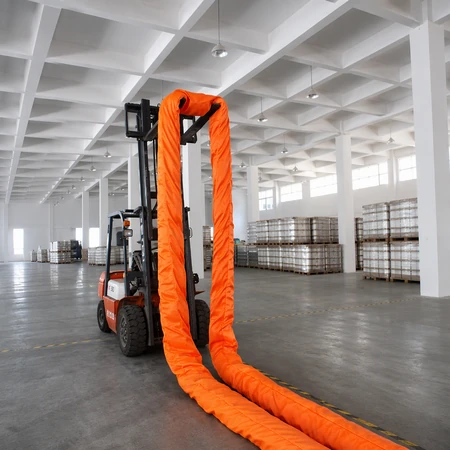
Shirkadda Lift Sling Rigging waxay soo saartaa wareegyada wareega ee aan dhamaadka lahayn.
Endless Round Sling — Closed-Loop Sling, 1-1000 t
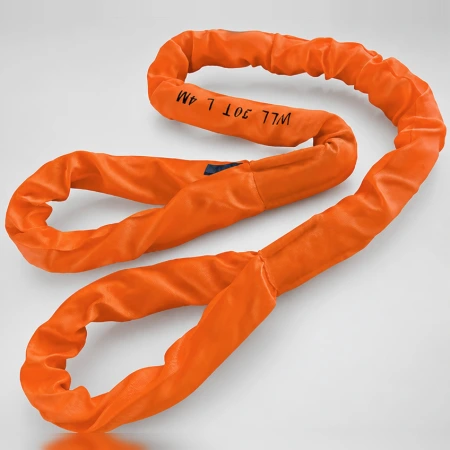
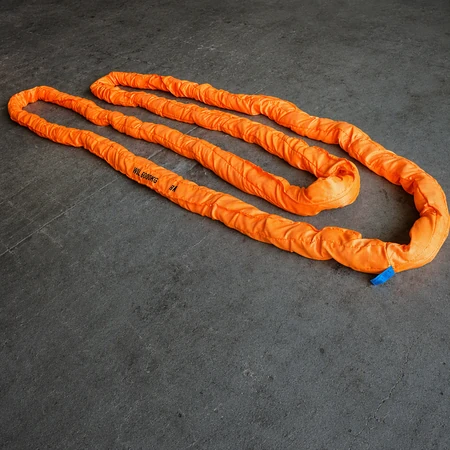
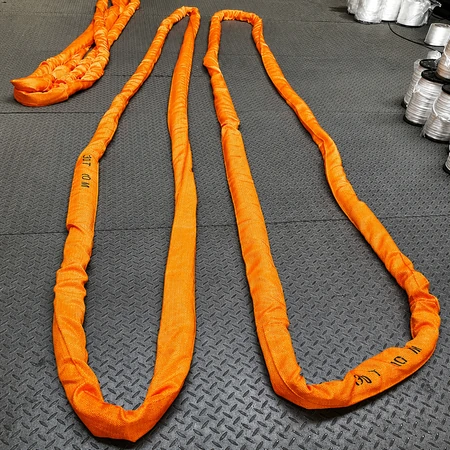
An dharbaaxo wareeg ah oo aan dhammaad lahayn is a closed loop: the core runs continuously inside the sleeve and is closed on itself, so there is no eye, no thimble, no hook and no stitching anywhere in the load path. It is made in high-tenacity polyester across 27 LFTEERS articles, ka 1,000 kg ku 1,000,000 kg, in bodies from 0.5 m ku 80 m. Because the loop has no ends it can be turned, re-reeved and re-oriented after a lift — which is why it is the usual choice for basket and choke work on plant that must not be marked.
- Xadka culeyska shaqada1,000 kg ku 1,000,000 kg
- Maqaalka kala duwanLFTEERS-1 to LFTEERS-1000, 27 cabbirrada
- Cabirka jirka15 × 50 mm ilaa 610 × 1,060 mm
- Dhererka0.5-80 m, effective or circumference
- Miisaanka halbeegga0.47 ku 226 kg/m
- Bir la'aanNothing on the sling touches the load
What “endless” changes for the rigger
Endless describes the construction of the loop, not the length of the article. Nothing is spliced, sewn or fitted into the load path, and four things follow on site.
- The loop has no direction. Both halves are the same article, so the sling can be turned end for end and re-reeved after a lift. In a basket the two legs are identical, which is not true of a sling with an eye at one end and a fitting at the other.
- Wear can be spread. The contact point moves as the sling is rotated along the loop, so the sleeve is not destroyed in one place while the rest of the body is new.
- There is nothing to mismatch. No eye has to be offered to a hook of the right shape, and no fitting has to be rated with the sling. The hook goes through the loop, or the loop goes round the load.
- The sleeve is the whole inspection. The core cannot be opened and looked at, so the sleeve is the window: what it shows is what the core has been through.
Endless Round Sling specifications
| Alaabta | Endless round sling — closed-loop polyester round sling, 1 t ku 1000 t |
|---|---|
| Dhismaha | Xudunta udub-dhexaadka ah ee is-bar-bar yaaca ee joogtada ah ee gacan-gacmeedka tuubbada tolan, xiran oo loop aan dhammaanayn; no metal and no stitching in the load path |
| Xudunta | High-tenacity polyester multifilament, is barbar dhig, wax lagu shubay; UHMWPE or aramid to order |
| Gacan | Polyester-ka tolsan ee awooda sare leh, hal lakab halbeegga; gacan laba-jibbaaran si aad u dalbato |
| Xadka culeyska shaqada | 1,000 kg ku 1,000,000 kg, hal lug oo toosan - 27 maqaallo, LFTEERS-1 to LFTEERS-1000 |
| Culayska jabinaya | 7 × working load limit |
| Qodobka badbaadada | 7:1 sida caadiga ah; 5:1 to order for markets working to ASME B30.9 |
| Kordhinta WLL | Approximately 2–3 % |
| Heerkulka adeega | -40 °C ilaa +100 °C, xuubka polyesterka |
| Dhererka | 0.5 m ku 80 m; minimum rises with the article, maximum is 80 m in every size |
| Midabka | Kaydka orange ama buluug; IN 1492-2 capacity colour applied when the order asks for the standard code |
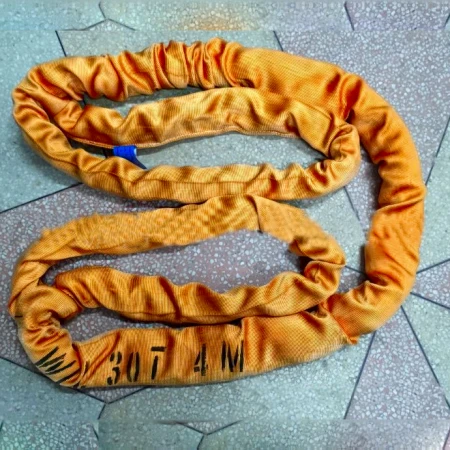
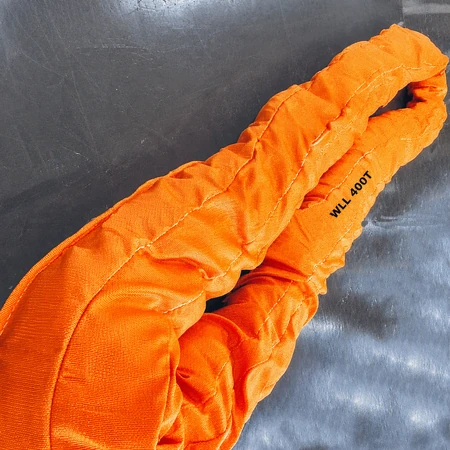
| Calaamadayn | Working load limit and length printed on the sleeve; sumad lagu tolay WLL, dhererka, lambarka taxanaha iyo heerka |
| Tijaabinta | Caddaynta la raray ka hor inta aan la dirin; rikoorka tijaabada oo la mid ah lambarka taxanaha |
| Baakad | Lagu duuduubay boorso badan, kartoon ku calaamadsan; palette ama sanduuq marka la codsado |
| HS code | 630790 - qaadista dharbaaxada alaabta dunta ah |
| MOQ / OEM | MOQ hoose ee dalabka tijaabada ah; OEM dhererka, midabka gacanta, fiber xudunta u ah, qaabka iyo xirxirida sumadda |
Maqaalka kala duwan: dooro qaabka
The article number carries the capacity — LFTEERS-10 is the 10,000 kg dharbaaxo, LFTEERS-100 the 100,000 kg mid. Dhumucda iyo ballaca ayaa tilmaamaya jirka, the two length columns give the shortest and longest body made in that article, and the unit weight is what you add to the crane load.
| Fanka.Maya. | WLL (kg) | WLL (t) | Dhumucda (mm) | Ballaca (mm) | Min (m) | Max (m) | Miisaanka (kg/m) |
|---|---|---|---|---|---|---|---|
| LFTEERS-1 | 1,000 | 1 | 15 | 50 | 0.5 | 80 | 0.47 |
| LFTEERS-2 | 2,000 | 2 | 16 | 60 | 0.5 | 80 | 0.60 |
| LFTEERS-3 | 3,000 | 3 | 18 | 70 | 0.5 | 80 | 0.82 |
| LFTEERS-4 | 4,000 | 4 | 20 | 75 | 0.5 | 80 | 1.20 |
| LFTEERS-5 | 5,000 | 5 | 25 | 80 | 0.5 | 80 | 1.47 |
| LFTEERS-6 | 6,000 | 6 | 27 | 90 | 1.0 | 80 | 1.70 |
| LFTEERS-8 | 8,000 | 8 | 28 | 100 | 1.0 | 80 | 2.20 |
| LFTEERS-10 | 10,000 | 10 | 29 | 110 | 2.0 | 80 | 3.00 |
| LFTEERS-12 | 12,000 | 12 | 30 | 125 | 2.0 | 80 | 3.40 |
| LFTEERS-15 | 15,000 | 15 | 31 | 150 | 2.0 | 80 | 4.00 |
| LFTEERS-20 | 20,000 | 20 | 32 | 180 | 2.5 | 80 | 5.60 |
| LFTEERS-25 | 25,000 | 25 | 34 | 200 | 2.5 | 80 | 6.80 |
| LFTEERS-30 | 30,000 | 30 | 68 | 220 | 2.5 | 80 | 8.20 |
| LFTEERS-40 | 40,000 | 40 | 75 | 250 | 2.5 | 80 | 10.9 |
| LFTEERS-50 | 50,000 | 50 | 86 | 270 | 2.5 | 80 | 13.8 |
| LFTEERS-60 | 60,000 | 60 | 126 | 280 | 4.0 | 80 | 16.6 |
| LFTEERS-80 | 80,000 | 80 | 138 | 300 | 4.0 | 80 | 22.0 |
| LFTEERS-100 | 100,000 | 100 | 152 | 320 | 4.0 | 80 | 27.0 |
| LFTEERS-200 | 200,000 | 200 | 230 | 460 | 5.0 | 80 | 66.0 |
| LFTEERS-300 | 300,000 | 300 | 310 | 535 | 5.0 | 80 | 82.0 |
| LFTEERS-400 | 400,000 | 400 | 380 | 680 | 5.0 | 80 | 98.0 |
| LFTEERS-500 | 500,000 | 500 | 410 | 760 | 8.0 | 80 | 116.0 |
| LFTEERS-600 | 600,000 | 600 | 460 | 830 | 8.0 | 80 | 139.0 |
| LFTEERS-700 | 700,000 | 700 | 498 | 880 | 8.0 | 80 | 155.0 |
| LFTEERS-800 | 800,000 | 800 | 520 | 940 | 9.0 | 80 | 178.0 |
| LFTEERS-900 | 900,000 | 900 | 580 | 1,000 | 9.0 | 80 | 202.0 |
| LFTEERS-1000 | 1,000,000 | 1,000 | 610 | 1,060 | 9.0 | 80 | 226.0 |
The series code is shown as supplied on the factory sheet. In that sheet the 20,000 kg article carries the code LFTEERS-15 for a second time; it is shown here as LFTEERS-20 so that the code matches the capacity ladder. Thickness and width are the body dimensions specified for the article, and the minimum length is the shortest body that can be closed and sleeved at that capacity. If your price list uses a different prefix, replace it across the table — the rest of the code is the capacity.
Capacity changes with the hitch, not with the tonnage on the sleeve
The figure printed on the sleeve is the working load limit of one leg hanging vertically. It is the number the sling is proof loaded against, and the starting point of a lifting plan — not the tonnage it will pick up in the arrangement you are actually using. Apply the factor for the hitch, and remember that a set of legs is calculated on fewer legs than it has, because a real load never sits perfectly symmetrically.
| Habaynta | Qodob | 5 t dharbaaxo | 20 t dharbaaxo |
|---|---|---|---|
| Hal dharbaax, toosan | × 1.0 | 5.0 t | 20.0 t |
| Hal dharbaax, ceejisay | × 0.8 | 4.0 t | 16.0 t |
| Hal dharbaax, basket 0–7° | × 2.0 | 10.0 t | 40.0 t |
| Hal dharbaax, basket 7–45° | × 1.4 | 7.0 t | 28.0 t |
| Hal dharbaax, basket 45–60° | × 1.0 | 5.0 t | 20.0 t |
| Laba lugood, 0-45° ka toosan | × 1.4 | 7.0 t | 28.0 t |
| Laba lugood, 45-60° ka toosan | × 1.0 | 5.0 t | 20.0 t |
| Afar lugood, 0-45° ka toosan | × 2.1 | 10.5 t | 42.0 t |
| Afar lugood, 45-60° ka toosan | × 1.5 | 7.5 t | 30.0 t |
Two lines in that table settle most orders. Marka hore, laba 5 t slings do not make a 10 t dhigay: at 0–45° from vertical they carry 7 t together, and past 45° they carry 5 t. Labaad, a four-leg set is worked on three legs, which is why the factor is 2.1 mana aha 2.8. Where the capacity is close to the limit, the honest answer is usually a kor u qaadid rather than a bigger sling — keeping the legs vertical recovers the factor that an open leg angle has just spent.
Dhererka: effective length or circumference
Dharbaaxo aan dhammaad lahayni dhammaad ma leh, markaa dhererkeeda waxaa loo soo qaadan karaa laba siyaabood, a factor of two apart. This is the most common ordering error on a round sling and the most expensive to correct, because the sling has to be remade rather than adjusted.
| Laga soo xigtay | Waxa aad hesho | loo isticmaalo | Example |
|---|---|---|---|
| Dhererka shaqada ee waxtarka leh | Half the circumference — hook down to the load and back up | Wiishash taagan oo xiiqsan, meesha lagu yaqaan dhererka laalaada | 4 m EWL = 8 m loop |
| Wareegto | Dhererka wareegga buuxa | Wiishka kolayga, halkaas oo giraanta rarka ay wado dhererka | 8 m loop = 4 m EWL |
On the slings we supply the figure printed on the sleeve is the dherer waxtar leh, so the print and the quotation always agree. Wixii dambiil ah, measure the girth of the load, ku dar qolka madaxa jillaab, and quote that figure: the body takes the long way round the load, and a sling that only just reaches forces the legs wide — the same as buying a smaller sling.
Where an endless loop earns its place
- Alwaaxdii hore loo saaray iyo qaybaha buundada picked in a basket at each end, where the sleeve protects the formed face and the chamfer.
- Gariiradaha birta ah sitting in a basket, where the doubled body gives twice the vertical capacity and follows the curve of the coil instead of bearing on one line.
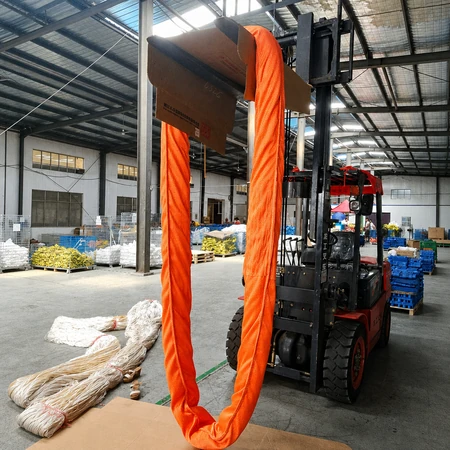
- Transformers, matoorrada iyo sariiraha mashiinka with small trunnions and painted surfaces — nothing metal touches the load.
- Caaryada oo dhinta whose lifting holes are drilled, aan loogu talagelin in lagu rakibo, so a soft loop threaded through the hole is the whole method.
- Skids, looxyada iyo dambiisha xeebaha choked at each corner with 6–12 m bodies, the sleeve taking the corner abrasion so the core does not.
- Stage and studio work around truss and set pieces where a scratch is a re-spray.
aan dhamaad lahayn, eye-eye or flat webbing
| Shuruudaha | Dharbaaxo wareeg ah oo aan dhammaad lahayn | Dharbaaxo wareeg ah oo indho-indho ah | Flat endless webbing sling |
|---|---|---|---|
| La xidhiidh rarka | Round body, conforms to curves and corners | Round body with two loaded eyes | Waji fidsan oo ballaadhan, spreads pressure over an area |
| Dhererka | Set by the loop; either convention can be quoted | Fixed between the eyes | Set by the sewn loop |
| Jidka rarka | Sii socota, no termination | Xudunta joogtada ah, eyes formed by the sleeve | Sewn join in the loop |
| Reeving | Can be turned and re-reeved after a lift | One orientation only | Can be turned, but the join takes the wear |
| ugu wanagsan | Basket iyo ceejis shaqo, awkward plant, jir dheer | Repeated lifts on the same two points | Balaadhan, flat and easily marked loads |
None of the three replaces another. For a fixed length and two known pick-up points see the eye-eye round sling; for a wide face and a visible load path see the dharbaaxo siman oo aan dhammaad lahayn. Both round sling forms are built from the same core and sleeve, so the choice is a rigging decision rather than a capacity one. For hard service the dharbaaxo wareeg ah oo gacan laba-jibbaaran ah waxay ku daraysaa lakabka labbaad ee isla qiimaynta, for weight-critical work there is a UHMWPE dharbaaxo wareeg ah xudunta u ah, and for hot loads an aramid wareeg ah.
Kormeerka iyo hawlgabka
Xuddunta lama arki karo, so the sleeve is the record of what the sling has been through. Kormeer ka hor isticmaal kasta, and formally at the interval your regime requires.
- Check the full length of the sleeve for cuts, dhuuqid, dhalaalid, melts and chemical staining, and open the sleeve at the join if anything looks wrong.
- Read the print and the label. If the working load limit or the length can no longer be read, the sling cannot be verified and comes out of service.
- Feel for grit inside the sleeve; it abrades the core from within long after the yard has been swept.
- Retire on any cut or hole that exposes the core, dhaldhalaalka kulaylka, a core that has gone stiff or lumpy, weerar kiimiko, or a missing label.
- Store coiled and off the floor, out of daylight and away from heat, solvents and weld spatter. Never store a sling wet in a closed bag.
- Waligaa gees ha u jiidin dharbaaxo rartay, and never lift on a damaged sleeve.
Su'aalaha soo noqnoqda
What is the difference between an endless round sling and a round sling with eyes?
An endless round sling is a closed loop with no termination: the core runs continuously inside the sleeve and nothing is spliced or sewn into the load path. A dharbaaxo wareegsan oo indho leh has two defined eyes at a fixed distance, so its length is set by the eyes and it works in one orientation.
Is the length the circumference or the effective length?
Both are used and they differ by a factor of two. Effective length is half the loop — hook down to the load and back up. Circumference is the full loop. A 4 m dhererka waxtarka leh waa a 8 m loop, so the convention has to be stated on the order.
How much capacity is lost in a choker?
A choked endless round sling is rated at 0.8 of its vertical working load limit, sidaas a 5 t dharbaaxo ayaa bixisa 4 t. A basket raises the figure to 2.0 at 0–7°, 1.4 at 7–45° and 1.0 at 45–60°. A four-leg set is calculated on three legs, giving 2.1 at 0–45° from vertical and 1.5 at 45–60°.
What does LFTEERS-10 mean?
Lambarka maqaalku waa xadka culeyska shaqada ee tan: LFTEERS-10 is 10,000 kg toosan, LFTEERS-100 is 100,000 kg and LFTEERS-1000 is 1,000,000 kg. Baaxadda ayaa raacda 1-2-3-4-5-6-8-10-12-15-20-25-30-40-50-60-80-100-200-300-400-500-600-700-800-900-1000 sallaanka, so there is no 7 t, 9 t ama 11 t maqaal.
How heavy is a long endless sling?
The last column of the article table is the weight per metre: 0.47 kg/m at LFTEERS-1, 3.00 kg/m at LFTEERS-10 and 226 kg/m at LFTEERS-1000. Multiply by the loop length and add the label and packing to get the figure to put against the crane. Where that number is a problem, a UHMWPE core gives the same capacity at a fraction of the weight.
Can the same sling be used in a basket and a choke?
Haa, and that is one of the reasons for the endless form: the same article goes round the load either way. What changes is the working figure, so the rating has to be recalculated for the hitch actually used.
How is the sling tested and documented?
Each sling is proof loaded before dispatch and the test record is matched to the serial number on the sewn label. Breaking load is 7 × the working load limit, and the factor can be varied to order where the market requires it.
Request an endless round sling quotation
U dir culeyska lugtiiba, the hitch and the leg angle, the distance between pick-up points and the headroom to the hook — plus the length convention and any marking or documentation your site requires. Waxaan xaqiijin doonaa awoodda, dhererka iyo gacanta, and quote factory-direct with a drawing, a proof-load record and a sample. Eeg full round sling range for the rest of the series.
Hel xigasho bilaash ah iyo muunad