 702461526


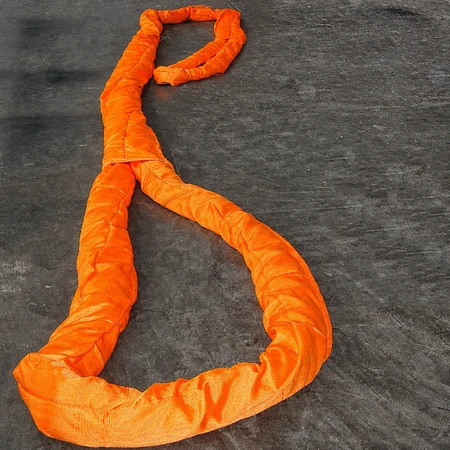

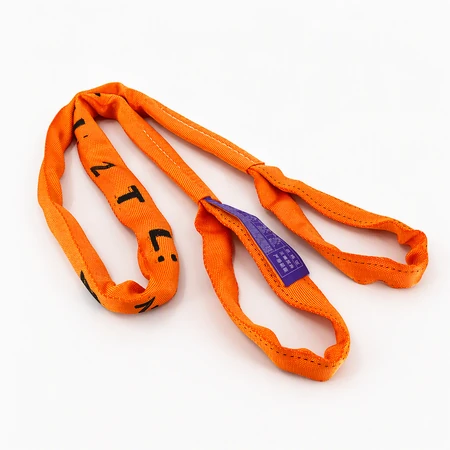
Lift sling rigging company produce Round Sling With Eyes,Round Sling With two eyes
Round Sling With Eyes
Eye and Eye Round Sling — A Defined Length and Two Defined Pick-Up Points
A round sling with eyes is the same article as any other round sling — a load-bearing core of parallel fibres inside a woven sleeve — but instead of being closed into an endless ring it is gathered and stitched at each end to form two reinforced eyes. That single change in the termination turns a sling with no ends into one with a defined length and two defined pick-up points. It hooks and shackles like a webbing sling, it can be specified to a measured distance between pick-ups, and the eye sits in the hook bowl as a formed unit instead of the sleeve bunching where it is caught. It keeps the round sling’s capacity and its sleeve-over-core protection — and it loses none of either.
- Two stitched eyes — defined pick-up points that hook and shackle cleanly
- A length you can specify — measured between the eyes, so a repeat lift repeats
- Sleeve over core — the abrasion protection and high capacity of a round sling are unchanged
- Bearing-friendly — in a basket the round body wraps the curve of a roll or a pipe


Key Features
A Fixed, Measurable Length
The distance between the two eyes can be specified, so the sling comes back the same length every time, and a repeat lift repeats exactly.
Two Defined Pick-Up Points
The eyes give you a known attachment point at each end. On an endless round sling the sleeve simply bites wherever it lands on the hook.
Hooks and Shackles Cleanly
A formed eye sits properly in a hook bowl or a shackle and stays where it is put. That makes the sling easier to rig, easier to inspect and easier to hand over between shifts.
Sleeve Over Core, Unchanged
The construction inside is identical to any round sling: a parallel core carries the load and a woven sleeve takes the abrasion. The eyes change nothing about that.
Low Stretch and High Capacity
A parallel core handles heavy loads in a slim, soft sling without the width a flat webbing sling needs at the same capacity.
Soft Against the Load
A woven sleeve conforms to the load and will not bruise a painted, machined or polished surface the way chain or wire rope does.
Round Sling With Eyes vs Endless Round Sling
These two are the same article with two different terminations, and the choice between them is the choice between a defined sling and a versatile one.
| Property | Round sling with eyes | Endless round sling |
|---|---|---|
| Ends | Two gathered, stitched eyes | None — a continuous closed ring |
| Length | Defined — measured between the eyes | Specified as the loop circumference and laid-flat length |
| Pick-up points | Two, and always in the same place | Anywhere along the loop, wherever it lands |
| Sitting on a hook | The formed eye sits in the hook bowl as a unit | The sleeve bunches and bites where it is caught |
| Rotating the wear point | Limited — the eyes stay where they are | Free — the whole loop can be turned to spread wear |
| Where the load transfers | Through the stitched eye at each end | Through the whole loop, continuously |
| Rigging | Eye-to-eye like a webbing sling; easy to hook, easy to shackle | Loop hitches — vertical, basket, choke and double wrap |
| Repetition | Ideal where the same lift is repeated with the same geometry | Better where every lift is different |
| Choose it for | Fixed-length lifting, repeat lifts, hooking and shackling, controlled length | Maximum versatility, awkward shapes, spreading wear, very large capacities |
Round Sling With Eyes vs Flat Webbing Eye and Eye Sling
Both have eyes, so the question here is the body — and the difference is exactly the difference between a round sling and a flat one.
| Property | Round sling with eyes | Flat webbing eye and eye sling |
|---|---|---|
| What carries the load | A parallel core inside a woven sleeve | The woven webbing band itself |
| Abrasion protection | The sleeve sacrifices itself before the core | Wear thins the load path directly |
| Profile | Round — bulkier on the hook | Flat — thinner, fits narrow openings |
| Stretch | Low | Moderate |
| Bearing on a round load | A basket wraps the curve | Touches along a single line |
| Inspection | Core hidden inside the sleeve | Whole load path visible |
| Same capacity in a slimmer sling | Yes — the parallel core is denser | Needs more width and more plies |
| Choose it for | High capacity, rough or curved loads, abrasion and repeated handling | Tight openings, low build-up on the hook, and lifts where the load path must be seen |
How to Specify the Length
This is the one thing that catches people out on an eye-and-eye sling, so it is worth being precise about it.
- Length is measured between the eyes — from the inside of one eye to the inside of the other, not the overall length of the sling including both eyes. A sling described as 2 m is 2 m of working length, and the eyes add to the overall measurement.
- Tell us the distance you need between your two pick-up points. That is the figure that matters. If the two points are a known distance apart on the load, that is the length to order.
- For a basket lift, remember the body takes a longer path — it runs down one side, under the load and back up the other. The sling has to be long enough to make that journey with room for the hook.
- Allow for the headroom — the eyes have to reach the hook comfortably. A sling that only just reaches forces the legs into a wide angle, which reduces the usable capacity.
- Minimum lengths apply — a wider or higher-capacity sleeve cannot be gathered into a very short eye-to-eye distance. Tell us the capacity and the length together and we will confirm what is possible.
Working Load Limit, Colour Code and Configuration
The ends change; the capacity does not. The working load limit is the same as any other round sling of the same sleeve, and the figure on the label is the vertical rating. Every other arrangement is derived from it by a mode factor.
| WLL (vertical) | EN 1492-2 colour | Choked (× 0.8) | Basket 0–7° (× 2.0) | Basket 7–45° (× 1.4) | Basket 45–60° (× 1.0) |
|---|---|---|---|---|---|
| 1 t | Purple | 0.8 t | 2.0 t | 1.4 t | 1.0 t |
| 2 t | Green | 1.6 t | 4.0 t | 2.8 t | 2.0 t |
| 3 t | Yellow | 2.4 t | 6.0 t | 4.2 t | 3.0 t |
| 4 t | Grey | 3.2 t | 8.0 t | 5.6 t | 4.0 t |
| 5 t | Red | 4.0 t | 10.0 t | 7.0 t | 5.0 t |
| 6 t | Brown | 4.8 t | 12.0 t | 8.4 t | 6.0 t |
| 8 t | Blue | 6.4 t | 16.0 t | 11.2 t | 8.0 t |
| 10 t | Orange | 8.0 t | 20.0 t | 14.0 t | 10.0 t |
| 12 t | Orange | 9.6 t | 24.0 t | 16.8 t | 12.0 t |
The colour code runs from 1 t to 10 t, with 12 t also orange. Above 12 t the colour no longer identifies the sling, so the working load limit printed on the sewn label is the figure that governs — read it, do not read the colour.
Technical Specifications
| Product name | Round sling with eyes / eye and eye round sling / eye to eye round sling / round lifting sling with eyes |
|---|---|
| Construction | Continuous parallel core inside a woven tubular sleeve, with the sleeve gathered and stitched at each end to form two reinforced eyes |
| Core material | High-tenacity polyester parallel yarn as standard; aramid and other fibres available on request |
| Sleeve material | Woven high-tenacity polyester, single or double layer; heat resistant and other sleeves to order |
| Working load limit | 1 t to 100 t, in the standard steps 1 · 2 · 3 · 4 · 5 · 6 · 8 · 10 · 12 · 15 · 20 · 25 · 30 · 40 · 50 · 100 t |
| Safety factor | EN 1492-2 practice is 7:1; other factors produced to order where your market requires them |
| Length | Specified as the eye-to-eye distance. A minimum applies and rises with the capacity; confirm the capacity and the length together |
| Eye type | Flat stitched eye as standard; reinforced eyes and wear pads optional for hard service |
| Elongation | Low stretch — a parallel polyester core elongates far less than a nylon sling of the same capacity |
| Colour | Standard sleeve colours with the EN 1492-2 capacity mark; custom sleeve colours to order |
| Marking | Sewn label with working load limit, eye-to-eye length and batch |
| Packing | Coil in a poly bag or carry bag, labelled carton, custom export packing |
| MOQ & OEM | Low MOQ for trial orders; full OEM — capacity, length, sleeve colour and fibre, eye type, label layout and packing |
Handling, Inspection and Limitations
A round sling with eyes has one inspection point that an endless round sling does not have: the stitching. On an endless sling the load transfers continuously through the loop; on this one it has to pass through two stitched terminations, so those two terminations are where the sling will fail first.
- Inspect the eyes, then the sleeve, then the whole body — in that order, every use.
- Watch for the sleeve wearing at the eye — that is where the sleeve is most compressed and where abrasion concentrates.
- Do not hook the eye on a cutting edge — a hook with a worn or sharp bowl, or a shackle with a rough pin, will chew through the eye.
- Do not rig the body over a sharp edge — the sleeve is the protection, but it is not armour. Use an edge protector.
- Do not use the eye as a choke point — the eyes are rated terminations, not a place to thread the body back through.
- Never drag a loaded sling — neither the sleeve nor the eye stitching tolerates being dragged.
- Record it — log the lifts, the loads and any damage, and retire the sling when the eyes or the sleeve tell you to.
Applications
- Repeat lifts with a fixed geometry, where the sling has to be the same length every time
- Lifts rigged eye-to-eye onto a hook, a shackle or a lifting beam
- Basket lifts under rolls, pipes, tubes and machined shafts where the round body wraps the curve
- Steel plate, sheet and coil packs where soft bearing and a slim, high-capacity sling are both wanted
- Machinery, castings and fabrications where a marked or scratched surface is not acceptable
- Work where the sling is handed between shifts and the pick-up points have to be obvious
- Any lift where an endless loop would be awkward to place but a defined eye is quick


Customisation and OEM Service
Because the length is part of the specification, an eye-and-eye sling is genuinely designed per job. Tell us the load, the distance between your pick-up points, the headroom and the environment, and we will size it to suit.
- Capacity — 1 t to 100 t, including intermediate steps between the standard sizes
- Eye-to-eye length — specified to your measurement, within the minimum for the capacity
- Eye type — flat stitched eyes as standard; reinforced eyes and wear pads for hard service
- Core and sleeve fibre — polyester as standard; aramid, UHMWPE and heat resistant sleeves available
- Marking — your label layout, language, eye-to-eye length and batch marking
- Related items — matching endless round slings, flat webbing slings and wire rope slings for the same lift
Quality Control
Every core is checked for filament count and lay before the sleeve is closed; the sleeve is checked for weave density and colour; and every finished sling is checked on its eye stitching, its eye-to-eye length, its working load limit marking and its label before packing. We have manufactured slings, webbing and rope products for industrial, safety and export customers for close to three decades, and we keep the process visible: on request we supply the fibre certificate, the batch test figures and a sample sling for you to handle and test before volume production begins.
Frequently Asked Questions
What is a round sling with eyes?
An eye-and-eye round sling: the same sleeve-over-core construction as any round sling, but gathered and stitched at each end to form two reinforced eyes instead of being closed into an endless ring. The result is a sling with a defined length and two defined pick-up points, which hooks and shackles like a webbing sling while keeping a round sling’s capacity and sleeve protection.
Should I choose a round sling with eyes or an endless round sling?
Choose eyes if you want to know how long the sling is and where it will pick up — repeat lifts, fixed geometry, clean hooking and shackling, and easy hand-over between shifts. Choose an endless loop if you want maximum versatility: it goes round anything, can be rigged in a basket, choke or double wrap, and the whole loop can be rotated to spread wear. Both are made at the same capacities from the same materials, so it is a rigging choice rather than a capacity one.
How is the length measured on an eye and eye round sling?
Between the eyes — from the inside of one eye to the inside of the other. That is the working length; the eyes themselves add to the overall measurement. Tell us the distance between your two pick-up points and we will build the sling to it, subject to the minimum length for the capacity you need.
Does it hold less than an endless round sling?
No. The working load limit is set by the sleeve and the core, and those are the same. What changes is the load path: on this sling the load passes through the two stitched eyes rather than continuously around the loop, so the eyes are the part to inspect first.
How much can it lift in a choke or a basket?
The label gives the vertical working load limit. A choke reduces it to 0.8 times that figure; a basket at a narrow angle increases it to 2 times, falling to 1.4 times between 7 and 45 degrees and to 1 times between 45 and 60 degrees. In a basket the body runs under the load, so the length and the basket angle both affect what you can pick up.
Can I get a custom length, capacity and eye type?
Yes. We build from 1 t to 100 t including intermediate steps, at the eye-to-eye length you specify, with flat stitched eyes as standard and reinforced eyes or wear pads where the sling will see hard service. Tell us the marking or certification your market requires and we will confirm what can be provided before the order.
Request a Quote for Round Slings With Eyes
Send us the capacity, the distance between your pick-up points, the arrangement you intend to rig, the headroom and the environment — plus any marking or certification your market requires. We will come back with a sleeve, a length, a sample and a factory-direct price.