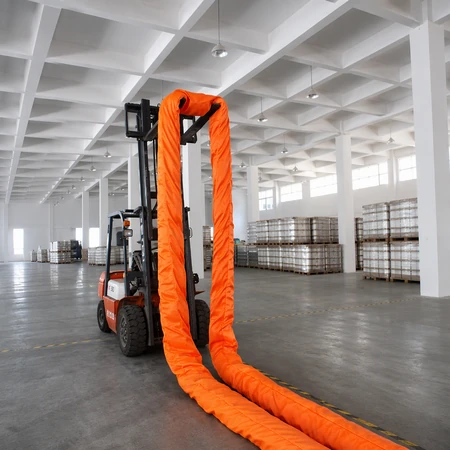
Lift sling rigging selskapet produserer Endless Round Sling.
Endless Round Sling — Closed-Loop Sling, 1–1000 t
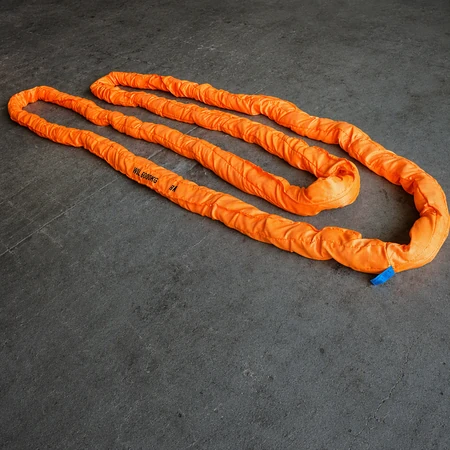
An endeløs rund slynge is a closed loop: the core runs continuously inside the sleeve and is closed on itself, so there is no eye, ingen fingerbøl, no hook and no stitching anywhere in the load path. It is made in high-tenacity polyester across 27 LFTEERS articles, fra 1,000 kg til 1,000,000 kg, in bodies from 0.5 m til 80 m. Because the loop has no ends it can be turned, re-reeved and re-oriented after a lift — which is why it is the usual choice for basket and choke work on plant that must not be marked.
- Arbeidsbelastningsgrense1,000 kg til 1,000,000 kg
- ArtikkelutvalgLFTEERS-1 to LFTEERS-1000, 27 størrelser
- Kroppsdimensjoner15 × 50 mm opp til 610 × 1,060 mm
- Lengde0.5–80 m, effective or circumference
- Enhetsvekt0.47 til 226 kg/m
- No metalNothing on the sling touches the load
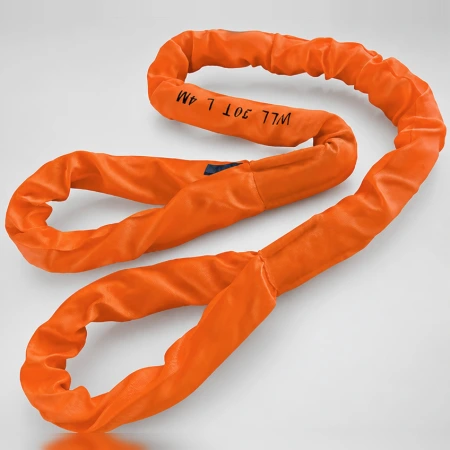
What “endless” changes for the rigger
Endless describes the construction of the loop, not the length of the article. Nothing is spliced, sewn or fitted into the load path, and four things follow on site.
- The loop has no direction. Both halves are the same article, so the sling can be turned end for end and re-reeved after a lift. In a basket the two legs are identical, which is not true of a sling with an eye at one end and a fitting at the other.
- Wear can be spread. The contact point moves as the sling is rotated along the loop, so the sleeve is not destroyed in one place while the rest of the body is new.
- There is nothing to mismatch. No eye has to be offered to a hook of the right shape, and no fitting has to be rated with the sling. The hook goes through the loop, or the loop goes round the load.
- The sleeve is the whole inspection. The core cannot be opened and looked at, så ermet er vinduet: what it shows is what the core has been through.
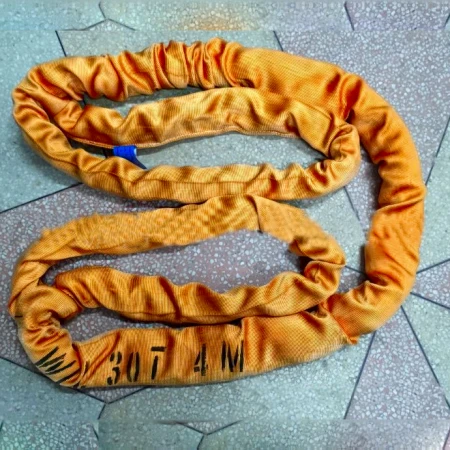
Endless Round Sling specifications
| Produkt | Endless round sling — closed-loop polyester round sling, 1 t til 1000 t |
|---|---|
| Konstruksjon | Kontinuerlig parallell filamentkjerne i en vevd rørformet hylse, lukket til en endeløs løkke; no metal and no stitching in the load path |
| Kjerne | High-tenacity polyester multifilament, parallell legging, vokset; UHMWPE or aramid to order |
| Erme | Vevd høyfast polyester, enkeltlags standard; dobbel erme på bestilling |
| Arbeidsbelastningsgrense | 1,000 kg til 1,000,000 kg, enkelt ben vertikal - 27 artikler, LFTEERS-1 to LFTEERS-1000 |
| Brudd last | 7 × working load limit |
| Sikkerhetsfaktor | 7:1 som standard; 5:1 to order for markets working to ASME B30.9 |
| Forlengelse ved WLL | Approximately 2–3 % |
| Servicetemperatur | −40 °C til +100 °C, polyester kjerne |
| Lengde | 0.5 m til 80 m; minimum rises with the article, maximum is 80 m in every size |
| Farge | Lager oransje eller blå; I 1492-2 capacity colour applied when the order asks for the standard code |
| Merking | Working load limit and length printed on the sleeve; sydd etikett med WLL, lengde, serienummer og standard |
| Testing | Bevis lastet før forsendelse; testposten samsvarer med serienummeret |
| Pakking | Kveilet i en polypose, merket kartong; pall eller kasse på forespørsel |
| HS-kode | 630790 — løftestropper av tekstilmaterialer |
| MOQ / OEM | Lav MOQ for en prøveordre; OEM på lengde, ermefarge, kjernefiber, etikettoppsett og pakking |
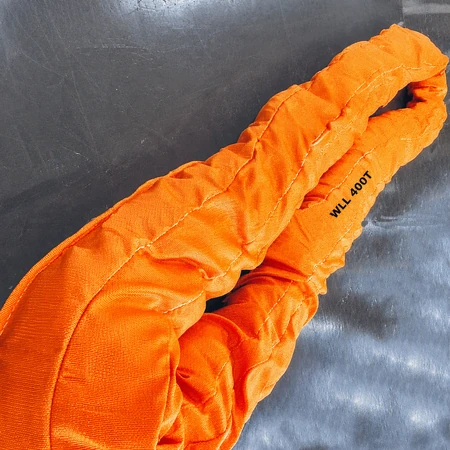
Artikkelutvalg: velg modell
The article number carries the capacity — LFTEERS-10 is the 10,000 kg slynge, LFTEERS-100 the 100,000 kg en. Tykkelse og bredde beskriver kroppen, the two length columns give the shortest and longest body made in that article, and the unit weight is what you add to the crane load.
| Art.nr. | WLL (kg) | WLL (t) | Tykkelse (mm) | Bredde (mm) | Min (m) | Maks (m) | Vekt (kg/m) |
|---|---|---|---|---|---|---|---|
| LFTEERS-1 | 1,000 | 1 | 15 | 50 | 0.5 | 80 | 0.47 |
| LFTEERS-2 | 2,000 | 2 | 16 | 60 | 0.5 | 80 | 0.60 |
| LFTEERS-3 | 3,000 | 3 | 18 | 70 | 0.5 | 80 | 0.82 |
| LFTEERS-4 | 4,000 | 4 | 20 | 75 | 0.5 | 80 | 1.20 |
| LFTEERS-5 | 5,000 | 5 | 25 | 80 | 0.5 | 80 | 1.47 |
| LFTEERS-6 | 6,000 | 6 | 27 | 90 | 1.0 | 80 | 1.70 |
| LFTEERS-8 | 8,000 | 8 | 28 | 100 | 1.0 | 80 | 2.20 |
| LFTEERS-10 | 10,000 | 10 | 29 | 110 | 2.0 | 80 | 3.00 |
| LFTEERS-12 | 12,000 | 12 | 30 | 125 | 2.0 | 80 | 3.40 |
| LFTEERS-15 | 15,000 | 15 | 31 | 150 | 2.0 | 80 | 4.00 |
| LFTEERS-20 | 20,000 | 20 | 32 | 180 | 2.5 | 80 | 5.60 |
| LFTEERS-25 | 25,000 | 25 | 34 | 200 | 2.5 | 80 | 6.80 |
| LFTEERS-30 | 30,000 | 30 | 68 | 220 | 2.5 | 80 | 8.20 |
| LFTEERS-40 | 40,000 | 40 | 75 | 250 | 2.5 | 80 | 10.9 |
| LFTEERS-50 | 50,000 | 50 | 86 | 270 | 2.5 | 80 | 13.8 |
| LFTEERS-60 | 60,000 | 60 | 126 | 280 | 4.0 | 80 | 16.6 |
| LFTEERS-80 | 80,000 | 80 | 138 | 300 | 4.0 | 80 | 22.0 |
| LFTEERS-100 | 100,000 | 100 | 152 | 320 | 4.0 | 80 | 27.0 |
| LFTEERS-200 | 200,000 | 200 | 230 | 460 | 5.0 | 80 | 66.0 |
| LFTEERS-300 | 300,000 | 300 | 310 | 535 | 5.0 | 80 | 82.0 |
| LFTEERS-400 | 400,000 | 400 | 380 | 680 | 5.0 | 80 | 98.0 |
| LFTEERS-500 | 500,000 | 500 | 410 | 760 | 8.0 | 80 | 116.0 |
| LFTEERS-600 | 600,000 | 600 | 460 | 830 | 8.0 | 80 | 139.0 |
| LFTEERS-700 | 700,000 | 700 | 498 | 880 | 8.0 | 80 | 155.0 |
| LFTEERS-800 | 800,000 | 800 | 520 | 940 | 9.0 | 80 | 178.0 |
| LFTEERS-900 | 900,000 | 900 | 580 | 1,000 | 9.0 | 80 | 202.0 |
| LFTEERS-1000 | 1,000,000 | 1,000 | 610 | 1,060 | 9.0 | 80 | 226.0 |
The series code is shown as supplied on the factory sheet. In that sheet the 20,000 kg article carries the code LFTEERS-15 for a second time; it is shown here as LFTEERS-20 so that the code matches the capacity ladder. Thickness and width are the body dimensions specified for the article, and the minimum length is the shortest body that can be closed and sleeved at that capacity. If your price list uses a different prefix, replace it across the table — the rest of the code is the capacity.
Capacity changes with the hitch, not with the tonnage on the sleeve
The figure printed on the sleeve is the working load limit of one leg hanging vertically. It is the number the sling is proof loaded against, and the starting point of a lifting plan — not the tonnage it will pick up in the arrangement you are actually using. Apply the factor for the hitch, and remember that a set of legs is calculated on fewer legs than it has, fordi en ekte last aldri sitter perfekt symmetrisk.
| Arrangement | Faktor | 5 t slynge | 20 t slynge |
|---|---|---|---|
| En slynge, vertikal | × 1.0 | 5.0 t | 20.0 t |
| En slynge, kvalt | × 0.8 | 4.0 t | 16.0 t |
| En slynge, basket 0–7° | × 2.0 | 10.0 t | 40.0 t |
| En slynge, basket 7–45° | × 1.4 | 7.0 t | 28.0 t |
| En slynge, basket 45–60° | × 1.0 | 5.0 t | 20.0 t |
| To bein, 0–45° fra loddrett | × 1.4 | 7.0 t | 28.0 t |
| To bein, 45–60° fra loddrett | × 1.0 | 5.0 t | 20.0 t |
| Fire ben, 0–45° fra loddrett | × 2.1 | 10.5 t | 42.0 t |
| Fire ben, 45–60° fra loddrett | × 1.5 | 7.5 t | 30.0 t |
Two lines in that table settle most orders. Først, to 5 t slynger gjør ikke en 10 t satt: at 0–45° from vertical they carry 7 t together, and past 45° they carry 5 t. Sekund, a four-leg set is worked on three legs, which is why the factor is 2.1 og ikke 2.8. Where the capacity is close to the limit, the honest answer is usually a løftebjelke rather than a bigger sling — keeping the legs vertical recovers the factor that an open leg angle has just spent.
Lengde: effektiv lengde eller omkrets
En endeløs slynge har ingen ender, så lengden kan siteres på to måter, a factor of two apart. This is the most common ordering error on a round sling and the most expensive to correct, because the sling has to be remade rather than adjusted.
| Sitert som | Hva du mottar | Brukes til | Eksempel |
|---|---|---|---|
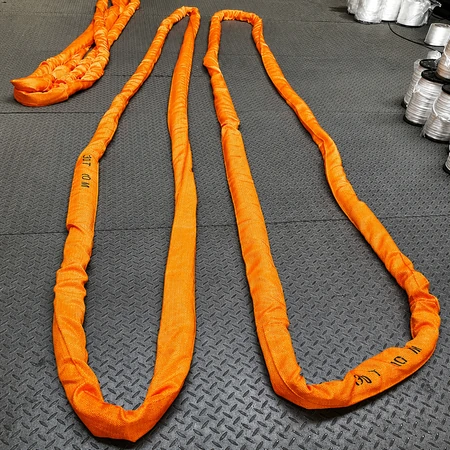
| Effektiv arbeidslengde | Halve omkretsen — hekt ned til lasten og opp igjen | Vertikale og strupede heiser, hvor hengehøyden er kjent | 4 m EWL = 8 m løkke |
| Omkrets | Hele løkkens lengde | Kurvløfter, der lastens omkrets driver lengden | 8 m loop = 4 m EWL |
On the slings we supply the figure printed on the sleeve is the effektiv lengde, så trykket og tilbudet stemmer alltid overens. For en kurv, mål omkretsen på lasten, legg til takhøyde på kroken, og siter den figuren: kroppen tar den lange veien rundt lasten, and a sling that only just reaches forces the legs wide — the same as buying a smaller sling.
Where an endless loop earns its place
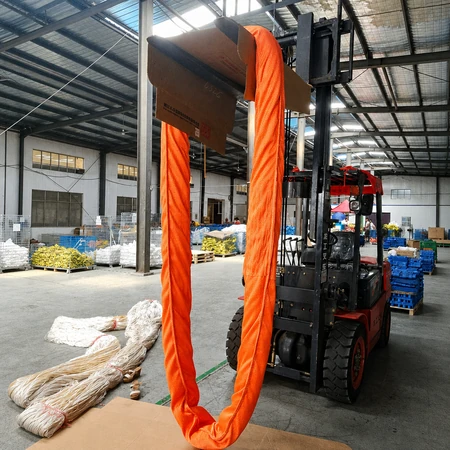
- Prefabrikerte bjelker og brosegmenter picked in a basket at each end, where the sleeve protects the formed face and the chamfer.
- Stålspiraler sitting in a basket, where the doubled body gives twice the vertical capacity and follows the curve of the coil instead of bearing on one line.
- Transformatorer, generatorer og maskinsenger with small trunnions and painted surfaces — nothing metal touches the load.
- Former og dør whose lifting holes are drilled, ikke designet for et beslag, so a soft loop threaded through the hole is the whole method.
- Skids, rammer og offshore-kurver choked at each corner with 6–12 m bodies, the sleeve taking the corner abrasion so the core does not.
- Stage and studio work around truss and set pieces where a scratch is a re-spray.
Endeløs, eye-eye or flat webbing
| Kriterium | Endeløs rund slynge | Øye-øye rund slynge | Flat endless webbing sling |
|---|---|---|---|
| Kontakt med lasten | Round body, conforms to curves and corners | Round body with two loaded eyes | Bredt flatt ansikt, spreads pressure over an area |
| Lengde | Set by the loop; either convention can be quoted | Fixed between the eyes | Set by the sewn loop |
| Lastebane | Kontinuerlig, no termination | Kontinuerlig kjerne, eyes formed by the sleeve | Sewn join in the loop |
| Reeving | Can be turned and re-reeved after a lift | One orientation only | Can be turned, but the join takes the wear |
| Best for | Kurv og choke fungerer, awkward plant, lange kropper | Repeated lifts on the same two points | Bred, flat and easily marked loads |
None of the three replaces another. For a fixed length and two known pick-up points see the øye-øye rund slynge; for a wide face and a visible load path see the endeløs flat båndslynge. Both round sling forms are built from the same core and sleeve, so the choice is a rigging decision rather than a capacity one. For hard service the dobbel ermet rund slynge legger til et ekstra slitelag med samme vurdering, for weight-critical work there is a UHMWPE rund slynge kjerne, and for hot loads an aramid rund slynge.
Befaring og pensjonering
Kjernen kan ikke sees, so the sleeve is the record of what the sling has been through. Inspiser før hver bruk, og formelt med det intervallet ditt regime krever.
- Check the full length of the sleeve for cuts, haker, innglassing, smelter og kjemisk farging, and open the sleeve at the join if anything looks wrong.
- Read the print and the label. If the working load limit or the length can no longer be read, seilet kan ikke verifiseres og kommer ut av drift.
- Kjenn etter grus inni ermet; den sliper kjernen innenfra lenge etter at gården er feid.
- Retire on any cut or hole that exposes the core, varmeglass, en kjerne som har blitt stiv eller klumpete, kjemisk angrep, eller en manglende etikett.
- Oppbevares sammenrullet og utenfor gulvet, ute av dagslys og borte fra varme, løsemidler og sveisesprut. Never store a sling wet in a closed bag.
- Never drag a loaded sling sideways, and never lift on a damaged sleeve.
Ofte stilte spørsmål
What is the difference between an endless round sling and a round sling with eyes?
An endless round sling is a closed loop with no termination: the core runs continuously inside the sleeve and nothing is spliced or sewn into the load path. EN rund slynge med øyne has two defined eyes at a fixed distance, so its length is set by the eyes and it works in one orientation.
Is the length the circumference or the effective length?
Both are used and they differ by a factor of two. Effective length is half the loop — hook down to the load and back up. Circumference is the full loop. EN 4 m effektiv lengde er en 8 m løkke, so the convention has to be stated on the order.
How much capacity is lost in a choker?
A choked endless round sling is rated at 0.8 of its vertical working load limit, så a 5 t slynge gir 4 t. A basket raises the figure to 2.0 at 0–7°, 1.4 at 7–45° and 1.0 at 45–60°. A four-leg set is calculated on three legs, giving 2.1 at 0–45° from vertical and 1.5 at 45–60°.
What does LFTEERS-10 mean?
Artikkelnummeret er grensen for arbeidslast i tonn: LFTEERS-10 is 10,000 kg vertikalt, LFTEERS-100 is 100,000 kg and LFTEERS-1000 is 1,000,000 kg. Utvalget følger 1-2-3-4-5-6-8-10-12-15-20-25-30-40-50-60-80-100-200-300-400-500-600-700-800-900-1000 stige, so there is no 7 t, 9 t eller 11 t artikkel.
How heavy is a long endless sling?
The last column of the article table is the weight per metre: 0.47 kg/m at LFTEERS-1, 3.00 kg/m at LFTEERS-10 and 226 kg/m at LFTEERS-1000. Multiply by the loop length and add the label and packing to get the figure to put against the crane. Where that number is a problem, a UHMWPE core gives the same capacity at a fraction of the weight.
Can the same sling be used in a basket and a choke?
Ja, and that is one of the reasons for the endless form: the same article goes round the load either way. What changes is the working figure, so the rating has to be recalculated for the hitch actually used.
How is the sling tested and documented?
Each sling is proof loaded before dispatch and the test record is matched to the serial number on the sewn label. Breaking load is 7 × the working load limit, and the factor can be varied to order where the market requires it.
Request an endless round sling quotation
Send belastningen per etappe, the hitch and the leg angle, the distance between pick-up points and the headroom to the hook — plus the length convention and any marking or documentation your site requires. Vi vil bekrefte kapasitet, lengde og erme, og siter fabrikkdirekte med tegning, a proof-load record and a sample. Se full round sling range for the rest of the series.