

Lub tuam txhab lift sling rigging tsim Single-Use Lifting Slings Endless Loop,Looped End Nqa ib zaug xwb,Single Use Endless Lifting Slings,Single Use lossis Disposable Carrying Sling,Disposable Pre-Slung Cargo Sling.
Ib zaug siv Lifting Slings Endless Loop
Flat Woven Polyester Endless Loop Sling — 1 t rau 24 t · 25 mm to 300 mm Dav · 5:1 · 6:1 · 7:1 Safety Factor
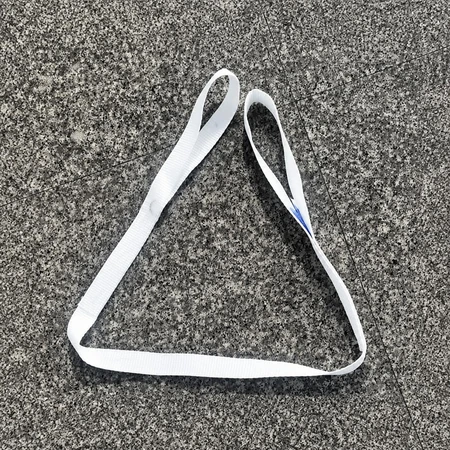
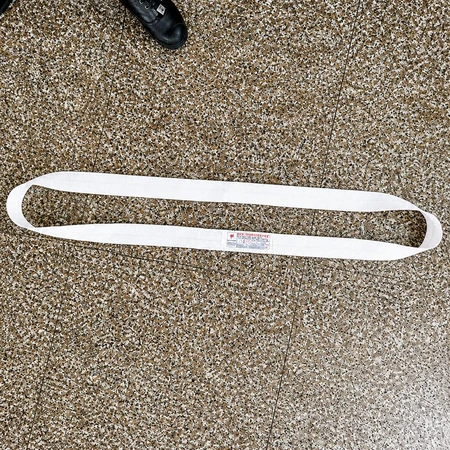
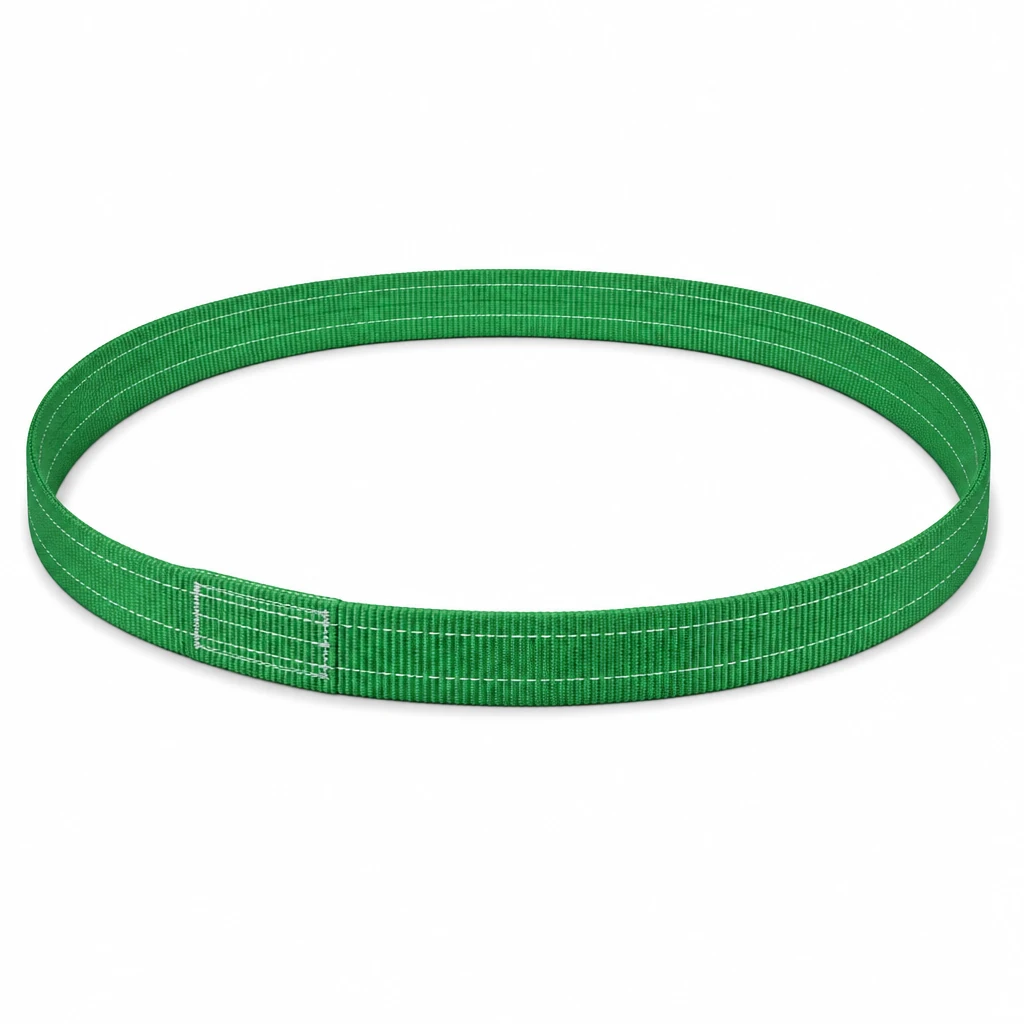
A ib zaug siv lifting sling hauv daim ntawv loop tsis kawg yog ib txoj hlua polyester woven tiaj uas txuas ua ib lub nplhaib kaw. Tsis muaj qhov muag ntawm ob kawg, tsis muaj hook, tsis muaj thimble thiab tsis muaj khoom siv dab tsi: cov khoom thauj nkag los ntawm kev hla txoj hlua ncig cov khoom thiab rov qab los ntawm nws tus kheej. Qhov tsis muaj ntawd yog qhov uas daim qauv no tau yuav rau. Tsis muaj dab tsi ntawm sling yuav ntes tau, tsis muaj dab tsi yuav haum yuam kev, and there is no end to thread through a hook — which is exactly what a one-trip export lift needs. We weave the band in 4 e 7.5 mm thickness, close the loop with a multi-row stitched join, and publish the working load limit for the three safety factors the market asks for: 5:1, 6:1 and 7:1.
- No ends, tsis muaj fittings — a closed ring with nothing to assemble and nothing to lose
- 1 t rau 24 t across two webbing thicknesses, 25 mm to 300 mm dav
- Flat woven polyester — soft, non-marking and light against the load
- Any length to order — 0.5 m minimum, 100 m maximum, cut to your line
Cov yam ntxwv tseem ceeb
Yuav rau ib zaug taug kev
Tsim los ua ib zaug nrog khoom xa tawm thiab tsis rov qab los. Nws yog kev txiav txim siab yuav khoom txog kev taug kev — tsis yog daim ntawv tso cai thauj khoom ntau dhau, thiab kev txwv thauj khoom ua haujlwm tseem tswj hwm.
Tsis muaj dab tsi yuav kho kom tsis raug
Tsis muaj qhov muag los tso, Tsis muaj qhov txuas los tshuaj xyuas, Tsis muaj shackle rau pin. Lub voj voog los yog hla ib ncig ntawm qhov hnyav lossis tsis dhau, uas tshem tawm feem ntau ntawm txoj kev uas lub sling sib dhos ua yuam kev.
Txawm hnav los ntawm kev tig
Ib lub voj kaw tsis muaj qhov chaw hnav ruaj khov. Chaw sib cuag tuaj yeem tig tau ntawm cov nce, kom tib lub nplhaib tsis txhob txais tag nrho cov kev puas tsuaj ib qho chaw tiv thaiv ib qho ntug sharp.
Mos thiab Tsis Muaj Cim
Flat polyester webbing spreads the load over the band width and will not bruise a painted, polished or coated surface the way chain or wire rope does.
Low Stretch
Polyester webbing stretches less than nylon under the same load, which keeps a bundled load level and stops the band creeping while it is being set down.
Three Safety Factors
The same tonnage is published at 5:1, 6:1 and 7:1 so the band width can be matched to whichever design factor your market or project specifies.
Dab tsi “Endless Loop” Means — and What It Does Not
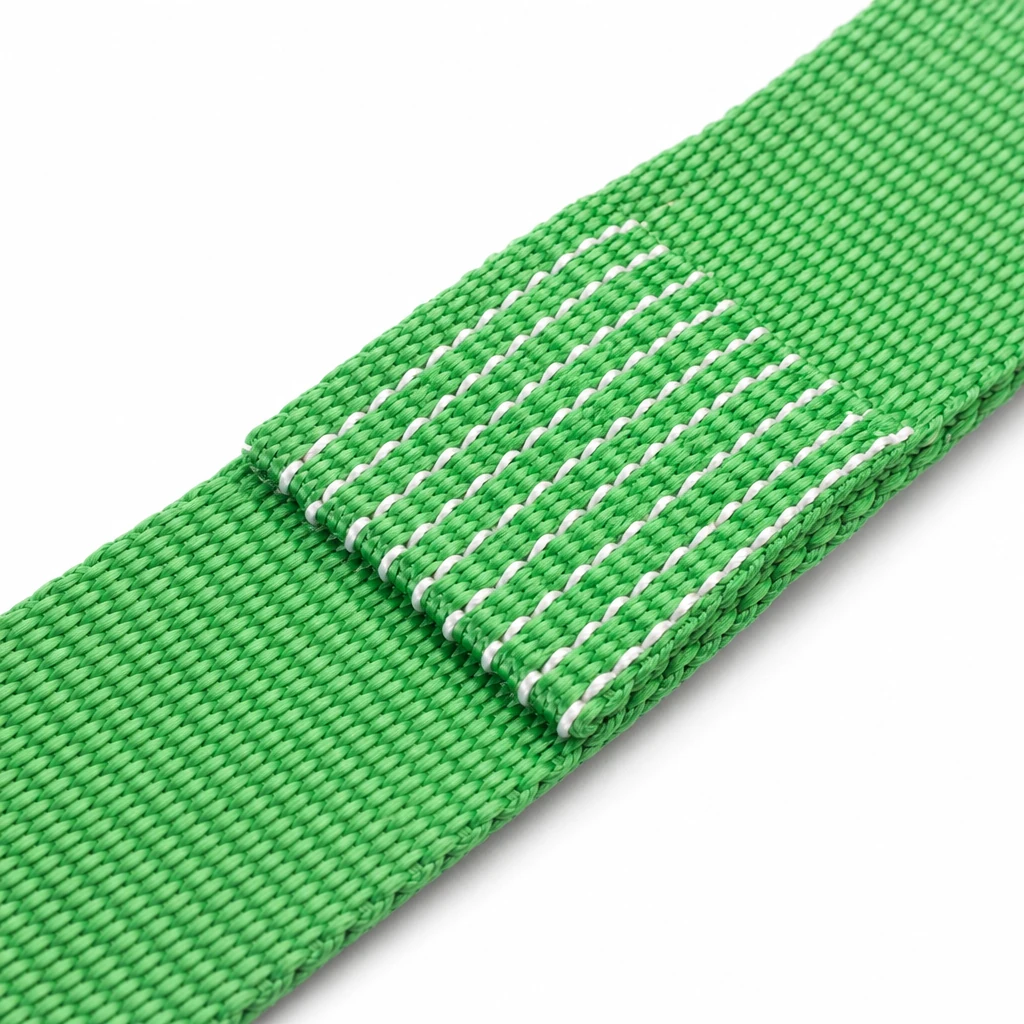
Lo lus tsis muaj kawg describes the form, not the length. The band is woven flat, then overlapped on itself and closed with several rows of stitching to form a continuous ring. Because there is no end, the article has no attachment point at which a load can be hooked — and equally, no end at which a routine inspection of a fitting would normally start.
| Endless loop flat webbing sling | A flat woven band of polyester, polyamide or polypropylene webbing closed on itself into a ring. The band itself carries the load. This is the article on this page. |
|---|---|
| Eye-and-eye webbing sling | The same flat webbing, but with a formed eye at each end instead of a closed loop. It has ends, so it is rigged differently and is a different article. |
| Endless round sling | Often mistaken for this product. A round sling is a load-bearing core of parallel polyester yarn inside a separate woven tubular cover — a sleeve over a core, not a single load-carrying band. Different construction, different handling, different standard. |
| Single-use / one-way / disposable | All three words describe the same purchase decision: the sling is bought for one journey. Tsis muaj ib qho piav txog qhov zoo ntawm qhov kawg, fiber, kev nyab xeeb lossis peev xwm ntsuas. |
Technical Specifications
| Product name | Lifting sling siv ib zaug tsis muaj kawg / sling ib txoj kev / sling siv ib zaug xwb / sling webbing tsis muaj kawg |
|---|---|
| Construction | Webbing band band flat woven uas txuas ua ke ua ib lub voj kaw nrog ntau kab stitched overlap |
| Cov ntaub ntawv Webbing | 100 % s (polyamide thiab polypropylene thaum thov) |
| Webbing tuab | 4 e 7.5 mm bands (ob lub blocks ntawm daim ntawv parameter hauv qab no) |
| Band width | 25 mm to 300 mm — the width is set by the working load limit and the safety factor, not chosen freely |
| Kev txwv thauj khoom ua haujlwm | 1 t rau 24 t (1–12 t on the 4 mm band, 2–24 t on the 7.5 mm band) |
| Safety factor | 5:1 · 6:1 · 7:1 — three published factor columns |
| Length range | Minimum 0.5 m rau 2.0 m depending on width; maximum 100 m |
| Weight | Published per metre for every row and every factor (see the table below) |
| Colour | White · green · blue · orange · red, with or without a printed size or capacity marking |
| Ends | None — a closed ring, with no fittings of any kind |
| Elongation | Low-stretch polyester webbing; working elongation stays well below nylon under the same load |
| Ntim | Coil or bundle, labelled bale or carton, custom export packaging with your own label |
| MOQ & OEM | Low MOQ for trial orders; full OEM — width, tuab, ntev, xim, printed marking and packaging |
Kev txwv thauj khoom ua haujlwm, Webbing Width and Safety Factor
This is the parameter table for the endless loop sling. It is published as one ladder of band widths at two webbing thicknesses, and each row gives the width and the weight per metre for the three safety factors. Read the two blocks together and the logic is simple: a 7.5 mm band carries exactly double the working load limit of a 4 mm band at the same widths, and it costs roughly two to two and three quarter times the weight per metre to do it.
| Kev txwv thauj khoom ua haujlwm | Thickness | Width at 5:1 | Width at 6:1 | Width at 7:1 | Min. ntev | Max.. ntev | kg/m at 5:1 | kg/m at 6:1 | kg/m at 7:1 |
|---|---|---|---|---|---|---|---|---|---|
| 4 mm Webbing Band | |||||||||
| 1 t | 4 mm | 25 mm | 50 mm | 30 mm | 0.5 m | 100 m | 0.16 | 0.18 | 0.20 |
| 2 t | 4 mm | 50 mm | 100 mm | 60 mm | 1.0 m | 100 m | 0.35 | 0.39 | 0.60 |
| 3 t | 4 mm | 75 mm | 150 mm | 90 mm | 1.0 m | 100 m | 0.52 | 0.73 | 0.78 |
| 4 t | 4 mm | 100 mm | 200 mm | 120 mm | 1.5 m | 100 m | 0.80 | 0.84 | 0.90 |
| 5 t | 4 mm | 125 mm | 250 mm | 150 mm | 1.5 m | 100 m | 0.85 | 0.96 | 1.14 |
| 6 t | 4 mm | 150 mm | 300 mm | 180 mm | 1.5 m | 100 m | 0.96 | 1.12 | 1.33 |
| 8 t | 4 mm | 200 mm | 200 mm | 240 mm | 2.0 m | 100 m | 1.34 | 1.65 | 1.85 |
| 10 t | 4 mm | 250 mm | 250 mm | 300 mm | 2.0 m | 100 m | 1.64 | 1.84 | 2.05 |
| 12 t | 4 mm | 300 mm | 300 mm | 300 mm | 2.0 m | 100 m | 1.86 | 2.06 | 2.70 |
| 7.5 mm Webbing Band | |||||||||
| 2 t | 7.5 mm | 25 mm | 50 mm | 30 mm | 0.5 m | 100 m | 0.38 | 0.44 | 0.50 |
| 4 t | 7.5 mm | 50 mm | 100 mm | 60 mm | 1.0 m | 100 m | 0.68 | 0.74 | 0.86 |
| 6 t | 7.5 mm | 75 mm | 150 mm | 90 mm | 1.0 m | 100 m | 1.28 | 1.42 | 1.50 |
| 8 t | 7.5 mm | 100 mm | 200 mm | 120 mm | 1.5 m | 100 m | 1.61 | 1.80 | 1.96 |
| 10 t | 7.5 mm | 125 mm | 250 mm | 150 mm | 1.5 m | 100 m | 2.04 | 2.42 | 2.62 |
| 12 t | 7.5 mm | 150 mm | 300 mm | 180 mm | 1.5 m | 100 m | 2.32 | 2.68 | 2.86 |
| 16 t | 7.5 mm | 200 mm | 200 mm | 240 mm | 2.0 m | 100 m | 3.30 | 3.70 | 4.10 |
| 20 t | 7.5 mm | 250 mm | 250 mm | 300 mm | 2.0 m | 100 m | 4.62 | 5.02 | 5.46 |
| 24 t | 7.5 mm | 300 mm | 300 mm | 300 mm | 2.0 m | 100 m | 5.12 | 5.62 | 6.10 |
Choosing the Safety Factor: 5:1, 6:1 or 7:1
The safety factor is the ratio between the band’s breaking strength and the working load limit printed on it. The higher the factor, the wider the band must be to carry the same tonnage — which is why the table above publishes three different widths for every load.
- 7:1 — the design factor used for general-purpose flat woven webbing slings under European practice. Choose it when the sling must match a European or UK project specification.
- 5:1 — the design factor customary under North American practice for synthetic webbing slings. Choose it for a North American project or where a lighter, narrower band is preferred.
- 6:1 — the middle of the ladder, used where a specification calls for a higher factor than 5:1 but does not require the full European figure.
Rigging an Endless Loop Sling
Because the loop has no ends, it can be arranged in four ways. The arrangement changes the load on the band, so the working load limit that applies is the one for the hitch you actually use.
Webbing and Construction
The band is woven from high-tenacity polyester, so the load-bearing capacity sits in the warp yarns that run the length of the sling, with the weft holding them in place. That is why a flat webbing sling shows fine longitudinal lines along its face: those lines are the load path. The two selvedge edges are woven closed, and the join is made by overlapping the band on itself and closing the overlap with several rows of dense stitching, so the load is transferred through the stitching rather than through a knot.
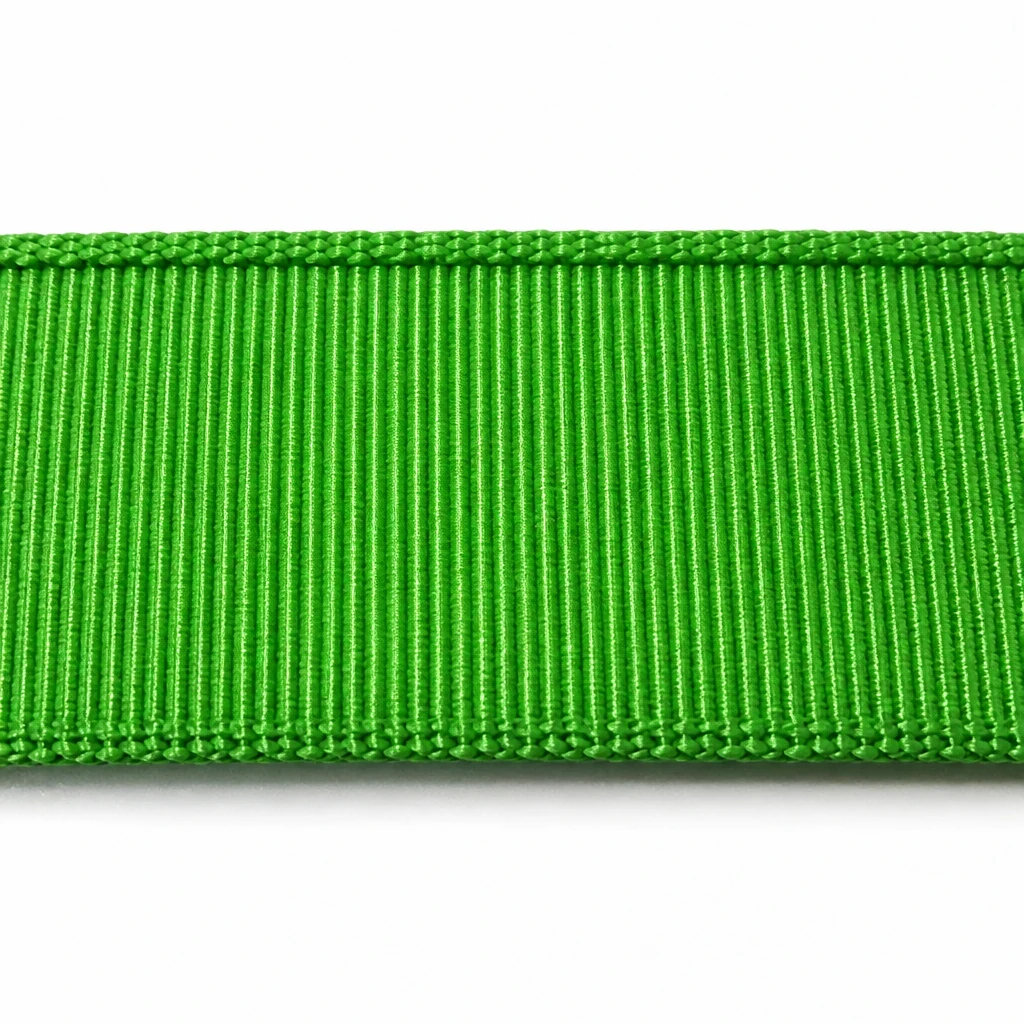
- Wider band, not thicker stitch — the width of the band is what spreads the bearing pressure against the load, so a delicate surface calls for a wider band at the same tonnage.
- Polyester by default — lower stretch than nylon and good resistance to water, oils and most chemicals. Polyamide and polypropylene are available where the environment calls for them.
- Recognisable by colour — a colour band makes a sling visually identifiable on site; we can also print the size or the working load limit along the band on request.
Kev siv
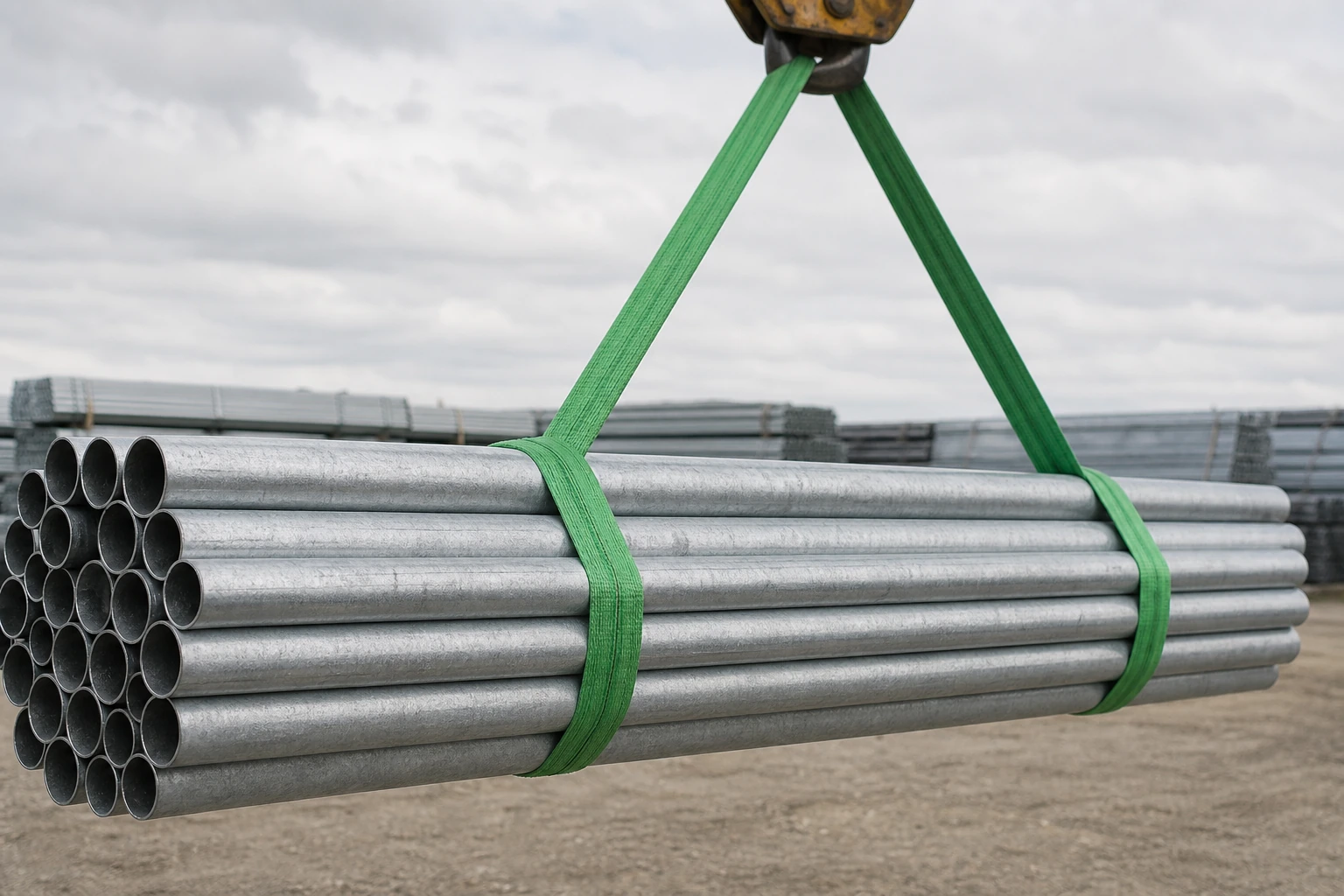
- Export steel pipe and tube bundles — slung at two points and lifted level
- Steel plate, sheet and coil packs loaded into containers
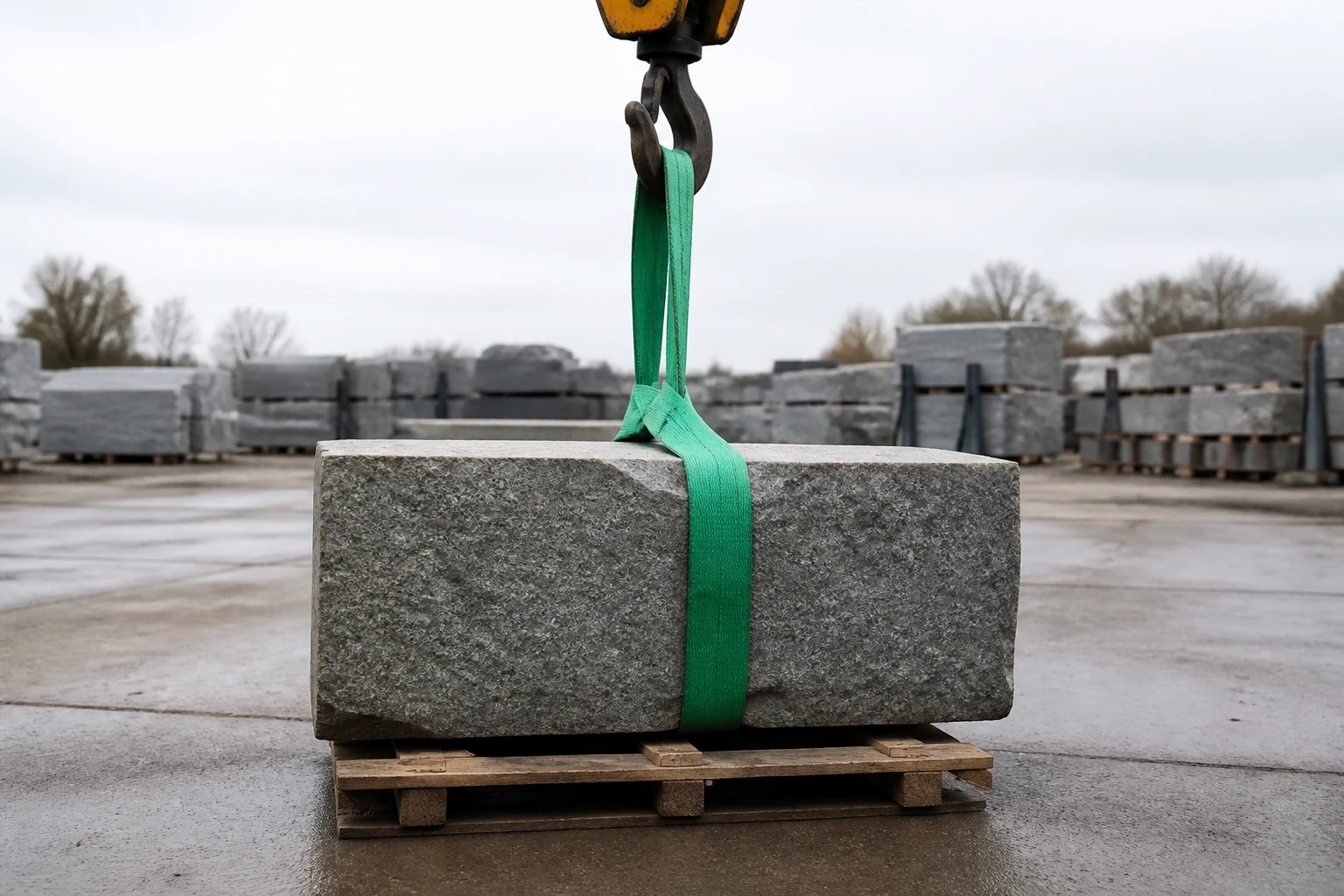
- Stone blocks, slabs and kerb sections where a marking-free band is required
- Ntoo, plywood and panel packs
- Machinery and fabricated steel where fittings would foul the lifting points
- Single-trip lifting where the sling travels with the consignment and is not returned
Kev kho kom haum thiab OEM Kev Pabcuam
Vim tias ib lub sling tsis muaj kawg tsim raws li kev txiav txim es tsis yog khaws cia hauv khw, Lo lus nug yog qhov chaw uas cov khoom tiag tiag tsim. Qhia peb qhov hnyav, Tus naj npawb ntawm cov ntsiab lus nqa, Qhov kev teeb tsa, Qhov chaw siab thiab dav ntawm qhov hnyav thiab peb yuav rov qab nrog qhov dav, tuab, Ntev thiab kev nyab xeeb uas haum.
- Dav thiab tuab — 25 mm to 300 mm band, 4 mm or 7.5 mm, Phim rau koj qhov kev txwv thiab qhov hnyav ua haujlwm
- Ntev —qhov ntev twg los tau txiav txim ntawm qhov tsawg kawg rau qhov dav ntawd thiab 100 m
- Safety factor —luam tawm ntawm 5:1, 6:1 or 7:1 Txhawm rau haum rau qhov kev qhia uas koj tab tom ua
- Xim thiab cim —xim yooj yim lossis qhov loj luam tawm, working load limit, or your own reference along the band
- Packing for export — banded bales, cartons or labelled packs, sized for container loading
- Related items — matching eye-and-eye slings, round slings and wire rope slings for the same consignment
Kev tswj xyuas zoo
Every batch of webbing is checked for width, tuab, weave density and colour, and the finished loop is checked on its join and its overall length before packing. We have manufactured slings, webbing and rope products for industrial, safety and export customers for close to three decades, and we keep the process visible: on request we supply the webbing report, the batch test figures and a sample loop for you to handle and load-test before volume production begins.
Cov Lus Nug Feem Ntau
What is a single-use lifting sling with an endless loop?
A flat woven polyester band joined to itself into a closed ring, so it has no ends and no fittings. It is bought for one journey with an export load and not returned. The endless loop is the form of the article; single-use, one-way and disposable all describe the same purchase decision.
Is an endless loop sling the same as a round sling?
Tsis tau. An endless loop flat webbing sling is a single woven band that carries the load itself. An endless round sling is a load-bearing core of parallel polyester yarn inside a separate woven tubular cover — a sleeve over a core. They look similar in use but they are different constructions with different handling and different pricing. Tell us which one your enquiry is for.
Which safety factor should I order — 5:1, 6:1 or 7:1?
Match it to the specification your market or project calls for. 7:1 is the design factor used for general-purpose flat woven webbing slings under European practice, 5:1 is the customary North American design factor for synthetic webbing slings, and 6:1 sits between them. The factor changes the band width required for the same tonnage, so it must be decided before the sling is made.
How do I choose the band width?
Start from the working load limit and the safety factor, which the parameter table converts into a width. Then check that width against the load: a wider band spreads the bearing pressure over a bigger area, so a painted, polished or otherwise delicate surface calls for a wider band even where a narrow one would carry the weight.
How do I measure the length of an endless loop sling?
Ib lub voj kaw tsis muaj kawg, so the length is a property of the ring as it is made rather than something you measure between two eyes. Give us the arrangement you intend to use, the load diameter and the available headroom, and we will size the loop so it rigs correctly; the minimum length for each width is set out in the parameter table.
Can a single-use sling be used more than once?
A single-use sling is designed and priced around one journey, and its working load limit still applies on that journey. Seb ib lub sling twg yuav siv tau dua yog kev txiav txim siab ntawm tus neeg muaj peev xwm tom qab tshuaj xyuas, saib xyuas qhov nws tau raug. Tsis muaj ib qho laj thawj los dhau qhov txwv ua haujlwm uas tau cim, thiab nws tsis hloov lub sling mus ua ib qho uas tau tshuaj xyuas thiab pov thawj siv dua tau.
Thov ib qho nqi rau Endless Loop Single-Use Slings
Xa peb qhov kev txwv ua haujlwm, qhov kev nyab xeeb uas koj qhov kev piav qhia xav tau, kev teeb tsa uas koj npaj siv thiab qhov ntev koj xav tau. Peb yuav rov qab nrog qhov dav, tuab thiab ntev ntawm lub voj voog, thiab ib qho qauv rau koj tuav ua ntej tsim ntau.