

Lift sling rigging company produce Flat Lifting Sling.
Flat Lifting Sling
Flat Woven Webbing Slings to EN 1492-1 — Polyester, Nylon or Polypropylene, 1–30 t, Eye and Eye or Endless
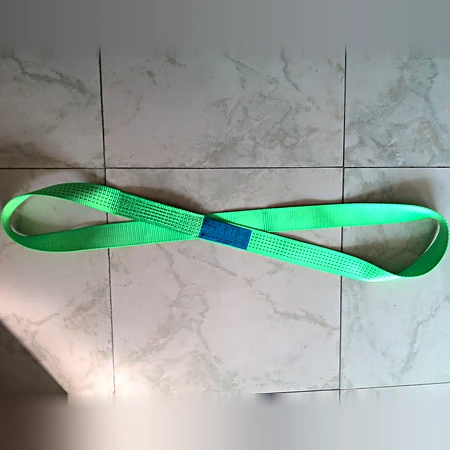
A flat lifting sling is defined by one thing and one thing only: its cross-section. The load-bearing element is a band of woven webbing with a rectangular section, so it bears on the load across a broad, flat face rather than a line. That single property is what everything else follows from — a flat band lies against a flat face and does not concentrate the load, it wraps a section without creasing, it needs no fittings because its ends can be formed from the webbing itself, and it can be coiled, folded and carried by one person at capacities where a steel sling would need two. “Flat” says nothing about the fibre, the ends or the capacity; those are three separate decisions, and this page takes them in turn. Get the cross-section right and you have chosen the family. Get the fiber wrong and you will still fail — heat, acid, alkali and shock are what actually destroy a flat sling, and each fibre answers a different one.
- Broad, flat bearing — spreads the load over a face instead of a line
- No fittings on the load path — the ends are formed from the webbing itself
- Three fibres, three duties — polyester, nylon and polypropylene answer different hazards
- Light and safe to handle — a fraction of the weight of the steel it replaces
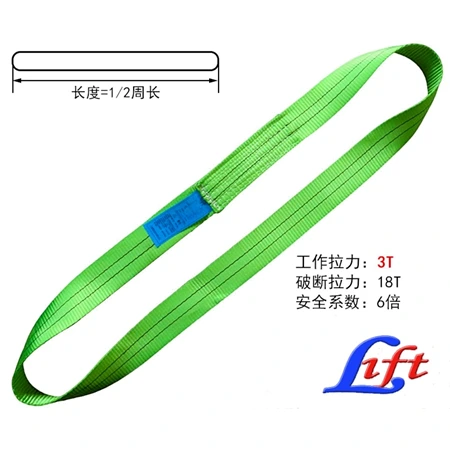
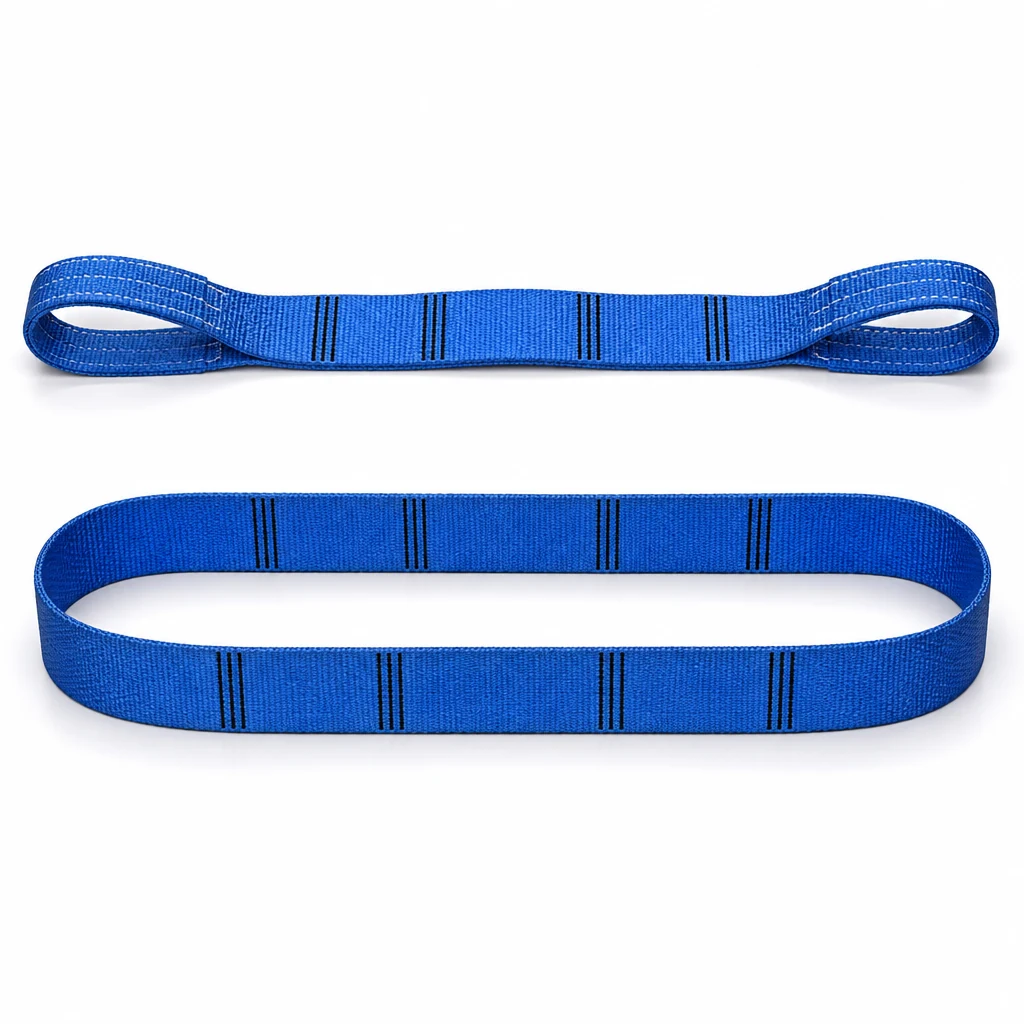
Cov yam ntxwv tseem ceeb
A Face, Not a Line
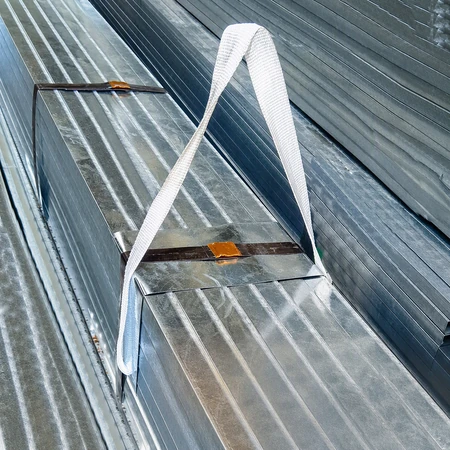
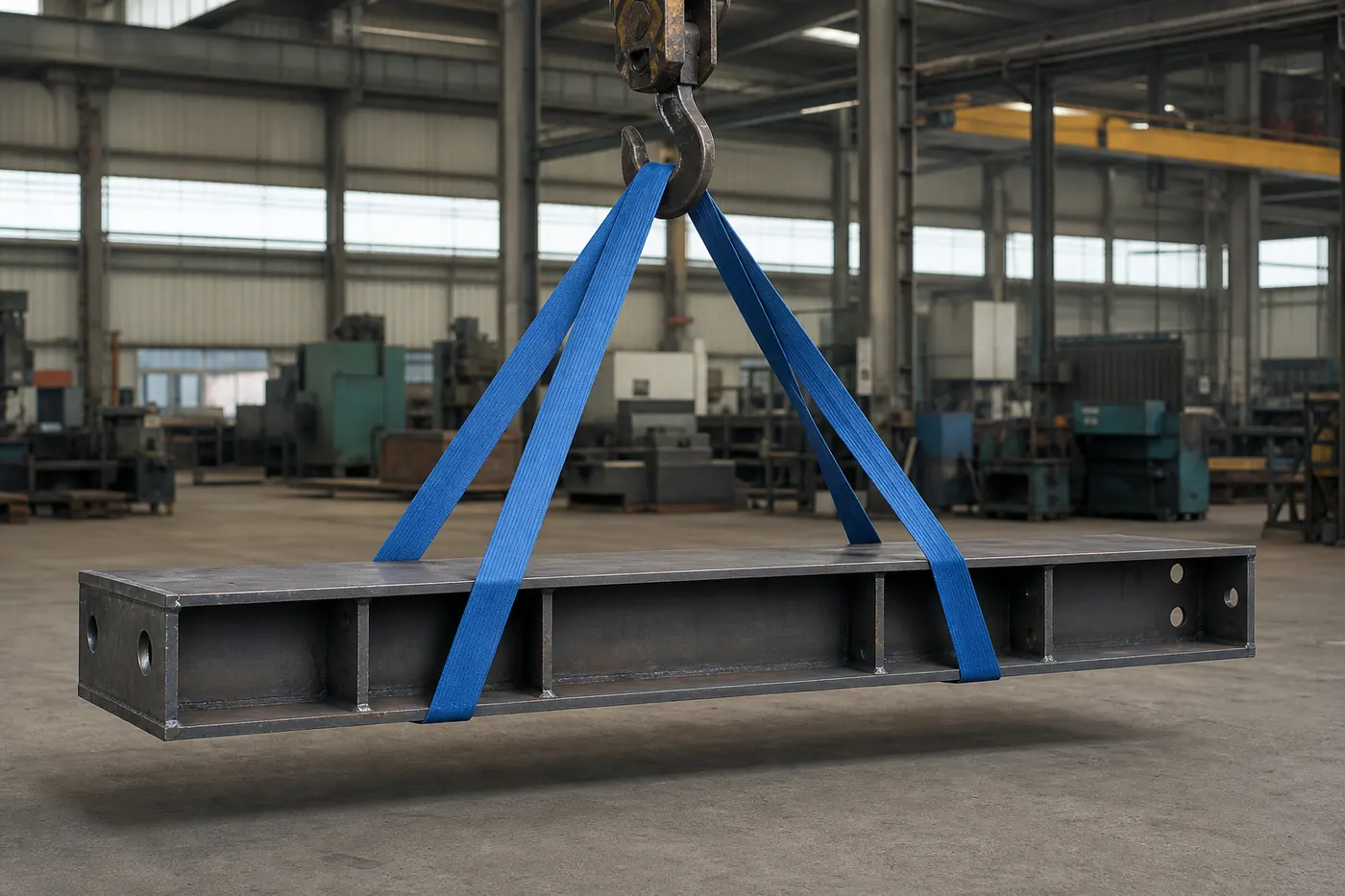
A flat band spreads the load across its whole width. That is why a flat sling will pick up a crate, a machine base or a section and leave it unmarked where a wire rope would cut in.
Ends Made From the Webbing
There is no hardware on the load path. The webbing is folded back on itself and stitched, so nothing can be lost, seized or distorted — and the construction sits on the outside, where it can be inspected.
a
Woven webbing conforms instead of biting. Painted, coated, polished and powder-coated surfaces survive a flat sling that a chain or wire rope would mark.
Nyias, and Kind to Your Crew
A flat sling of a given capacity weighs a fraction of the steel it replaces, and a shock load is not stored in it and released back into the lift.
Will Not Rust, Will Not Rot
Synthetic webbing is unaffected by water and does not corrode or support rot or mildew, which is why flat slings dominate yards, ports and wash-down environments.
Non-Conductive
With no metal in the load path, Ib lub sling tiaj tsis coj hluav taws xob — qhov zoo rau cov nroj tsuag muaj sia lossis kab hluav taws xob saum toj.
Dab tsi “Flat Lifting Sling” Cov npog — thiab yam nws tsis ua
Cov neeg yuav khoom pom tsev neeg no los ntawm ntau lo lus, thiab cov lus tsis txhais tib yam. Kev faib lawv siv sijhawm me ntsis thiab tiv thaiv kev xaj tsis raug.
| Lo lus | Qhov nws tiag tiag hu ua dab tsi | Qhov nws tso qhib |
|---|---|---|
| Flat lifting sling | Qhov txiav — ib txoj hlua uas muaj duab plaub | The fibre, kawg thiab peev xwm |
| Webbing sling / Flat woven sling | Tib yam khoom, tau muab npe raws li cov ntaub uas nws tau xaws | Txhua yam saum toj |
| Strap / siv / band | Lub webbing nws tus kheej, ua ib yam khoom muaj dav thiab weave | Yog tias nws muaj peev xwm nqa tau — txoj hlua yog ib yam khoom, tsis yog kev piav qhia |
| Nylon sling / Polyester sling | The fibre | Qhov seem, kawg thiab peev xwm |
| round sling | Ib tsev neeg txawv — ib lub fiber core sib npaug hauv lub hnab raj | Tsis yog ib lub sling tiaj li, tsis hais xim twg lub hnab tsho |
The Three Types You Can Buy
The cross-section is fixed by the family. What varies is how the article is finished — and that decides how the load enters it, and therefore what you can and cannot do with it.
| Hom | Yam nws yog | The load enters at | Xaiv rau |
|---|---|---|---|
| Qhov muag thiab qhov muag | A flat band with a formed, folded and stitched eye at each end | Two defined points, one at each end | Any lift where the pick-up points must be known and repeated, and where a defined length is part of the method |
| Tsis muaj kawg (Puag ncig) flat sling | The same flat band, closed into a continuous loop with no ends and no eyes | Wherever the band happens to bear, and through the loop itself | Choked lifts, pob, and any job where one sling has to serve several different rigs — the loop can also be turned to move the wear |
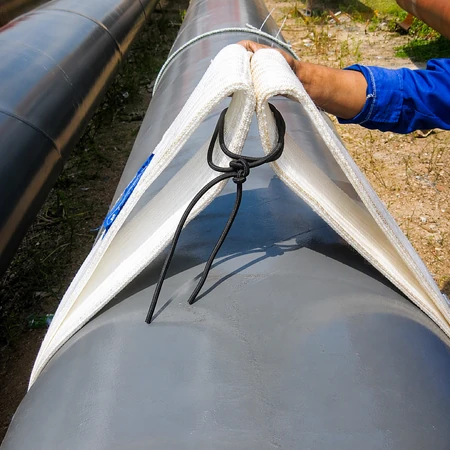
| Sleeved or padded | Either of the above with an extra protective layer at the bearing areas | Zoo li saum toj no, tab sis los ntawm ib txheej txi | Cov thauj khoom coated lossis tiav, cov thauj khoom abrasive, thiab txhua qhov chaw nqa uas webbing tsis txhob kov ncaj qha rau qhov hnyav |
Xaiv Fibre — Polyester, Nylon or Polypropylene
This is the decision that actually decides whether your sling survives, and it is the one buyers most often make by accident. The three fibres look much the same in a photograph, carry the same capacity ladder and are distinguished on the article only by the colour of the sewn label. They behave very differently against heat, acid, alkali, shock and stretch.
| Fibre | Label colour | Typical temperature range | Stretch | Chemicals | Xaiv thaum |
|---|---|---|---|---|---|
| u (PES) | Xiav | −40 °C to +100 °C | Low — around 3% ntawm qhov txwv thauj khoom ua haujlwm | Good against most acids; attacked by strong alkalis | The general-purpose answer, and the default. Lowest stretch for its strength, best all-round value, and the fibre most of the standard capacity ladder is published in. |
| Polyamide / Nylon (PA) | Ntsuab | Typically to about +90 °C | High — it stretches further before it breaks | Attacked by acids; better than polyester against alkalis | b, and where the load must be caught rather than held rigidly. It gives where polyester would pass the load straight on. Also the better choice in very cold conditions. |
| Polypropylene (PP) | Xim av | Typically to about +80 °C | Nruab nrab | Good against both acids and alkalis | Chemical and coating environments. It is the lightest of the three and it floats, which makes it the fibre of choice for wet and chemical duty — and for the large-tonnage white belts used on coated products. |
Capacity, Colour, Width and Ply — Reading the Ladder
Nyob hauv EN 1492-1 the colour of the webbing certifies the capacity band, hauv kev nqa ncaj, thiab tsis muaj dab tsi ntxiv. Alongside it the band carries one black transverse stripe per tonne, yog li ob qho cim tuaj yeem kuaj xyuas sib piv tau.
| WLL (straight lift) | Webbing xim | Black stripes | Reference width | Choked (× 0.8) | MBL ntawm 7:1 |
|---|---|---|---|---|---|
| 1 t | Violet | 1 | Paub tseeb | 0.8 t | 7 t |
| 2 t | Ntsuab | 2 | 50 mm | 1.6 t | 14 t |
| 3 t | Daj | 3 | 75 mm | 2.4 t | 21 t |
| 4 t | Grey | 4 | 100 mm | 3.2 t | 28 t |
| 5 t | Liab | 5 | 125 mm | 4.0 t | 35 t |
| 6 t | Xim av | 6 | 150 mm | 4.8 t | 42 t |
| 8 t | Xiav | 8 | 200 mm | 6.4 t | 56 t |
| 10 t | Orange | 10 | 250 mm | 8.0 t | 70 t |
| 30 t | Tsis muaj xim code | 30 | Paub tseeb | 24.0 t | 210 t |
Sab saum 10 Xim tsis qhia txog sling lawm, so the working load limit printed on the sewn label governs. Nyeem daim ntawv cim, tsis yog xim.
Width and ply — why two slings of the same capacity are not the same sling
Two flat slings can carry exactly the same working load limit and still be different articles, because the same capacity can be built at different widths and in different numbers of layers.
- Width decides the bearing area. A wider band spreads the same load over more of the load’s surface, which matters wherever the surface must not be marked.
- Ply decides stiffness and edge tolerance. A single-layer band is lighter and more flexible; a duplex or double-layer band is stiffer, sits flatter under a load, and lasts longer where the band runs over an edge.
- Thickness matters in the hook. A very thick band occupies more of the hook bowl, which can limit how many slings you can gather onto one hook.
The Formed Eye — Where the Load Enters
Nyob rau ntawm ib lub sling tiaj uas muaj kawg, lub load nkag ntawm qhov muag. Lub webbing raug quav rov qab rau nws tus kheej thiab kaw nrog ntau kab xaws tuab sib npaug, thiab qhov fold ntawd yog qhov chaw hauv tag nrho cov khoom uas qhov hnyav dhau los ntawm kev txuas ua ke es tsis yog kev xaws txuas ntxiv.
- Qhov kev tsim nyob sab nraud. Qhov ntawd yog qhov zoo ntsiag to ntawm sling tiaj dua sling round uas muaj tes tsho: txhua yam uas nqa qhov hnyav — kev xaws thiab cov xaws — nyob saum npoo, qhov chaw uas koj pom tau.
- Qhov muag yog qhov chaw hnav ruaj khov. Tsis zoo li ib lub voj voog tsis kawg, an eye and eye sling always wears at the same two places — the eyes and the two bearing points. When they wear out, the sling is spent even if the rest of the band is sound.
- Protect the eye at the hook. A rough hook bowl or an undersized hook will abrade the eye far faster than the load will. Check the hook as well as the sling.
- Reinforced eyes are available where the same eyes are repeatedly hooked or the hook bowl is rough.
Hitches and Mode Factors
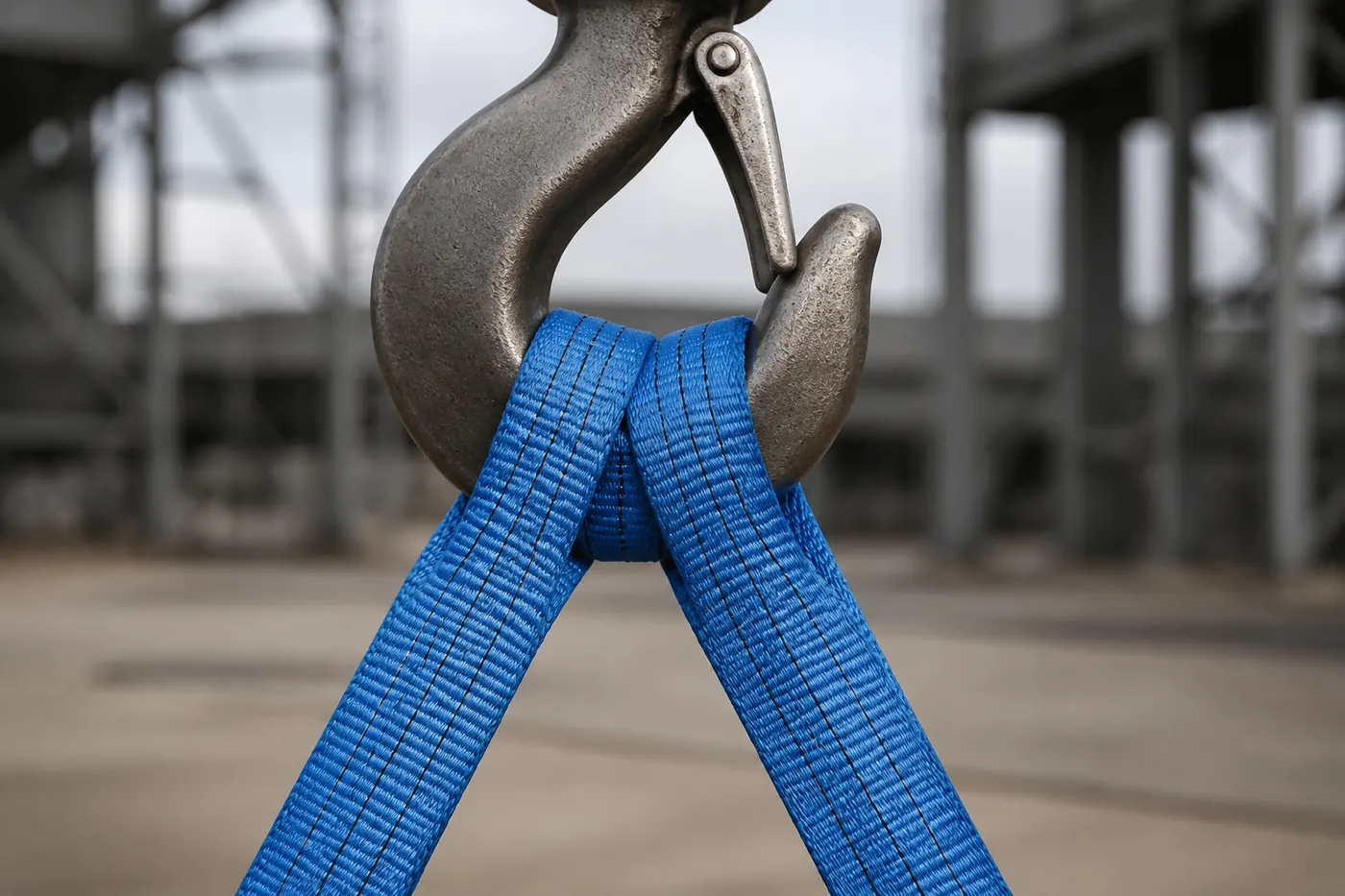
Daim duab cim npe yog straight lift qib. Every other hitch is derived from it by a mode factor.
| Hitch lossis hom | Mode factor M | Nws txhais li cas |
|---|---|---|
| Straight lift | 1.0 | Daim duab cim npe. Both parts of the sling hang to the hook. |
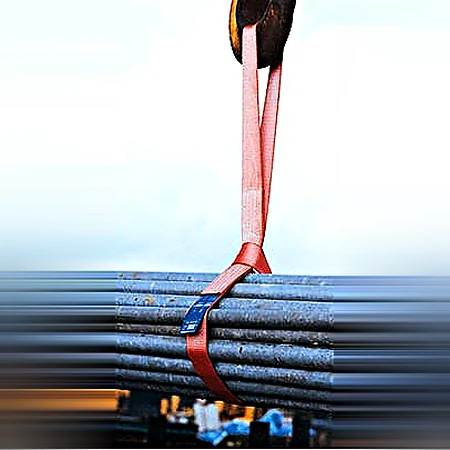
| Choked | 0.8 | The band passes round the load and back through itself so it grips as it takes the weight. |
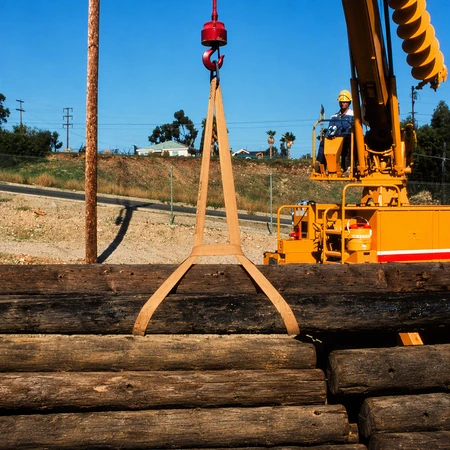
| Lub hnab, 0–7° | 2.0 | The band passes under the load with both legs on the hook, legs within 7° of vertical. |
| Lub hnab, 7–45° | 1.4 | Thaum ob txhais taw qhib, kev tension hauv txhua qhov nce thiab peev xwm siv tau poob. |
| Lub hnab, 45–60° | 1.0 | Thaum qhov kev faib no lub hnab tsuas muab ib qho nce ncaj xwb. |
| Angled choke ntawm 45° | 0.7 | Choked, thiab ob txhais taw ces qhib deb ntawm kab ncaj. Ib qho choke ncaj qha rau ntawm hook tuav 0.8. |
| Angled choke ntawm 60° | 0.5 | The most heavily reduced arrangement in common use — check it before the lift, tsis yog tom qab. |
Two flat-specific habits, neither of which applies to a round sling: keep the band flat and untwisted in the hitch, because a flat band twisted into a rope concentrates the load on one edge and loses the contact area that is its whole advantage; and Tiv thaiv lub band ntawm cov ntug, vim tias ntawm ntug txiav lossis tshuab, ib lub sling tiaj yuav tsis ua haujlwm ntawm ntug ntev ua ntej nws puas thaum thauj khoom.
Cov Lus Qhia Txog Kev Ua Haujlwm thiab Yuav Ua Li Cas
| Product name | Flat lifting sling / flat webbing sling / flat woven webbing sling / webbing lifting sling |
|---|---|
| Hom | Flat woven webbing sling mus rau EN 1492-1; eye and eye or endless (Puag ncig) form |
| Fibre | u (cim xiav) raws li qauv; Polyamide / Nylon (cim ntsuab); polypropylene (cim xim av) |
| Kev txwv thauj khoom ua haujlwm | 1 t rau 30 t hauv cov ncej luam tawm, thiab peev xwm nruab nrab rau kev txiav txim |
| Safety factor | 7:1 to EN 1492-1 raws li qauv; 5:1 rau ASME B30.9 thiab 8:1 rau AS 1353 ua raws li kev txiav txim |
| Ply | Ib txheej raws li qauv; duplex thiab ob txheej raws li kev thov |
| Width | Phim rau peev xwm thiab qhov hnyav — cov series piv txwv yog 2 t = 50 mm, 3 t = 75 mm, 4 t = 100 mm, 5 t = 125 mm, 6 t = 150 mm, 8 t = 200 mm, 10 t = 250 mm; dav kawg ntawm kev lees paub kev txiav txim |
| Ntev | Ua raws li kev txiav txim; qhia qhov ntev ntawm qhov chaw nqa ntawm qhov muag, lossis ntev uas haum rau koj lub rig |
| Elongation | Qhov siab tshaj plaws 3% ntawm qhov txwv thauj khoom rau polyester; maximum 10% ntawm qhov hnyav tawg |
| Kub ntau | −40 °C to +100 °C rau qauv polyester; nylon thiab polypropylene sib txawv — saib hauv fibre table |
| Kev tiv thaiv | Protective sleeves, cov phaj hnav, edge protectors and reinforced eyes on request |
| Cim npe | EN 1492-1 capacity colour with one black stripe per tonne; sewn label carrying the straight-lift WLL, fiber, the standard reference, the manufacturer, the length and a traceability code |
| Kev kuaj | Batch tested; test certificate supplied per batch on request |
| MOQ & OEM | Low MOQ for trial orders; full OEM — capacity, fiber, dav, Ply, ends, xim, label layout and packing |
How to specify one — in this order
- Qhov hnyav, and its shape. The shape decides whether a flat band can lie against it at all, or whether you need a round section instead.
- The hitch you will actually rig. Not the one in the method statement — the one the crew will use. Then apply the mode factor and size the capacity from that figure.
- Ib puag ncig. Kub, acid, alkali, dej, grit. This decides the fibre, and getting it wrong is the failure you will not see coming.
- The surface. Whether the load may be marked decides the width and whether you need a sleeve or a pad.
- The ends. Eye and eye if the pick-up points must be defined; endless if the sling must serve many rigs and you want to rotate the wear.
- Qhov ntev, the marking and the standard. Length between bearing points; the label layout and language your market needs; and the standard and destination market the sling must be built to.
Handling, Kev tshuaj xyuas thiab kev txwv
A flat sling is the easiest of all the synthetic slings to inspect, because the load path is on the surface. Inspect in this order.
- The eyes first. Every stitch row across the fold, the webbing immediately behind the eye, and the fold itself. Tawg, Cov hlua nplaum uas tsis muaj zog lossis rub tawm ua rau sling.
- The bearing points. Where the band has wrapped the load — cuts, kev xeb, glazing or a worn edge.
- The whole band. A flat band carries the load across its whole width, so a cut anywhere matters. Run it through your hands.
- Edges and ends. Cuts from the load’s own corners are the classic flat sling failure.
- Glazing and hardening. A band gone shiny or stiff has met heat or sustained friction, and the fibre is not what it was.
- Kev paug. Acid or alkali attack leaves little visible on the outside and destroys the fibre within. If the sling has been exposed, take it out of service and ask.
- An eye and eye sling cannot be rotated. Its wear points are fixed for life. This is the honest trade-off against an endless sling, and if you find yourself condemning slings while the middle of the band is still sound, that is the signal to move to the endless form.
- Keep it flat, keep it off edges, keep it off heat. Those three account for most premature failures.
- Never repair a sling. No stitching, no splicing, no knotting. A knot in a webbing sling can lose half its capacity.
- Store it clean, dry and out of sunlight, and never on a concrete floor where it can pick up grit.
- Sau tseg. Log the lifts, the hitches, the loads and any damage.
Kev siv
- Plant, machinery, skids, dies and castings — anywhere the surface must not be marked
- Structural steel sections, beams and welded fabrications, choked or in a basket
- Crates, stillages, pallets and boxed goods
- Precast concrete units where a broad bearing is wanted
- Coated, painted and powder-coated products — the large-tonnage white polypropylene band is used on coated work exactly for this reason
- Bundles of tube, pipe and sections
- Chemical., wet and wash-down environments, where polypropylene is the fibre of choice
- Cold stores and cold-climate sites, where nylon keeps its composure
- Chaw nres tsheb, chaw nres nkoj, depots and site work where one sling has to serve many different lifts
Kev kho kom haum thiab OEM Kev Pabcuam
A flat sling is built to order more often than it is bought off a rack, because the length, the width and the fibre all follow from the lift.
- Capacity — 1 t rau 30 t hauv cov ncej luam tawm, and intermediate capacities
- Fibre — polyester, nylon or polypropylene, chosen against heat, chemical or shock duty
- Width and ply — matched to the load surface and the edge condition, single or double layer
- Ends — eye and eye or endless; reinforced eyes where the hook duty is hard
- Ntev — to your rig, stated between the bearing points of the eyes
- Kev tiv thaiv — sleeves, pads and edge protectors
- Cim npe — the EN 1492-1 capacity colour and stripes, or your own scheme where the market allows; your label layout, language and figures
- Ntim — coiled, bagged or baled; custom export packing
Kev tswj xyuas zoo
Every length of webbing is checked for weave, width and colour before it is cut. Every formed eye is checked on its fold and on the number and continuity of its stitch rows. Every finished sling is checked on its length, its capacity marking, its label and its traceability code before packing, and each batch is tested. We have manufactured slings, webbing and rope products for industrial, safety and export customers for close to three decades, and we keep the process visible: on request we supply the webbing certificate, the batch test figures and a sample sling for you to handle and test before volume production begins.
Cov Lus Nug Feem Ntau
What is a flat lifting sling?
A flat woven webbing sling: a rated lifting sling whose load-bearing element is a band of woven webbing with a rectangular cross-section, built to EN 1492-1. It is called flat to describe that cross-section, not the fibre, the ends or the capacity — a flat sling can be polyester, nylon or polypropylene, can have a formed eye at each end or be closed into an endless loop, and can be built from 1 t rau 30 t. Its defining advantage is that it bears across a broad, flat face rather than a line, and that it needs no fittings on the load path.
Is a flat lifting sling the same as a webbing sling?
Effectively yes — flat sling and webbing sling name the same family from two directions. “Webbing” names the material it is woven from; “flat” names the shape of its cross-section. Both distinguish it from a round sling, which is a different family: a parallel fibre core inside a tubular sleeve, with a circular section.
Should I choose a flat sling or a round sling?
Choose flat when the band can lie flat against the load and the load has a wide face or edges — plate, sections, crates, machinery, boxy and flat things. Choose round when the load is round, tightly curved or awkward, where a flat band cannot lie flat and would crease or bear on a single corner. The flat form also has the inspection advantage: everything that carries the load is on the outside, qhov chaw uas koj pom tau.
u, nylon or polypropylene — which should I buy?
Polyester unless you have a reason not to: it has the lowest stretch for its strength and is the best all-round value, and it is what most of the capacity ladder is published in. Nylon if the sling will be shock-loaded or has to stretch to catch a load, and it also behaves better in very cold conditions. Polypropylene if the environment is wet, chemical or both, because it resists acids and alkalis better than either of the others. C, o.
v?
Lub cim qhia qhov hnyav ua haujlwm ncaj qha. y 0.8 a. A basket at a narrow angle increases it to 2 times, u 1.4 a 7 and 45 degrees thiab to 1 a 45 and 60 h. f, u 0.7 at 45 i 0.5 at 60 h. A 4 t load hauv choker xav tau a 5 t sling, vim 4 ÷ 0.8 = 5.
b?
e. r, in different numbers of layers, r. a; u; g. When you compare two quotations for “a 5 t flat sling”, t, x.
h “double buckle” e?
e. In this trade buckle and double buckle are normally names for an end formed by folding the webbing back on itself and stitching it — the same construction as any other formed eye, with no metal anywhere. It is the commonest misreading in the whole flat sling family, so if a quotation says buckle, ask which it is before the goods ship.
Kuv puas tau txais peev xwm tshwj xeeb, fiber, dav, Ntev thiab cim?
h. l 1 t rau 30 t in the published ladder and in intermediate capacities, Hauv polyester, nylon or polypropylene, at the width and ply your load and edges require, in eye and eye or endless form, to the length your rig needs, with the EN 1492-1 capacity colour and stripes or your own marking scheme where the market allows. Qhia peb txog qhov hnyav, lub hitch, the environment and the destination market and we will work the specification out with you.
Request a Quote for Flat Lifting Slings
Xa peb qhov hnyav thiab nws daim duab, the hitch you will actually rig, the environment the sling will work in, seb qhov chaw puas tuaj yeem cim tau, ntev uas koj lub rig xav tau, and the standard and destination market the sling must be built to. Peb yuav rov qab nrog ib qho fiber, a width, a ply, ib qho ntev, ib qho qauv thiab tus nqi ncaj qha los ntawm lub hoobkas.
Cov Khoom Uas Muaj Txiaj Ntsig
- Tag nrho Daim Ntawv Teev Npe, Faib raws Fibre, Hom, Kawg thiab Peev Xwm
- Endless Type Webbing Sling — lub flat band tsis muaj kawg
- Steel Pipe Lifting Strap — wide bands and sleeves for pipe
- High Temperature Webbing Sling — for hot loads
- Aramid Webbing Sling — the cut-resistant option
- Round Slings — tsev neeg round-section