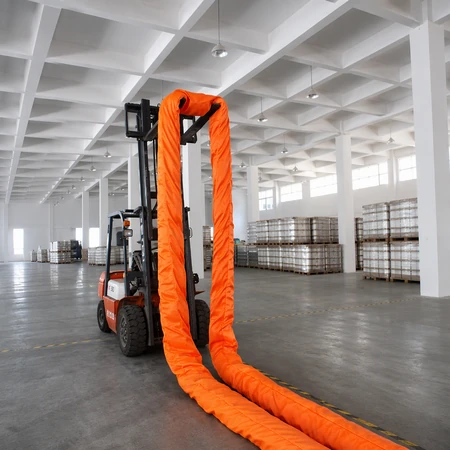
Ko te kamupene rewa kotaha hiki te whakaputa Endless Round Sling.
Endless Round Sling — Closed-Loop Sling, 1–1000 t
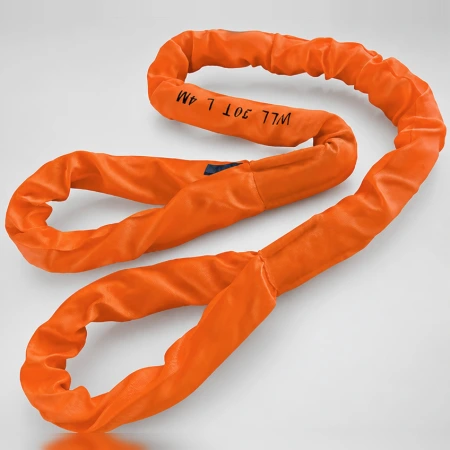
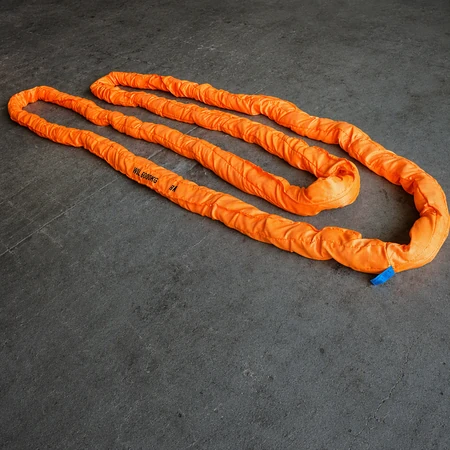
He kotaha porotaka mutunga kore is a closed loop: the core runs continuously inside the sleeve and is closed on itself, so there is no eye, kahore he toka, no hook and no stitching anywhere in the load path. He mea hanga i roto i te polyester tino kaha puta noa 27 LFTEERS articles, mai 1,000 kg ki 1,000,000 kg, in bodies from 0.5 m ki 80 m. Because the loop has no ends it can be turned, re-reeved and re-oriented after a lift — which is why it is the usual choice for basket and choke work on plant that must not be marked.
- Te rohe kawenga mahi1,000 kg ki 1,000,000 kg
- Awhe tuhingaLFTEERS-1 to LFTEERS-1000, 27 rahi
- Te rahi o te tinana15 × 50 mm ki 610 × 1,060 mm
- Te roa0.5–80 m, effective or circumference
- Taumaha wae0.47 ki 226 kg/m
- No metalNothing on the sling touches the load
What “endless” changes for the rigger
Endless describes the construction of the loop, not the length of the article. Nothing is spliced, sewn or fitted into the load path, and four things follow on site.
- The loop has no direction. Both halves are the same article, so the sling can be turned end for end and re-reeved after a lift. In a basket the two legs are identical, which is not true of a sling with an eye at one end and a fitting at the other.
- Wear can be spread. The contact point moves as the sling is rotated along the loop, so the sleeve is not destroyed in one place while the rest of the body is new.
- There is nothing to mismatch. No eye has to be offered to a hook of the right shape, and no fitting has to be rated with the sling. The hook goes through the loop, or the loop goes round the load.
- The sleeve is the whole inspection. The core cannot be opened and looked at, na ko te ringaringa te matapihi: what it shows is what the core has been through.
Endless Round Sling specifications
| Hua | Endless round sling — closed-loop polyester round sling, 1 t ki 1000 t |
|---|---|
| Hangahanga | Ko te uho kakawaua whakarara tonu i roto i te ringaringa tubular raranga, katia ki roto i te kohanga mutunga kore; no metal and no stitching in the load path |
| Core | High-tenacity polyester multifilament, takoto whakarara, te waxed; UHMWPE or aramid to order |
| ringaringa | Ka raranga te polyester teitei, paerewa papa kotahi; ringaringa rua ki te ota |
| Te rohe kawenga mahi | 1,000 kg ki 1,000,000 kg, waewae kotahi poutū — 27 tuhinga, LFTEERS-1 to LFTEERS-1000 |
| Te kawenga pakaru | 7 × working load limit |
| Te take haumaru | 7:1 hei paerewa; 5:1 to order for markets working to ASME B30.9 |
| Te whakaroa i te WLL | Approximately 2–3 % |
| Te pāmahana ratonga | −40 °C ki +100 °C, matua polyester |
| Te roa | 0.5 m ki 80 m; minimum rises with the article, maximum is 80 m in every size |
| Tae | He karaka, he puru ranei; IN 1492-2 ka tono te tae kaha ina tono te ota mo te waehere paerewa |
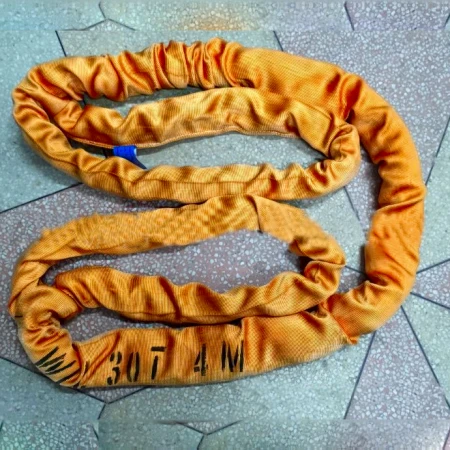
| Te tohu | Working load limit and length printed on the sleeve; tapanga tuia ki te WLL, roa, tau rangatū me te paerewa |
| Whakamatau | Kua utaina he tohu i mua i te tuku; te rekoata whakamatautau i rite ki te tau rangatū |
| Te takai | He mea takai ki roto i te putea poly, kātene tapaina; pallet, pouaka ranei i runga i te tono |
| Waehere HS | 630790 — te hiki i nga kotaha o nga mea pueru |
| MOQ / OEM | MOQ iti mo te ota whakamatautau; OEM i runga i te roa, tae ringaringa, muka matua, tahora tapanga me te takai |
Awhe tuhinga: whiriwhiri i te tauira
Ko te nama tuhinga kei te kawe te kaha — LFTEERS-10 is the 10,000 kg kotaha, LFTEERS-100 the 100,000 kg kotahi. Ko te matotoru me te whanui e whakaatu ana i te tinana, the two length columns give the shortest and longest body made in that article, and the unit weight is what you add to the crane load.
| Toi No. | WLL (kg) | WLL (t) | Mātotoru (mm) | Whānui (mm) | Min (m) | Max (m) | Taumaha (kg/m) |
|---|---|---|---|---|---|---|---|
| LFTEERS-1 | 1,000 | 1 | 15 | 50 | 0.5 | 80 | 0.47 |
| LFTEERS-2 | 2,000 | 2 | 16 | 60 | 0.5 | 80 | 0.60 |
| LFTEERS-3 | 3,000 | 3 | 18 | 70 | 0.5 | 80 | 0.82 |
| LFTEERS-4 | 4,000 | 4 | 20 | 75 | 0.5 | 80 | 1.20 |
| LFTEERS-5 | 5,000 | 5 | 25 | 80 | 0.5 | 80 | 1.47 |
| LFTEERS-6 | 6,000 | 6 | 27 | 90 | 1.0 | 80 | 1.70 |
| LFTEERS-8 | 8,000 | 8 | 28 | 100 | 1.0 | 80 | 2.20 |
| LFTEERS-10 | 10,000 | 10 | 29 | 110 | 2.0 | 80 | 3.00 |
| LFTEERS-12 | 12,000 | 12 | 30 | 125 | 2.0 | 80 | 3.40 |
| LFTEERS-15 | 15,000 | 15 | 31 | 150 | 2.0 | 80 | 4.00 |
| LFTEERS-20 | 20,000 | 20 | 32 | 180 | 2.5 | 80 | 5.60 |
| LFTEERS-25 | 25,000 | 25 | 34 | 200 | 2.5 | 80 | 6.80 |
| LFTEERS-30 | 30,000 | 30 | 68 | 220 | 2.5 | 80 | 8.20 |
| LFTEERS-40 | 40,000 | 40 | 75 | 250 | 2.5 | 80 | 10.9 |
| LFTEERS-50 | 50,000 | 50 | 86 | 270 | 2.5 | 80 | 13.8 |
| LFTEERS-60 | 60,000 | 60 | 126 | 280 | 4.0 | 80 | 16.6 |
| LFTEERS-80 | 80,000 | 80 | 138 | 300 | 4.0 | 80 | 22.0 |
| LFTEERS-100 | 100,000 | 100 | 152 | 320 | 4.0 | 80 | 27.0 |
| LFTEERS-200 | 200,000 | 200 | 230 | 460 | 5.0 | 80 | 66.0 |
| LFTEERS-300 | 300,000 | 300 | 310 | 535 | 5.0 | 80 | 82.0 |
| LFTEERS-400 | 400,000 | 400 | 380 | 680 | 5.0 | 80 | 98.0 |
| LFTEERS-500 | 500,000 | 500 | 410 | 760 | 8.0 | 80 | 116.0 |
| LFTEERS-600 | 600,000 | 600 | 460 | 830 | 8.0 | 80 | 139.0 |
| LFTEERS-700 | 700,000 | 700 | 498 | 880 | 8.0 | 80 | 155.0 |
| LFTEERS-800 | 800,000 | 800 | 520 | 940 | 9.0 | 80 | 178.0 |
| LFTEERS-900 | 900,000 | 900 | 580 | 1,000 | 9.0 | 80 | 202.0 |
| LFTEERS-1000 | 1,000,000 | 1,000 | 610 | 1,060 | 9.0 | 80 | 226.0 |
The series code is shown as supplied on the factory sheet. In that sheet the 20,000 kg article carries the code LFTEERS-15 for a second time; it is shown here as LFTEERS-20 so that the code matches the capacity ladder. Thickness and width are the body dimensions specified for the article, and the minimum length is the shortest body that can be closed and sleeved at that capacity. If your price list uses a different prefix, replace it across the table — the rest of the code is the capacity.
Capacity changes with the hitch, not with the tonnage on the sleeve
The figure printed on the sleeve is the working load limit of one leg hanging vertically. It is the number the sling is proof loaded against, and the starting point of a lifting plan — not the tonnage it will pick up in the arrangement you are actually using. Apply the factor for the hitch, and remember that a set of legs is calculated on fewer legs than it has, because a real load never sits perfectly symmetrically.
| Whakaritenga | Tauwehe | 5 t kotaha | 20 t kotaha |
|---|---|---|---|
| Kotahi te kotaha, poutū | × 1.0 | 5.0 t | 20.0 t |
| Kotahi te kotaha, kowaowaotia | × 0.8 | 4.0 t | 16.0 t |
| Kotahi te kotaha, basket 0–7° | × 2.0 | 10.0 t | 40.0 t |
| Kotahi te kotaha, basket 7–45° | × 1.4 | 7.0 t | 28.0 t |
| Kotahi te kotaha, basket 45–60° | × 1.0 | 5.0 t | 20.0 t |
| E rua nga waewae, 0–45° mai i te poutū | × 1.4 | 7.0 t | 28.0 t |
| E rua nga waewae, 45–60° mai i te poutū | × 1.0 | 5.0 t | 20.0 t |
| E wha nga waewae, 0–45° mai i te poutū | × 2.1 | 10.5 t | 42.0 t |
| E wha nga waewae, 45–60° mai i te poutū | × 1.5 | 7.5 t | 30.0 t |
Two lines in that table settle most orders. Tuatahi, rua 5 t slings do not make a 10 t huinga: at 0–45° from vertical they carry 7 t together, and past 45° they carry 5 t. Tuarua, a four-leg set is worked on three legs, which is why the factor is 2.1 a kahore 2.8. Where the capacity is close to the limit, the honest answer is usually a kurupae hiki rather than a bigger sling — keeping the legs vertical recovers the factor that an open leg angle has just spent.
Te roa: roa whai hua, porowhita ranei
Ko te kotaha mutunga kore he mutunga, no reira ka taea te whakahua i tona roa e rua nga huarahi, a factor of two apart. This is the most common ordering error on a round sling and the most expensive to correct, because the sling has to be remade rather than adjusted.
| I whakahuahia hei | Ko nga mea e whiwhi ana koe | Whakamahia mo | Tauira |
|---|---|---|---|
| Te roa o te mahi whai hua | Ko te haurua o te porowhita — hono iho ki te uta ka hoki whakamuri | Hikinga poutū me te kowaowao, e mohiotia ana te teitei iri | 4 m EWL = 8 m kopikopiko |
| Porowhita | Ko te roa o te koropiko katoa | Whakarewa kete, kei hea te porowhita o te kawenga e akiaki ana i te roa | 8 m loop = 4 m EWL |
On the slings we supply the figure printed on the sleeve is the roa whai hua, no reira ka whakaae tonu te ta me te whakahua. Mo te kete, ine i te whitiki o te kawenga, tāpirihia te rūma upoko ki te matau, me te whakahua i taua whika: ka roa te tinana ki te huri i te kawenga, and a sling that only just reaches forces the legs wide — the same as buying a smaller sling.
Where an endless loop earns its place
- Nga kurupae o mua me nga waahanga piriti picked in a basket at each end, where the sleeve protects the formed face and the chamfer.
- Roopu maitai sitting in a basket, where the doubled body gives twice the vertical capacity and follows the curve of the coil instead of bearing on one line.
- Kaihurihuri, generators and machine beds with small trunnions and painted surfaces — nothing metal touches the load.
- Moulds and dies whose lifting holes are drilled, not designed for a fitting, so a soft loop threaded through the hole is the whole method.
- Pahekeheke, frames and offshore baskets choked at each corner with 6–12 m bodies, the sleeve taking the corner abrasion so the core does not.
- Stage and studio work around truss and set pieces where a scratch is a re-spray.
Mutunga kore, eye-eye or flat webbing
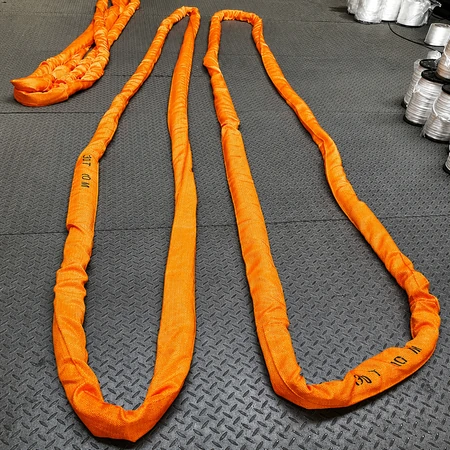
| Criterion | Kotaha porotaka mutunga kore | Kotaha porotaka kanohi-kanohi | Flat endless webbing sling |
|---|---|---|---|
| Whakapa atu ki te uta | Round body, conforms to curves and corners | Round body with two loaded eyes | Mata papatahi whanui, spreads pressure over an area |
| Te roa | Set by the loop; either convention can be quoted | Fixed between the eyes | Set by the sewn loop |
| Te ara uta | Tonu, no termination | matua tonu, eyes formed by the sleeve | Sewn join in the loop |
| Reeving | Can be turned and re-reeved after a lift | One orientation only | Can be turned, but the join takes the wear |
| Te mea pai mo | Mahi kete me te kowaowao, awkward plant, tinana roa | Repeated lifts on the same two points | Whānui, flat and easily marked loads |
None of the three replaces another. For a fixed length and two known pick-up points see the kanohi-kanohi porotaka kotaha; for a wide face and a visible load path see the kotaha tukutuku papatahi mutunga kore. Both round sling forms are built from the same core and sleeve, so the choice is a rigging decision rather than a capacity one. For hard service the kotaha porotaka ringa rua ka taapirihia he paparanga kakahu tuarua i te whakatauranga kotahi, for weight-critical work there is a UHMWPE kotaha porotaka matua, and for hot loads an kotaha porotaka aramid.
Te tirotiro me te reti
Kaore e kitea te uho, so the sleeve is the record of what the sling has been through. Tirohia i mua i nga whakamahinga katoa, me okawa i te wa e hiahiatia ana e to tikanga.
- Check the full length of the sleeve for cuts, mahanga, whakarara, te rewa me te poke matū, and open the sleeve at the join if anything looks wrong.
- Read the print and the label. If the working load limit or the length can no longer be read, e kore e taea te manatoko te kotaha ka puta mai i te mahi.
- Ka rongo mo te kirikiri i roto i te ringaringa; ka werohia te uho o roto i muri roa i te tahia o te iari.
- Retire on any cut or hole that exposes the core, whakamahana wera, he uho kua maro, kua pupuke ranei, whakaeke matū, he tapanga ngaro ranei.
- Roopuhia ka takai i te papa, mai i te awatea me te matara atu i te wera, nga whakarewa me te maatai a te weld. Never store a sling wet in a closed bag.
- Kaua rawa e toia te kotaha kua utaina ki te taha, and never lift on a damaged sleeve.
Pātai auau
What is the difference between an endless round sling and a round sling with eyes?
An endless round sling is a closed loop with no termination: the core runs continuously inside the sleeve and nothing is spliced or sewn into the load path. A kotaha porotaka me nga kanohi has two defined eyes at a fixed distance, so its length is set by the eyes and it works in one orientation.
Is the length the circumference or the effective length?
Both are used and they differ by a factor of two. Effective length is half the loop — hook down to the load and back up. Circumference is the full loop. A 4 m te roa whai hua he an 8 m kopikopiko, so the convention has to be stated on the order.
How much capacity is lost in a choker?
A choked endless round sling is rated at 0.8 of its vertical working load limit, na a 5 t kotaha homai 4 t. A basket raises the figure to 2.0 at 0–7°, 1.4 at 7–45° and 1.0 at 45–60°. A four-leg set is calculated on three legs, giving 2.1 at 0–45° from vertical and 1.5 at 45–60°.
What does LFTEERS-10 mean?
Ko te nama tuhinga ko te rohe kawenga mahi i roto i nga tana: LFTEERS-10 is 10,000 kg poutū, LFTEERS-100 is 100,000 kg and LFTEERS-1000 is 1,000,000 kg. Ka whai te awhe i te 1-2-3-4-5-6-8-10-12-15-20-25-30-40-50-60-80-100-200-300-400-500-600-700-800-900-1000 arawhata, so there is no 7 t, 9 t ranei 11 t tuhinga.
How heavy is a long endless sling?
Ko te pou whakamutunga o te ripanga tuhinga ko te taumaha mo ia mita: 0.47 kg/m at LFTEERS-1, 3.00 kg/m at LFTEERS-10 and 226 kg/m at LFTEERS-1000. Multiply by the loop length and add the label and packing to get the figure to put against the crane. Where that number is a problem, a UHMWPE core gives the same capacity at a fraction of the weight.
Can the same sling be used in a basket and a choke?
Ae, and that is one of the reasons for the endless form: the same article goes round the load either way. What changes is the working figure, so the rating has to be recalculated for the hitch actually used.
How is the sling tested and documented?
Each sling is proof loaded before dispatch and the test record is matched to the serial number on the sewn label. Breaking load is 7 × the working load limit, and the factor can be varied to order where the market requires it.
Request an endless round sling quotation
Tukuna te kawenga mo ia waewae, the hitch and the leg angle, the distance between pick-up points and the headroom to the hook — plus the length convention and any marking or documentation your site requires. Ka whakapumautia e matou te kaha, te roa me te ringaringa, me te whakahua i te wheketere-tonu me te tuhi, a proof-load record and a sample. Tirohia te full round sling range for the rest of the series.
Tikina he korero kore utu me te tauira