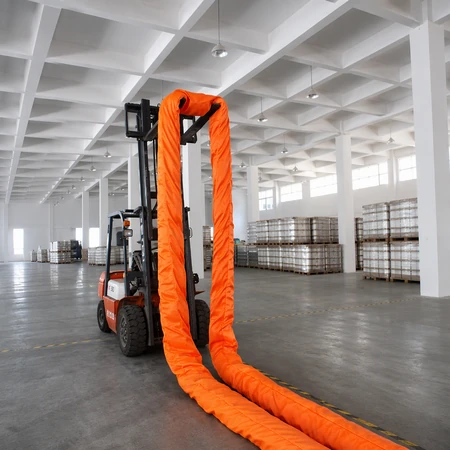
Fundis armari turba producere Infinita circum funda.
Endless Round Sling — Closed-Loop Sling, 1-1000 t*
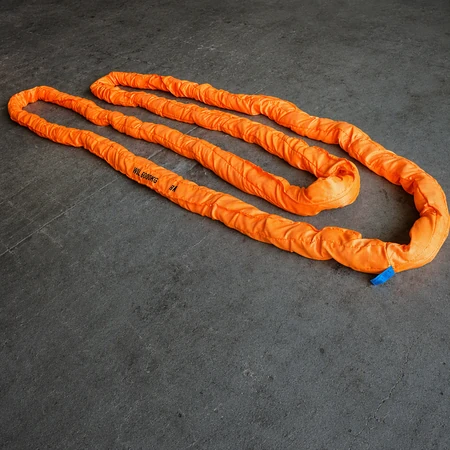
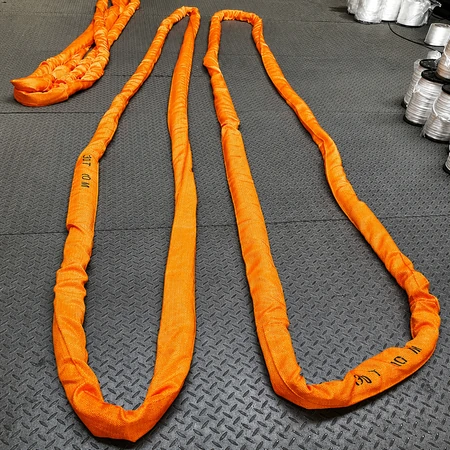
An sine fine per funda is a closed loop: the core runs continuously inside the sleeve and is closed on itself, so there is no eye, non thimble, no hook and no stitching anywhere in the load path. It is made in high-tenacity polyester across 27 LFTEERS articles, e* 1,000 kg to 1,000,000 kg, in bodies from 0.5 m to 80 m. Because the loop has no ends it can be turned, re-reeved and re-oriented after a lift — which is why it is the usual choice for basket and choke work on plant that must not be marked.
- Opus onus modum1,000 kg to 1,000,000 kg
- Articulus rangeLFTEERS-1 to LFTEERS-1000, 27 magnitudinum
- Corpus dimensionum15 × 50 mm usque ad * 610 × 1,060 mm
- Longitudo0.5-80 m, effective or circumference
- Unitas pondus0.47 to 226 kg/m
- Nulla metallumNothing on the sling touches the load
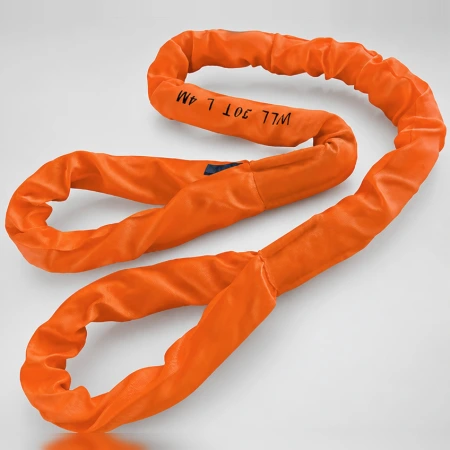
What “endless” changes for the rigger
Endless describes the construction of the loop, not the length of the article. Nothing is spliced, sewn or fitted into the load path, and four things follow on site.
- The loop has no direction. Both halves are the same article, so the sling can be turned end for end and re-reeved after a lift. In a basket the two legs are identical, which is not true of a sling with an eye at one end and a fitting at the other.
- Wear can be spread. The contact point moves as the sling is rotated along the loop, so the sleeve is not destroyed in one place while the rest of the body is new.
- There is nothing to mismatch. No eye has to be offered to a hook of the right shape, and no fitting has to be rated with the sling. The hook goes through the loop, or the loop goes round the load.
- The sleeve is the whole inspection. The core cannot be opened and looked at, sic sleeve est fenestra: what it shows is what the core has been through.
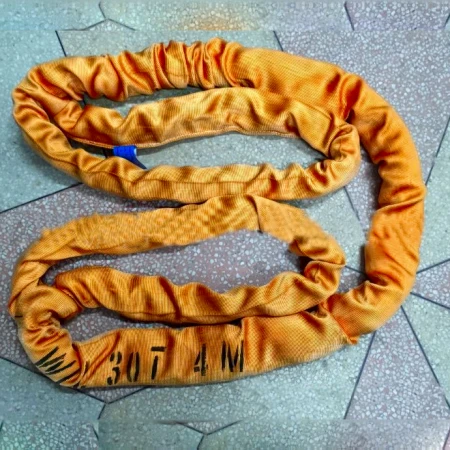
Endless Round Sling specifications
| Product | Endless round sling — closed-loop polyester round sling, 1 t to 1000 t |
|---|---|
| Construction | nucleus filamentum continuum parallelum in manica tubulosa textile, clausit in sine fine loop; no metal and no stitching in the load path |
| Core | High-tenacity polyester multifilament, parallel ponere, creverat; UHMWPE or aramid to order |
| Manica | Textus summus contumacia polyester, unum tabulatum vexillum; duplex sleeve ad ordinem |
| Opus onus modum | 1,000 kg to 1,000,000 kg, unum crus vertical - 27 vasa, LFTEERS-1 to LFTEERS-1000 |
| Fractio onus | 7 × working load limit |
| salus factor | 7:1 ut vexillum; 5:1 to order for markets working to ASME B30.9 |
| Prolongatio ad WLL | Approximately 2–3 % |
| Service temperatus | 40 °F +100 °C, polyester core |
| Longitudo | 0.5 m to 80 m; minimum rises with the article, maximum is 80 m in every size |
| Color | Stock orange vel caeruleum; IN' 1492-2 capacity colour applied when the order asks for the standard code |
| Vestigium | Working load limit and length printed on the sleeve; consuti titulus cum WLL, longitudo, Vide numerum et vexillum |
| Testis | Probatur oneratus ante celeritatem; test record matched ad Vide numerum |
| stipare | In poly peram amplexus, intitulatum carton:; grabatum aut crate ad petitionem |
| HS code | 630790 - fundas elato materiae textili |
| MOQ / OEM | Humilis MOQ ad iudicium ordinem; Altera in longitudinem, sleeve color, core fibra, label layout et sarcina |
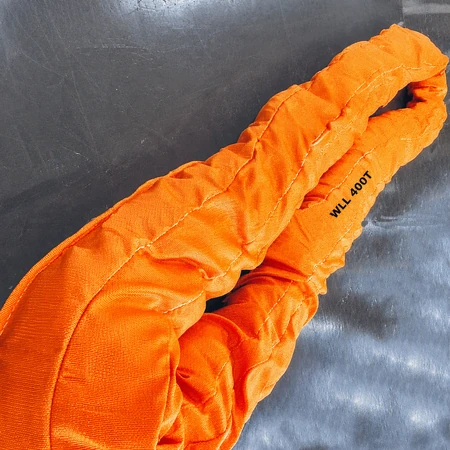
Articulus range: eligere exemplum
The article number carries the capacity — LFTEERS-10 is the 10,000 kg fundae, LFTEERS-100 the 100,000 kg one. Crassitudo et latitudo corporis describet, the two length columns give the shortest and longest body made in that article, and the unit weight is what you add to the crane load.
| Art.No. | WLL (kg) | WLL (t) | Crassitudo (mm) | Latitudo (mm) | Min (m) | Max (m) | Pondus (kg/m) |
|---|---|---|---|---|---|---|---|
| LFTEERS-1 | 1,000 | 1 | 15 | 50 | 0.5 | 80 | 0.47 |
| LFTEERS-2 | 2,000 | 2 | 16 | 60 | 0.5 | 80 | 0.60 |
| LFTEERS-3 | 3,000 | 3 | 18 | 70 | 0.5 | 80 | 0.82 |
| LFTEERS-4 | 4,000 | 4 | 20 | 75 | 0.5 | 80 | 1.20 |
| LFTEERS-5 | 5,000 | 5 | 25 | 80 | 0.5 | 80 | 1.47 |
| LFTEERS-6 | 6,000 | 6 | 27 | 90 | 1.0 | 80 | 1.70 |
| LFTEERS-8 | 8,000 | 8 | 28 | 100 | 1.0 | 80 | 2.20 |
| LFTEERS-10 | 10,000 | 10 | 29 | 110 | 2.0 | 80 | 3.00 |
| LFTEERS-12 | 12,000 | 12 | 30 | 125 | 2.0 | 80 | 3.40 |
| LFTEERS-15 | 15,000 | 15 | 31 | 150 | 2.0 | 80 | 4.00 |
| LFTEERS-20 | 20,000 | 20 | 32 | 180 | 2.5 | 80 | 5.60 |
| LFTEERS-25 | 25,000 | 25 | 34 | 200 | 2.5 | 80 | 6.80 |
| LFTEERS-30 | 30,000 | 30 | 68 | 220 | 2.5 | 80 | 8.20 |
| LFTEERS-40 | 40,000 | 40 | 75 | 250 | 2.5 | 80 | 10.9 |
| LFTEERS-50 | 50,000 | 50 | 86 | 270 | 2.5 | 80 | 13.8 |
| LFTEERS-60 | 60,000 | 60 | 126 | 280 | 4.0 | 80 | 16.6 |
| LFTEERS-80 | 80,000 | 80 | 138 | 300 | 4.0 | 80 | 22.0 |
| LFTEERS-100 | 100,000 | 100 | 152 | 320 | 4.0 | 80 | 27.0 |
| LFTEERS-200 | 200,000 | 200 | 230 | 460 | 5.0 | 80 | 66.0 |
| LFTEERS-300 | 300,000 | 300 | 310 | 535 | 5.0 | 80 | 82.0 |
| LFTEERS-400 | 400,000 | 400 | 380 | 680 | 5.0 | 80 | 98.0 |
| LFTEERS-500 | 500,000 | 500 | 410 | 760 | 8.0 | 80 | 116.0 |
| LFTEERS-600 | 600,000 | 600 | 460 | 830 | 8.0 | 80 | 139.0 |
| LFTEERS-700 | 700,000 | 700 | 498 | 880 | 8.0 | 80 | 155.0 |
| LFTEERS-800 | 800,000 | 800 | 520 | 940 | 9.0 | 80 | 178.0 |
| LFTEERS-900 | 900,000 | 900 | 580 | 1,000 | 9.0 | 80 | 202.0 |
| LFTEERS-1000 | 1,000,000 | 1,000 | 610 | 1,060 | 9.0 | 80 | 226.0 |
The series code is shown as supplied on the factory sheet. In that sheet the 20,000 kg article carries the code LFTEERS-15 for a second time; it is shown here as LFTEERS-20 so that the code matches the capacity ladder. Thickness and width are the body dimensions specified for the article, and the minimum length is the shortest body that can be closed and sleeved at that capacity. If your price list uses a different prefix, replace it across the table — the rest of the code is the capacity.
Capacity changes with the hitch, not with the tonnage on the sleeve
The figure printed on the sleeve is the working load limit of one leg hanging vertically. It is the number the sling is proof loaded against, and the starting point of a lifting plan — not the tonnage it will pick up in the arrangement you are actually using. Apply the factor for the hitch, and remember that a set of legs is calculated on fewer legs than it has, quia verum onus non sedet perfecte aequaliter.
| Ordinatio | Factor | 5 t funda | 20 t funda |
|---|---|---|---|
| unus fundibulum, verticalis | × 1.0 | 5.0 t | 20.0 t |
| unus fundibulum, suffocatus est | × 0.8 | 4.0 t | 16.0 t |
| unus fundibulum, basket 0–7° | × 2.0 | 10.0 t | 40.0 t |
| unus fundibulum, basket 7–45° | × 1.4 | 7.0 t | 28.0 t |
| unus fundibulum, basket 45–60° | × 1.0 | 5.0 t | 20.0 t |
| Duo crura, 0-45 ° ex verticali | × 1.4 | 7.0 t | 28.0 t |
| Duo crura, 45-60 ° ex verticali | × 1.0 | 5.0 t | 20.0 t |
| Quattuor pedes, 0-45 ° ex verticali | × 2.1 | 10.5 t | 42.0 t |
| Quattuor pedes, 45-60 ° ex verticali | × 1.5 | 7.5 t | 30.0 t |
Two lines in that table settle most orders. Primum, duo 5 t fundis non faciunt 10 t set: at 0–45° from vertical they carry 7 t together, and past 45° they carry 5 t. Secundus, a four-leg set is worked on three legs, which is why the factor is 2.1 et non 2.8. Where the capacity is close to the limit, the honest answer is usually a trabem rather than a bigger sling — keeping the legs vertical recovers the factor that an open leg angle has just spent.
Longitudo: efficax longitudo vel circumferentia
Fundis sine fine caret, Unde eius longitudo dupliciter potest adduci, a factor of two apart. This is the most common ordering error on a round sling and the most expensive to correct, because the sling has to be remade rather than adjusted.
| Adducta as | Quod accipitis | Used for | Exemplum |
|---|---|---|---|
| Effective operationem longitudinis | Dimidium circumferentiae — hamo usque ad onus et retro sursum | Verticalis et suffocatus levo, ubi demissa altitudo cognoscitur | 4 m EWL = 8 m loop |
| circumferentia | Plenum loop longitudinem | Basket levo, ubi oneris cingens longitudinem pellit | 8 m loop = 4 m EWL |
On the slings we supply the figure printed on the sleeve is the efficax longitudo, sic print and the scntentia semper consentiunt. Nam canistrum, metimur deest onus, adde in hamo ad headroom, et hanc figuram: corpus longum iter per onus, and a sling that only just reaches forces the legs wide — the same as buying a smaller sling.
Where an endless loop earns its place
- Praecant radii et segmenta pontis picked in a basket at each end, where the sleeve protects the formed face and the chamfer.
- gyros ferro sitting in a basket, where the doubled body gives twice the vertical capacity and follows the curve of the coil instead of bearing on one line.
- Transformers, generantibus et apparatus stratoria with small trunnions and painted surfaces — nothing metal touches the load.
- Fingit et perit whose lifting holes are drilled, non disposito conveniens, so a soft loop threaded through the hole is the whole method.
- Skids, tabulas et ipsam cophinos choked at each corner with 6–12 m bodies, the sleeve taking the corner abrasion so the core does not.
- Stage and studio work around truss and set pieces where a scratch is a re-spray.
Infinita, eye-eye or flat webbing
| Criterium | Fundis per infinita | Oculi per fundam | Flat endless webbing sling |
|---|---|---|---|
| Contactus cum onere | Round body, conforms to curves and corners | Round body with two loaded eyes | Lata plana facies, spreads pressure over an area |
| Longitudo | Set by the loop; either convention can be quoted | Fixed between the eyes | Set by the sewn loop |
| Onus iter | Continuus, no termination | Continua core, eyes formed by the sleeve | Sewn join in the loop |
| Reeving | Can be turned and re-reeved after a lift | One orientation only | Can be turned, but the join takes the wear |
| optimus for | Basket ac suffocant opus, awkward plant, longa corpora | Repeated lifts on the same two points | Lata, flat and easily marked loads |
None of the three replaces another. For a fixed length and two known pick-up points see the oculum per fundam; for a wide face and a visible load path see the sine fine plana webbing fundae. Both round sling forms are built from the same core and sleeve, so the choice is a rigging decision rather than a capacity one. For hard service the duplex sleeve per fundae Addit secundo iacuit eodem rating ", for weight-critical work there is a UHMWPE circum funda core, and for hot loads an aramid per funda.
Inspectionis et secessus
Core non potest videri, so the sleeve is the record of what the sling has been through. Ante omnem usum inspice, ac formally in spatio tuo regimen requirit.
- Check the full length of the sleeve for cuts, snags, linitionem, liquefactum ac eget tinguere, and open the sleeve at the join if anything looks wrong.
- Read the print and the label. If the working load limit or the length can no longer be read, funda non verificatur et exeat.
- Sentire pro sleeve GLAREA intus; intus nucleum eminet post longam scopis navale.
- Retire on any cut or hole that exposes the core, calor linitionem, core quod abiit rigida vel glebosum, eget impetus, aut absentis titulus.
- Copia plexus et off pavimento, de luce et de calore, menstrua et pugillo inquinatus est. Never store a sling wet in a closed bag.
- Numquam trahunt onusto funda transversa, and never lift on a damaged sleeve.
Saepe quaesivit quaestiones
What is the difference between an endless round sling and a round sling with eyes?
An endless round sling is a closed loop with no termination: the core runs continuously inside the sleeve and nothing is spliced or sewn into the load path. A per funda oculos has two defined eyes at a fixed distance, so its length is set by the eyes and it works in one orientation.
Is the length the circumference or the effective length?
Both are used and they differ by a factor of two. Effective length is half the loop — hook down to the load and back up. Circumference is the full loop. A 4 m longitudo est effective 8 m loop, so the convention has to be stated on the order.
How much capacity is lost in a choker?
A choked endless round sling is rated at 0.8 of its vertical working load limit, sic a * 5 t funda fundat 4 t. A basket raises the figure to 2.0 at 0–7°, 1.4 at 7–45° and 1.0 at 45–60°. A four-leg set is calculated on three legs, giving 2.1 at 0–45° from vertical and 1.5 at 45–60°.
What does LFTEERS-10 mean?
Articulus numerus est terminus onus operantes in amphoras: LFTEERS-10 is 10,000 kg vertical, LFTEERS-100 is 100,000 kg and LFTEERS-1000 is 1,000,000 kg. Rhoncus sequitur 1-2-3-4-5-6-8-10-12-15-20-25-30-40-50-60-80-100-200-300-400-500-600-700-800-900-1000 scalae, so there is no 7 t, 9 t or * 11 t articulus.
How heavy is a long endless sling?
The last column of the article table is the weight per metre: 0.47 kg/m at LFTEERS-1, 3.00 kg/m at LFTEERS-10 and 226 kg/m at LFTEERS-1000. Multiply by the loop length and add the label and packing to get the figure to put against the crane. Where that number is a problem, a UHMWPE core gives the same capacity at a fraction of the weight.
Can the same sling be used in a basket and a choke?
Ita, and that is one of the reasons for the endless form: the same article goes round the load either way. What changes is the working figure, so the rating has to be recalculated for the hitch actually used.
How is the sling tested and documented?
Each sling is proof loaded before dispatch and the test record is matched to the serial number on the sewn label. Breaking load is 7 × the working load limit, and the factor can be varied to order where the market requires it.
Request an endless round sling quotation
Mitte onus per crus, the hitch and the leg angle, the distance between pick-up points and the headroom to the hook — plus the length convention and any marking or documentation your site requires. Confirmabimus facultatem, longitudo manica, et quote officinas-directe cum drawing, a proof-load record and a sample. Vide the full round sling range for the rest of the series.
Accipere gratis quote et sample