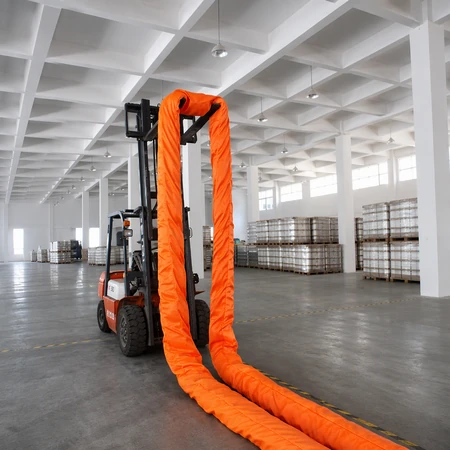
Lift sling rigging company produce Endless Round Sling.
Endless Round Sling — Closed-Loop Sling, 1–1000 t
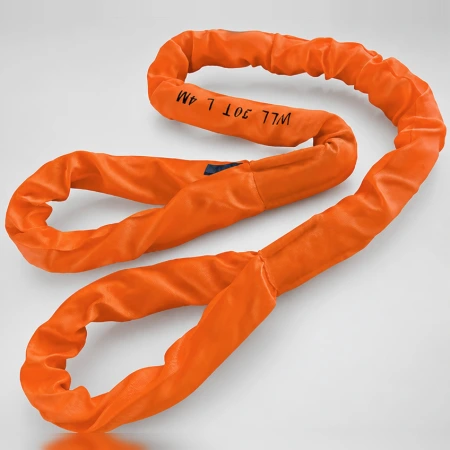
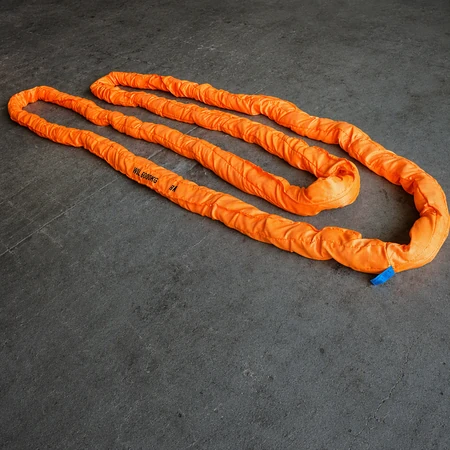
An sling bunder tanpa wates is a closed loop: the core runs continuously inside the sleeve and is closed on itself, so there is no eye, ora thimble, no hook and no stitching anywhere in the load path. It is made in high-tenacity polyester across 27 LFTEERS articles, saka 1,000 kg iki 1,000,000 kg, in bodies from 0.5 m kanggo 80 m. Because the loop has no ends it can be turned, re-reeved and re-oriented after a lift — which is why it is the usual choice for basket and choke work on plant that must not be marked.
- Watesan beban kerja1,000 kg iki 1,000,000 kg
- Range artikelLFTEERS-1 to LFTEERS-1000, 27 ukuran
- Ukuran awak15 × 50 mm nganti 610 × 1,060 mm
- dawa0.5–80 m, effective or circumference
- Unit bobot0.47 kanggo 226 kg/m
- No metalNothing on the sling touches the load
What “endless” changes for the rigger
Endless describes the construction of the loop, not the length of the article. Nothing is spliced, sewn or fitted into the load path, and four things follow on site.
- The loop has no direction. Both halves are the same article, so the sling can be turned end for end and re-reeved after a lift. In a basket the two legs are identical, which is not true of a sling with an eye at one end and a fitting at the other.
- Wear can be spread. The contact point moves as the sling is rotated along the loop, so the sleeve is not destroyed in one place while the rest of the body is new.
- There is nothing to mismatch. No eye has to be offered to a hook of the right shape, and no fitting has to be rated with the sling. The hook goes through the loop, or the loop goes round the load.
- The sleeve is the whole inspection. The core cannot be opened and looked at, so the sleeve is the window: what it shows is what the core has been through.
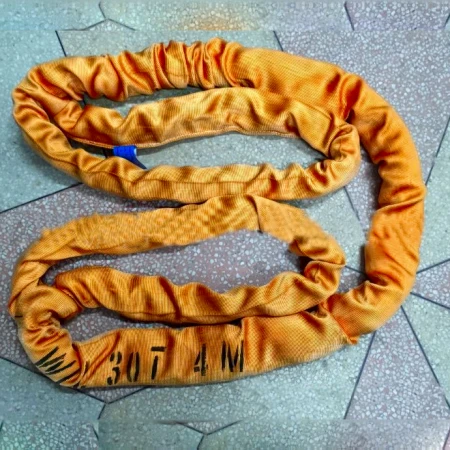
Endless Round Sling specifications
| produk | Endless round sling — closed-loop polyester round sling, 1 t iki 1000 t |
|---|---|
| Konstruksi | Continuous parallel filament core in a woven tubular sleeve, ditutup ing loop tanpa wates; no metal and no stitching in the load path |
| inti | High-tenacity polyester multifilament, paralel lay, waxed; UHMWPE or aramid to order |
| Lengan | Tenun poliester kanthi daya tahan dhuwur, standar lapisan siji; double sleeve to order |
| Watesan beban kerja | 1,000 kg iki 1,000,000 kg, kaki tunggal vertikal - 27 artikel, LFTEERS-1 to LFTEERS-1000 |
| Breaking load | 7 × working load limit |
| Faktor keamanan | 7:1 minangka standar; 5:1 to order for markets working to ASME B30.9 |
| Elongation ing WLL | Approximately 2–3 % |
| Suhu layanan | -40 °C iki +100 °C, polyester core |
| dawa | 0.5 m kanggo 80 m; minimum rises with the article, maximum is 80 m in every size |
| warna | Simpenan oranye utawa biru; ING 1492-2 capacity colour applied when the order asks for the standard code |
| menehi tandha | Working load limit and length printed on the sleeve; label sewn karo WLL, dawa, nomer serial lan standar |
| Testing | Bukti dimuat sadurunge dikirim; test record matched to the serial number |
| Packing | Coiled ing polybag, karton labeled; pallet utawa peti ing request |
| kode HS | 630790 - ngangkat slings saka bahan tekstil |
| MOQ / OEM | MOQ kurang kanggo pesenan nyoba; OEM ing dawa, warna lengan, serat inti, tata letak lan packing label |
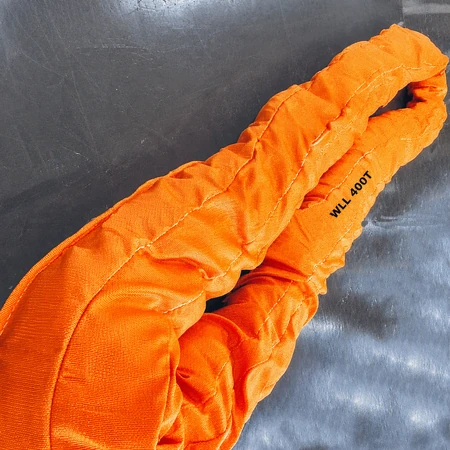
Range artikel: milih model
The article number carries the capacity — LFTEERS-10 is the 10,000 kg slendang, LFTEERS-100 the 100,000 kg siji. Kekandelan lan jembar nggambarake awak, the two length columns give the shortest and longest body made in that article, and the unit weight is what you add to the crane load.
| Art. No. | WLL (kg) | WLL (t) | kekandelan (mm) | Jembar (mm) | Min (m) | Maks (m) | Bobot (kg/m) |
|---|---|---|---|---|---|---|---|
| LFTEERS-1 | 1,000 | 1 | 15 | 50 | 0.5 | 80 | 0.47 |
| LFTEERS-2 | 2,000 | 2 | 16 | 60 | 0.5 | 80 | 0.60 |
| LFTEERS-3 | 3,000 | 3 | 18 | 70 | 0.5 | 80 | 0.82 |
| LFTEERS-4 | 4,000 | 4 | 20 | 75 | 0.5 | 80 | 1.20 |
| LFTEERS-5 | 5,000 | 5 | 25 | 80 | 0.5 | 80 | 1.47 |
| LFTEERS-6 | 6,000 | 6 | 27 | 90 | 1.0 | 80 | 1.70 |
| LFTEERS-8 | 8,000 | 8 | 28 | 100 | 1.0 | 80 | 2.20 |
| LFTEERS-10 | 10,000 | 10 | 29 | 110 | 2.0 | 80 | 3.00 |
| LFTEERS-12 | 12,000 | 12 | 30 | 125 | 2.0 | 80 | 3.40 |
| LFTEERS-15 | 15,000 | 15 | 31 | 150 | 2.0 | 80 | 4.00 |
| LFTEERS-20 | 20,000 | 20 | 32 | 180 | 2.5 | 80 | 5.60 |
| LFTEERS-25 | 25,000 | 25 | 34 | 200 | 2.5 | 80 | 6.80 |
| LFTEERS-30 | 30,000 | 30 | 68 | 220 | 2.5 | 80 | 8.20 |
| LFTEERS-40 | 40,000 | 40 | 75 | 250 | 2.5 | 80 | 10.9 |
| LFTEERS-50 | 50,000 | 50 | 86 | 270 | 2.5 | 80 | 13.8 |
| LFTEERS-60 | 60,000 | 60 | 126 | 280 | 4.0 | 80 | 16.6 |
| LFTEERS-80 | 80,000 | 80 | 138 | 300 | 4.0 | 80 | 22.0 |
| LFTEERS-100 | 100,000 | 100 | 152 | 320 | 4.0 | 80 | 27.0 |
| LFTEERS-200 | 200,000 | 200 | 230 | 460 | 5.0 | 80 | 66.0 |
| LFTEERS-300 | 300,000 | 300 | 310 | 535 | 5.0 | 80 | 82.0 |
| LFTEERS-400 | 400,000 | 400 | 380 | 680 | 5.0 | 80 | 98.0 |
| LFTEERS-500 | 500,000 | 500 | 410 | 760 | 8.0 | 80 | 116.0 |
| LFTEERS-600 | 600,000 | 600 | 460 | 830 | 8.0 | 80 | 139.0 |
| LFTEERS-700 | 700,000 | 700 | 498 | 880 | 8.0 | 80 | 155.0 |
| LFTEERS-800 | 800,000 | 800 | 520 | 940 | 9.0 | 80 | 178.0 |
| LFTEERS-900 | 900,000 | 900 | 580 | 1,000 | 9.0 | 80 | 202.0 |
| LFTEERS-1000 | 1,000,000 | 1,000 | 610 | 1,060 | 9.0 | 80 | 226.0 |
The series code is shown as supplied on the factory sheet. In that sheet the 20,000 kg article carries the code LFTEERS-15 for a second time; it is shown here as LFTEERS-20 so that the code matches the capacity ladder. Thickness and width are the body dimensions specified for the article, and the minimum length is the shortest body that can be closed and sleeved at that capacity. If your price list uses a different prefix, replace it across the table — the rest of the code is the capacity.
Capacity changes with the hitch, not with the tonnage on the sleeve
The figure printed on the sleeve is the working load limit of one leg hanging vertically. It is the number the sling is proof loaded against, and the starting point of a lifting plan — not the tonnage it will pick up in the arrangement you are actually using. Apply the factor for the hitch, and remember that a set of legs is calculated on fewer legs than it has, because a real load never sits perfectly symmetrically.
| Tatanan | Faktor | 5 t sling | 20 t sling |
|---|---|---|---|
| Sling siji, vertikal | × 1.0 | 5.0 t | 20.0 t |
| Sling siji, keselak | × 0.8 | 4.0 t | 16.0 t |
| Sling siji, basket 0–7° | × 2.0 | 10.0 t | 40.0 t |
| Sling siji, basket 7–45° | × 1.4 | 7.0 t | 28.0 t |
| Sling siji, basket 45–60° | × 1.0 | 5.0 t | 20.0 t |
| sikil loro, 0-45 ° saka vertikal | × 1.4 | 7.0 t | 28.0 t |
| sikil loro, 45-60 ° saka vertikal | × 1.0 | 5.0 t | 20.0 t |
| Sikil papat, 0-45 ° saka vertikal | × 2.1 | 10.5 t | 42.0 t |
| Sikil papat, 45-60 ° saka vertikal | × 1.5 | 7.5 t | 30.0 t |
Two lines in that table settle most orders. Pisanan, loro 5 t slings do not make a 10 t nyetel: at 0–45° from vertical they carry 7 t together, and past 45° they carry 5 t. Kapindho, a four-leg set is worked on three legs, which is why the factor is 2.1 lan ora 2.8. Where the capacity is close to the limit, the honest answer is usually a ngangkat balok rather than a bigger sling — keeping the legs vertical recovers the factor that an open leg angle has just spent.
dawa: effective length or circumference
Sling tanpa wates ora ana ujunge, dadi dawane bisa dipetik rong cara, a factor of two apart. This is the most common ordering error on a round sling and the most expensive to correct, because the sling has to be remade rather than adjusted.
| Dipetik minangka | Apa sing ditampa | Digunakake kanggo | Tuladha |
|---|---|---|---|
| Dawane kerja sing efektif | Setengah circumference - pancing mudhun kanggo mbukak lan gawe serep | Angkat vertikal lan keselak, where the hanging height is known | 4 m EWL = 8 m gelung |
| Lingkaran | Dawane loop lengkap | Basket ngangkat, where the girth of the load drives the length | 8 m loop = 4 m EWL |
On the slings we supply the figure printed on the sleeve is the dawa efektif, so the print and the quotation always agree. Kanggo kranjang, ngukur girth saka beban, add the headroom to the hook, and quote that figure: the body takes the long way round the load, and a sling that only just reaches forces the legs wide — the same as buying a smaller sling.
Where an endless loop earns its place
- Precast beams and bridge segments picked in a basket at each end, where the sleeve protects the formed face and the chamfer.
- Kumparan baja sitting in a basket, where the doubled body gives twice the vertical capacity and follows the curve of the coil instead of bearing on one line.
- Transformers, generators and machine beds with small trunnions and painted surfaces — nothing metal touches the load.
- Moulds and dies whose lifting holes are drilled, not designed for a fitting, so a soft loop threaded through the hole is the whole method.
- Skids, frames and offshore baskets choked at each corner with 6–12 m bodies, the sleeve taking the corner abrasion so the core does not.
- Stage and studio work around truss and set pieces where a scratch is a re-spray.
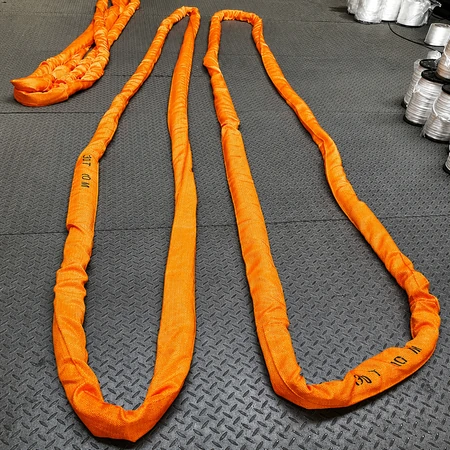
tanpa wates, eye-eye or flat webbing
| Kriteria | Sling bunder tanpa wates | Slendhang bunder mripat-mripat | Flat endless webbing sling |
|---|---|---|---|
| Kontak karo beban | Round body, conforms to curves and corners | Round body with two loaded eyes | Raine warata lebar, spreads pressure over an area |
| dawa | Set by the loop; either convention can be quoted | Fixed between the eyes | Set by the sewn loop |
| Muat dalan | terus-terusan, no termination | Inti terus menerus, eyes formed by the sleeve | Sewn join in the loop |
| Reeving | Can be turned and re-reeved after a lift | One orientation only | Can be turned, but the join takes the wear |
| Paling apik kanggo | Kerja bakul lan keselak, awkward plant, awak dawa | Repeated lifts on the same two points | jembar, flat and easily marked loads |
None of the three replaces another. For a fixed length and two known pick-up points see the slendhang bunder mripat-mripat; for a wide face and a visible load path see the sling anyaman datar tanpa wates. Both round sling forms are built from the same core and sleeve, so the choice is a rigging decision rather than a capacity one. For hard service the sling bulat lengan ganda nambah lapisan nyandhang kapindho ing rating padha, for weight-critical work there is a UHMWPE round sling inti, and for hot loads an sling bulat aramid.
Inspeksi lan pensiun
Inti ora bisa katon, so the sleeve is the record of what the sling has been through. Priksa sadurunge saben nggunakake, and formally at the interval your regime requires.
- Check the full length of the sleeve for cuts, snags, glazing, melts and chemical staining, and open the sleeve at the join if anything looks wrong.
- Read the print and the label. If the working load limit or the length can no longer be read, sling ora bisa diverifikasi lan metu saka layanan.
- Feel for grit inside the sleeve; it abrades the core from within long after the yard has been swept.
- Retire on any cut or hole that exposes the core, panas glazing, a core that has gone stiff or lumpy, chemical attack, or a missing label.
- Store coiled and off the floor, out of daylight and away from heat, solvents and weld spatter. Never store a sling wet in a closed bag.
- Aja nyeret sling sing dimuat miring, and never lift on a damaged sleeve.
Pitakonan sing kerep ditakoni
What is the difference between an endless round sling and a round sling with eyes?
An endless round sling is a closed loop with no termination: the core runs continuously inside the sleeve and nothing is spliced or sewn into the load path. A sling bunder kanthi mripat has two defined eyes at a fixed distance, so its length is set by the eyes and it works in one orientation.
Is the length the circumference or the effective length?
Both are used and they differ by a factor of two. Effective length is half the loop — hook down to the load and back up. Circumference is the full loop. A 4 m effective length is an 8 m gelung, so the convention has to be stated on the order.
How much capacity is lost in a choker?
A choked endless round sling is rated at 0.8 of its vertical working load limit, dadi a 5 t sling menehi 4 t. A basket raises the figure to 2.0 at 0–7°, 1.4 at 7–45° and 1.0 at 45–60°. A four-leg set is calculated on three legs, giving 2.1 at 0–45° from vertical and 1.5 at 45–60°.
What does LFTEERS-10 mean?
Nomer artikel minangka watesan beban kerja ing ton: LFTEERS-10 is 10,000 kg vertikal, LFTEERS-100 is 100,000 kg and LFTEERS-1000 is 1,000,000 kg. Kisaran nderek ing 1-2-3-4-5-6-8-10-12-15-20-25-30-40-50-60-80-100-200-300-400-500-600-700-800-900-1000 ladder, so there is no 7 t, 9 t utawa 11 t artikel.
How heavy is a long endless sling?
The last column of the article table is the weight per metre: 0.47 kg/m at LFTEERS-1, 3.00 kg/m at LFTEERS-10 and 226 kg/m at LFTEERS-1000. Multiply by the loop length and add the label and packing to get the figure to put against the crane. Where that number is a problem, a UHMWPE core gives the same capacity at a fraction of the weight.
Can the same sling be used in a basket and a choke?
ya wis, and that is one of the reasons for the endless form: the same article goes round the load either way. What changes is the working figure, so the rating has to be recalculated for the hitch actually used.
How is the sling tested and documented?
Each sling is proof loaded before dispatch and the test record is matched to the serial number on the sewn label. Breaking load is 7 × the working load limit, and the factor can be varied to order where the market requires it.
Request an endless round sling quotation
Kirimi beban saben sikil, the hitch and the leg angle, the distance between pick-up points and the headroom to the hook — plus the length convention and any marking or documentation your site requires. We will confirm capacity, length and sleeve, and quote factory-direct with a drawing, a proof-load record and a sample. Waca full round sling range for the rest of the series.
Entuk penawaran lan conto gratis