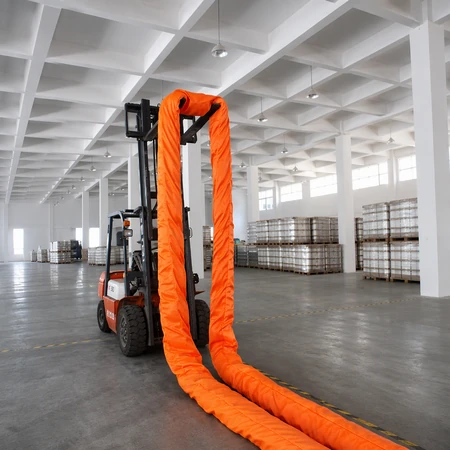
Kamfanin rigingimu na ɗaga majajjawa yana samar da Round Sling mara iyaka.
Endless Round Sling — Closed-Loop Sling, 1– 1000 t
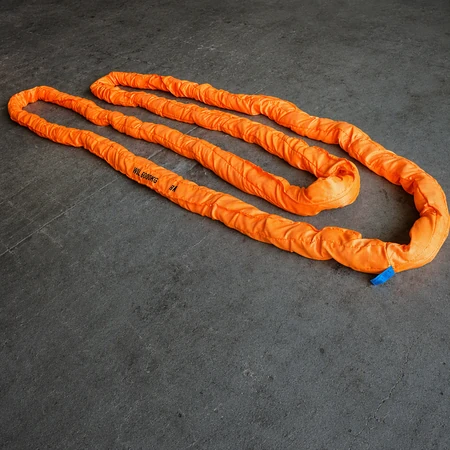
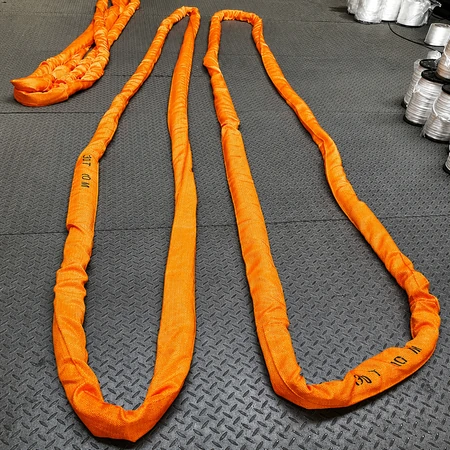
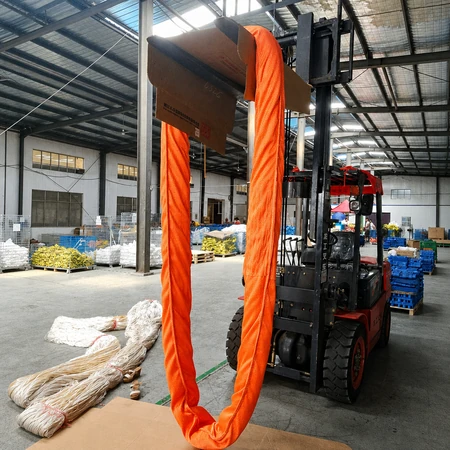
An majajjawa mara iyaka is a closed loop: the core runs continuously inside the sleeve and is closed on itself, so there is no eye, no thimble, no hook and no stitching anywhere in the load path. It is made in high-tenacity polyester across 27 LFTEERS articles, daga 1,000 kg ku 1,000,000 kg, in bodies from 0.5 m zuwa 80 m. Because the loop has no ends it can be turned, re-reeved and re-oriented after a lift — which is why it is the usual choice for basket and choke work on plant that must not be marked.
- Iyakar nauyin aiki1,000 kg ku 1,000,000 kg
- kewayon labarinLFTEERS-1 to LFTEERS-1000, 27 masu girma dabam
- Girman jiki15 × 50 mm zuwa 610 × 1,060 mm
- Tsawon0.5-80m, effective or circumference
- Nauyin raka'a0.47 ku 226 kg/m
- Babu karfeNothing on the sling touches the load
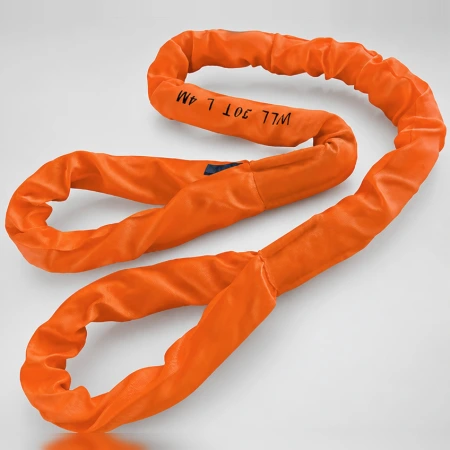
What “endless” changes for the rigger
Endless describes the construction of the loop, not the length of the article. Nothing is spliced, sewn or fitted into the load path, and four things follow on site.
- The loop has no direction. Both halves are the same article, so the sling can be turned end for end and re-reeved after a lift. In a basket the two legs are identical, which is not true of a sling with an eye at one end and a fitting at the other.
- Wear can be spread. The contact point moves as the sling is rotated along the loop, so the sleeve is not destroyed in one place while the rest of the body is new.
- There is nothing to mismatch. No eye has to be offered to a hook of the right shape, and no fitting has to be rated with the sling. The hook goes through the loop, or the loop goes round the load.
- The sleeve is the whole inspection. The core cannot be opened and looked at, don haka hannun riga ne taga: what it shows is what the core has been through.
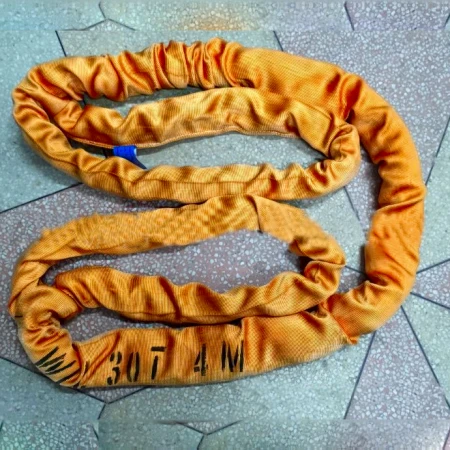
Endless Round Sling specifications
| Samfura | Endless round sling — closed-loop polyester round sling, 1 t zuwa 1000 t |
|---|---|
| Gina | Ci gaba da daidaitaccen ainihin filament a cikin saƙan tubular hannun riga, rufe cikin madauki mara iyaka; no metal and no stitching in the load path |
| Core | High-tenacity polyester multifilament, layi daya kwanta, kakin zuma; UHMWPE or aramid to order |
| Hannun hannu | Saƙa polyester mai ƙarfi, ma'auni guda ɗaya; hannun riga biyu don yin oda |
| Iyakar nauyin aiki | 1,000 kg ku 1,000,000 kg, kafa daya a tsaye - 27 labarai, LFTEERS-1 to LFTEERS-1000 |
| Karya kaya | 7 × working load limit |
| Safety factor | 7:1 a matsayin misali; 5:1 to order for markets working to ASME B30.9 |
| Canje-canje a cikin WLL | Approximately 2–3 % |
| Yanayin sabis | -40 °C zuwa +100 °C, polyester core |
| Tsawon | 0.5 m zuwa 80 m; minimum rises with the article, maximum is 80 m in every size |
| Launi | Stock orange ko blue; IN 1492-2 capacity colour applied when the order asks for the standard code |
| Alama | Working load limit and length printed on the sleeve; dinka tambarin WLL, tsayi, serial number da misali |
| Gwaji | An ɗora tabbacin kafin aikawa; rikodin gwajin yayi daidai da lambar serial |
| Shiryawa | An naɗe a cikin jakar poly, labeled kartani; pallet ko akwati akan buƙata |
| HS code | 630790 - dagawa majajjawa na kayan yadi |
| MOQ / OEM | Low MOQ don odar gwaji; OEM a tsawon, launi hannun riga, core fiber, label layout da shiryawa |
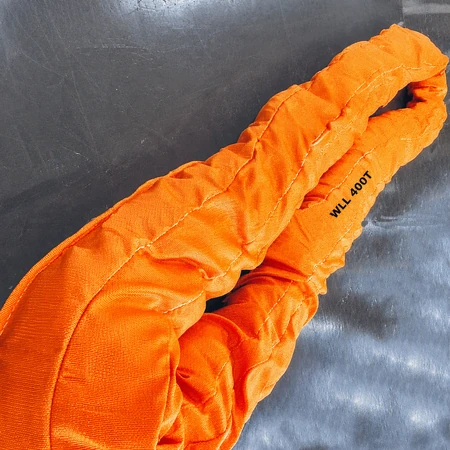
kewayon labarin: zabi samfurin
The article number carries the capacity — LFTEERS-10 is the 10,000 kg zare, LFTEERS-100 the 100,000 kg daya. Kauri da fadi suna kwatanta jiki, the two length columns give the shortest and longest body made in that article, and the unit weight is what you add to the crane load.
| Art. No. | WLL (kg) | WLL (t) | Kauri (mm) | Nisa (mm) | Min (m) | Max (m) | Nauyi (kg/m) |
|---|---|---|---|---|---|---|---|
| LFTEERS-1 | 1,000 | 1 | 15 | 50 | 0.5 | 80 | 0.47 |
| LFTEERS-2 | 2,000 | 2 | 16 | 60 | 0.5 | 80 | 0.60 |
| LFTEERS-3 | 3,000 | 3 | 18 | 70 | 0.5 | 80 | 0.82 |
| LFTEERS-4 | 4,000 | 4 | 20 | 75 | 0.5 | 80 | 1.20 |
| LFTEERS-5 | 5,000 | 5 | 25 | 80 | 0.5 | 80 | 1.47 |
| LFTEERS-6 | 6,000 | 6 | 27 | 90 | 1.0 | 80 | 1.70 |
| LFTEERS-8 | 8,000 | 8 | 28 | 100 | 1.0 | 80 | 2.20 |
| LFTEERS-10 | 10,000 | 10 | 29 | 110 | 2.0 | 80 | 3.00 |
| LFTEERS-12 | 12,000 | 12 | 30 | 125 | 2.0 | 80 | 3.40 |
| LFTEERS-15 | 15,000 | 15 | 31 | 150 | 2.0 | 80 | 4.00 |
| LFTEERS-20 | 20,000 | 20 | 32 | 180 | 2.5 | 80 | 5.60 |
| LFTEERS-25 | 25,000 | 25 | 34 | 200 | 2.5 | 80 | 6.80 |
| LFTEERS-30 | 30,000 | 30 | 68 | 220 | 2.5 | 80 | 8.20 |
| LFTEERS-40 | 40,000 | 40 | 75 | 250 | 2.5 | 80 | 10.9 |
| LFTEERS-50 | 50,000 | 50 | 86 | 270 | 2.5 | 80 | 13.8 |
| LFTEERS-60 | 60,000 | 60 | 126 | 280 | 4.0 | 80 | 16.6 |
| LFTEERS-80 | 80,000 | 80 | 138 | 300 | 4.0 | 80 | 22.0 |
| LFTEERS-100 | 100,000 | 100 | 152 | 320 | 4.0 | 80 | 27.0 |
| LFTEERS-200 | 200,000 | 200 | 230 | 460 | 5.0 | 80 | 66.0 |
| LFTEERS-300 | 300,000 | 300 | 310 | 535 | 5.0 | 80 | 82.0 |
| LFTEERS-400 | 400,000 | 400 | 380 | 680 | 5.0 | 80 | 98.0 |
| LFTEERS-500 | 500,000 | 500 | 410 | 760 | 8.0 | 80 | 116.0 |
| LFTEERS-600 | 600,000 | 600 | 460 | 830 | 8.0 | 80 | 139.0 |
| LFTEERS-700 | 700,000 | 700 | 498 | 880 | 8.0 | 80 | 155.0 |
| LFTEERS-800 | 800,000 | 800 | 520 | 940 | 9.0 | 80 | 178.0 |
| LFTEERS-900 | 900,000 | 900 | 580 | 1,000 | 9.0 | 80 | 202.0 |
| LFTEERS-1000 | 1,000,000 | 1,000 | 610 | 1,060 | 9.0 | 80 | 226.0 |
The series code is shown as supplied on the factory sheet. In that sheet the 20,000 kg article carries the code LFTEERS-15 for a second time; it is shown here as LFTEERS-20 so that the code matches the capacity ladder. Thickness and width are the body dimensions specified for the article, and the minimum length is the shortest body that can be closed and sleeved at that capacity. If your price list uses a different prefix, replace it across the table — the rest of the code is the capacity.
Capacity changes with the hitch, not with the tonnage on the sleeve
The figure printed on the sleeve is the working load limit of one leg hanging vertically. It is the number the sling is proof loaded against, and the starting point of a lifting plan — not the tonnage it will pick up in the arrangement you are actually using. Apply the factor for the hitch, and remember that a set of legs is calculated on fewer legs than it has, domin kaya na gaske baya zama daidai gwargwado.
| Shirye-shirye | Factor | 5 t majajjawa | 20 t majajjawa |
|---|---|---|---|
| Majajjawa ɗaya, a tsaye | × 1.0 | 5.0 t | 20.0 t |
| Majajjawa ɗaya, shake | × 0.8 | 4.0 t | 16.0 t |
| Majajjawa ɗaya, basket 0–7° | × 2.0 | 10.0 t | 40.0 t |
| Majajjawa ɗaya, basket 7–45° | × 1.4 | 7.0 t | 28.0 t |
| Majajjawa ɗaya, basket 45–60° | × 1.0 | 5.0 t | 20.0 t |
| Kafafu biyu, 0-45° daga tsaye | × 1.4 | 7.0 t | 28.0 t |
| Kafafu biyu, 45-60° daga tsaye | × 1.0 | 5.0 t | 20.0 t |
| Kafafu hudu, 0-45° daga tsaye | × 2.1 | 10.5 t | 42.0 t |
| Kafafu hudu, 45-60° daga tsaye | × 1.5 | 7.5 t | 30.0 t |
Two lines in that table settle most orders. Na farko, biyu 5 t majajjawa ba sa yin a 10 t saita: at 0–45° from vertical they carry 7 t together, and past 45° they carry 5 t. Na biyu, a four-leg set is worked on three legs, which is why the factor is 2.1 kuma ba 2.8. Where the capacity is close to the limit, the honest answer is usually a katako mai ɗagawa rather than a bigger sling — keeping the legs vertical recovers the factor that an open leg angle has just spent.
Tsawon: tsayi ko kewaye mai tasiri
Majajjawa mara iyaka ba ta da iyaka, don haka tsawonsa ana iya kawo shi ta hanyoyi biyu, a factor of two apart. This is the most common ordering error on a round sling and the most expensive to correct, because the sling has to be remade rather than adjusted.
| An nakalto kamar | Abin da kuke karba | An yi amfani da shi don | Example |
|---|---|---|---|
| Tsawon aiki mai inganci | Half the circumference — hook down to the load and back up | A tsaye da shake dagawa, inda aka san tsayin rataye | 4 m EWL = 8 m madauki |
| Da'irar | Cikakken madauki tsawon | Kwando daga, inda girkin kaya ke tafiyar da tsayi | 8 m loop = 4 m Ewl |
On the slings we supply the figure printed on the sleeve is the tasiri tsawon, don haka bugu da zance koyaushe suna yarda. Don kwando, measure the girth of the load, ƙara headroom zuwa ƙugiya, kuma ka faɗi wannan adadi: jiki yana ɗaukar hanya mai nisa zagaye da kaya, and a sling that only just reaches forces the legs wide — the same as buying a smaller sling.
Where an endless loop earns its place
- Precast beams and bridge segments picked in a basket at each end, where the sleeve protects the formed face and the chamfer.
- Karfe nada sitting in a basket, where the doubled body gives twice the vertical capacity and follows the curve of the coil instead of bearing on one line.
- Masu canji, janareta da gadaje na inji with small trunnions and painted surfaces — nothing metal touches the load.
- Molds kuma ya mutu whose lifting holes are drilled, ba a tsara don dacewa ba, so a soft loop threaded through the hole is the whole method.
- Skids, firam da kwanduna na bakin teku choked at each corner with 6–12 m bodies, the sleeve taking the corner abrasion so the core does not.
- Stage and studio work around truss and set pieces where a scratch is a re-spray.
Mara iyaka, eye-eye or flat webbing
| Ma'auni | Zagaye mara iyaka | Ido zagaye majajjawa | Flat endless webbing sling |
|---|---|---|---|
| Tuntuɓi tare da kaya | Round body, conforms to curves and corners | Round body with two loaded eyes | Fadin fuska, spreads pressure over an area |
| Tsawon | Set by the loop; either convention can be quoted | Fixed between the eyes | Set by the sewn loop |
| Hanya mai kayatarwa | Ci gaba, no termination | Ci gaba da tsakiya, eyes formed by the sleeve | Sewn join in the loop |
| Reeving | Can be turned and re-reeved after a lift | One orientation only | Can be turned, but the join takes the wear |
| Mafi kyau ga | Kwando da aikin shake, awkward plant, dogayen jiki | Repeated lifts on the same two points | Fadi, flat and easily marked loads |
None of the three replaces another. For a fixed length and two known pick-up points see the eye-eye round sling; for a wide face and a visible load path see the majajjawa lebur mara iyaka. Both round sling forms are built from the same core and sleeve, so the choice is a rigging decision rather than a capacity one. For hard service the majajjawa hannun riga biyu yana ƙara Layer wear na biyu a daidai wannan ƙimar, for weight-critical work there is a UHMWPE zagaye majajjawa cibiya, and for hot loads an aramid zagaye majajjawa.
Dubawa da ritaya
Ba za a iya ganin ainihin abin ba, so the sleeve is the record of what the sling has been through. Bincika kafin kowane amfani, kuma a bisa ƙa'ida a lokacin da tsarin mulkin ku ya buƙaci.
- Check the full length of the sleeve for cuts, snags, gilashin gilashi, narke da sinadarai, and open the sleeve at the join if anything looks wrong.
- Read the print and the label. If the working load limit or the length can no longer be read, the sling cannot be verified and comes out of service.
- Ji ga grit a cikin hannun riga; yana kawar da cibiya daga cikin dogon lokaci bayan an share farfajiyar.
- Retire on any cut or hole that exposes the core, zafi glazing, jigon da ya yi tauri ko kullutu, harin sinadari, ko alamar da ta ɓace.
- Ajiye an naɗe kuma daga ƙasa, daga hasken rana kuma daga zafi, kaushi da walda spatter. Never store a sling wet in a closed bag.
- Kada a taɓa ja majajjawa da aka ɗora a gefe, and never lift on a damaged sleeve.
Tambayoyin da ake yawan yi
What is the difference between an endless round sling and a round sling with eyes?
An endless round sling is a closed loop with no termination: the core runs continuously inside the sleeve and nothing is spliced or sewn into the load path. A zagaye majajjawa da idanu has two defined eyes at a fixed distance, so its length is set by the eyes and it works in one orientation.
Is the length the circumference or the effective length?
Both are used and they differ by a factor of two. Effective length is half the loop — hook down to the load and back up. Circumference is the full loop. A 4 m tsayin tasiri shine 8 m madauki, so the convention has to be stated on the order.
How much capacity is lost in a choker?
A choked endless round sling is rated at 0.8 of its vertical working load limit, haka a 5 t majajjawa yana bayarwa 4 t. A basket raises the figure to 2.0 at 0–7°, 1.4 at 7–45° and 1.0 at 45–60°. A four-leg set is calculated on three legs, giving 2.1 at 0–45° from vertical and 1.5 at 45–60°.
What does LFTEERS-10 mean?
The article number is the working load limit in tonnes: LFTEERS-10 is 10,000 kg a tsaye, LFTEERS-100 is 100,000 kg and LFTEERS-1000 is 1,000,000 kg. The range follows the 1-2-3-4-5-6-8-10-12-15-20-25-30-40-50-60-80-100-200-300-400-500-600-700-800-900-1000 tsani, so there is no 7 t, 9 t ko 11 t article.
How heavy is a long endless sling?
The last column of the article table is the weight per metre: 0.47 kg/m at LFTEERS-1, 3.00 kg/m at LFTEERS-10 and 226 kg/m at LFTEERS-1000. Multiply by the loop length and add the label and packing to get the figure to put against the crane. Where that number is a problem, a UHMWPE core gives the same capacity at a fraction of the weight.
Can the same sling be used in a basket and a choke?
Ee, and that is one of the reasons for the endless form: the same article goes round the load either way. What changes is the working figure, so the rating has to be recalculated for the hitch actually used.
How is the sling tested and documented?
Each sling is proof loaded before dispatch and the test record is matched to the serial number on the sewn label. Breaking load is 7 × the working load limit, and the factor can be varied to order where the market requires it.
Request an endless round sling quotation
Aika kaya kowace kafa, the hitch and the leg angle, the distance between pick-up points and the headroom to the hook — plus the length convention and any marking or documentation your site requires. Za mu tabbatar da iya aiki, tsawo da hannun riga, da faɗi factory-kai tsaye tare da zane, a proof-load record and a sample. Duba cikin full round sling range for the rest of the series.