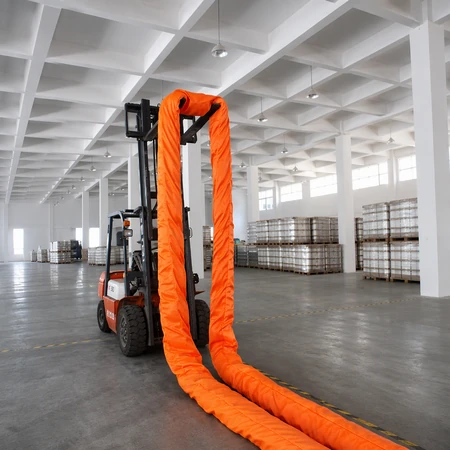
Ang kumpanya ng lift sling rigging ay gumagawa ng Endless Round Sling.
Endless Round Sling — Closed-Loop Sling, 1–1000 t
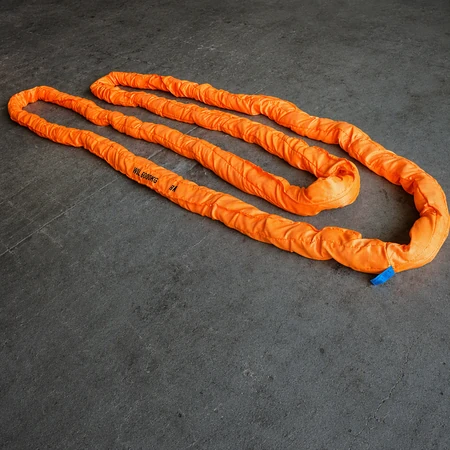
An walang katapusang bilog na lambanog is a closed loop: the core runs continuously inside the sleeve and is closed on itself, so there is no eye, walang didal, no hook and no stitching anywhere in the load path. It is made in high-tenacity polyester across 27 LFTEERS articles, mula sa 1,000 kg hanggang 1,000,000 kg, in bodies from 0.5 m sa 80 m. Because the loop has no ends it can be turned, re-reeved and re-oriented after a lift — which is why it is the usual choice for basket and choke work on plant that must not be marked.
- Limitasyon ng pagkarga sa pagtatrabaho1,000 kg hanggang 1,000,000 kg
- Saklaw ng artikuloLFTEERS-1 to LFTEERS-1000, 27 mga sukat
- Mga sukat ng katawan15 × 50 mm hanggang sa 610 × 1,060 mm
- Ang haba0.5–80 m, effective or circumference
- Timbang ng yunit0.47 sa 226 kg/m
- Walang metalNothing on the sling touches the load
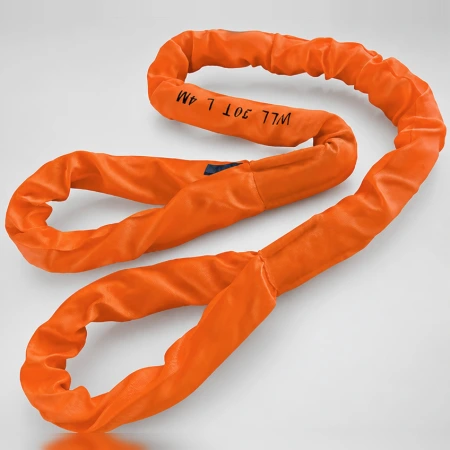
What “endless” changes for the rigger
Endless describes the construction of the loop, not the length of the article. Nothing is spliced, sewn or fitted into the load path, and four things follow on site.
- The loop has no direction. Both halves are the same article, so the sling can be turned end for end and re-reeved after a lift. In a basket the two legs are identical, which is not true of a sling with an eye at one end and a fitting at the other.
- Wear can be spread. The contact point moves as the sling is rotated along the loop, so the sleeve is not destroyed in one place while the rest of the body is new.
- There is nothing to mismatch. No eye has to be offered to a hook of the right shape, and no fitting has to be rated with the sling. The hook goes through the loop, or the loop goes round the load.
- The sleeve is the whole inspection. The core cannot be opened and looked at, kaya ang manggas ay ang bintana: what it shows is what the core has been through.
Endless Round Sling specifications
| produkto | Endless round sling — closed-loop polyester round sling, 1 t sa 1000 t |
|---|---|
| Konstruksyon | Ang tuluy-tuloy na parallel filament core sa isang habi na tubular na manggas, sarado sa isang walang katapusang loop; no metal and no stitching in the load path |
| Core | High-tenacity polyester multifilament, parallel lay, nilagyan ng wax; UHMWPE or aramid to order |
| manggas | Pinagtagpi na high-tenacity na polyester, solong layer na pamantayan; dobleng manggas para mag-order |
| Limitasyon ng pagkarga sa pagtatrabaho | 1,000 kg hanggang 1,000,000 kg, patayo ang isang paa - 27 mga artikulo, LFTEERS-1 to LFTEERS-1000 |
| Nakakasira ng load | 7 × working load limit |
| Salik ng kaligtasan | 7:1 bilang pamantayan; 5:1 to order for markets working to ASME B30.9 |
| Pagpahaba sa WLL | Approximately 2–3 % |
| Temperatura ng serbisyo | −40 °C hanggang +100 °C, polyester core |
| Ang haba | 0.5 m sa 80 m; minimum rises with the article, maximum is 80 m in every size |
| Kulay | Stock orange o asul; SA 1492-2 capacity colour applied when the order asks for the standard code |
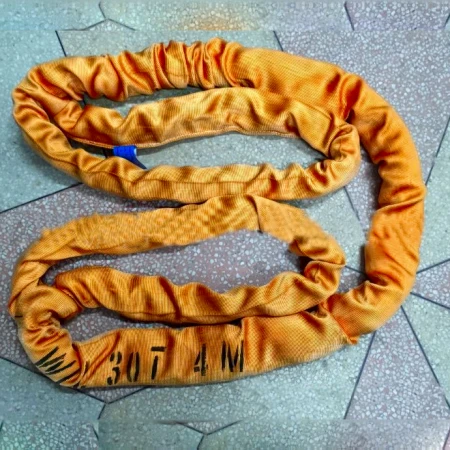
| Pagmamarka | Working load limit and length printed on the sleeve; sewn label na may WLL, haba, serial number at pamantayan |
| Pagsubok | Na-load ang patunay bago ipadala; test record na tumugma sa serial number |
| Pag-iimpake | Nakapulupot sa isang poly bag, may label na karton; papag o crate kapag hiniling |
| HS code | 630790 — pag-aangat ng mga lambanog ng mga materyales sa tela |
| MOQ / OEM | Mababang MOQ para sa isang trial order; OEM sa haba, kulay ng manggas, pangunahing hibla, layout ng label at pag-iimpake |
Saklaw ng artikulo: piliin ang modelo
The article number carries the capacity — LFTEERS-10 is the 10,000 kg lambanog, LFTEERS-100 the 100,000 kg isa. Ang kapal at lapad ay naglalarawan sa katawan, the two length columns give the shortest and longest body made in that article, and the unit weight is what you add to the crane load.
| Art.No. | WLL (kg) | WLL (t) | kapal (mm) | Lapad (mm) | Min (m) | Max (m) | Timbang (kg/m) |
|---|---|---|---|---|---|---|---|
| LFTEERS-1 | 1,000 | 1 | 15 | 50 | 0.5 | 80 | 0.47 |
| LFTEERS-2 | 2,000 | 2 | 16 | 60 | 0.5 | 80 | 0.60 |
| LFTEERS-3 | 3,000 | 3 | 18 | 70 | 0.5 | 80 | 0.82 |
| LFTEERS-4 | 4,000 | 4 | 20 | 75 | 0.5 | 80 | 1.20 |
| LFTEERS-5 | 5,000 | 5 | 25 | 80 | 0.5 | 80 | 1.47 |
| LFTEERS-6 | 6,000 | 6 | 27 | 90 | 1.0 | 80 | 1.70 |
| LFTEERS-8 | 8,000 | 8 | 28 | 100 | 1.0 | 80 | 2.20 |
| LFTEERS-10 | 10,000 | 10 | 29 | 110 | 2.0 | 80 | 3.00 |
| LFTEERS-12 | 12,000 | 12 | 30 | 125 | 2.0 | 80 | 3.40 |
| LFTEERS-15 | 15,000 | 15 | 31 | 150 | 2.0 | 80 | 4.00 |
| LFTEERS-20 | 20,000 | 20 | 32 | 180 | 2.5 | 80 | 5.60 |
| LFTEERS-25 | 25,000 | 25 | 34 | 200 | 2.5 | 80 | 6.80 |
| LFTEERS-30 | 30,000 | 30 | 68 | 220 | 2.5 | 80 | 8.20 |
| LFTEERS-40 | 40,000 | 40 | 75 | 250 | 2.5 | 80 | 10.9 |
| LFTEERS-50 | 50,000 | 50 | 86 | 270 | 2.5 | 80 | 13.8 |
| LFTEERS-60 | 60,000 | 60 | 126 | 280 | 4.0 | 80 | 16.6 |
| LFTEERS-80 | 80,000 | 80 | 138 | 300 | 4.0 | 80 | 22.0 |
| LFTEERS-100 | 100,000 | 100 | 152 | 320 | 4.0 | 80 | 27.0 |
| LFTEERS-200 | 200,000 | 200 | 230 | 460 | 5.0 | 80 | 66.0 |
| LFTEERS-300 | 300,000 | 300 | 310 | 535 | 5.0 | 80 | 82.0 |
| LFTEERS-400 | 400,000 | 400 | 380 | 680 | 5.0 | 80 | 98.0 |
| LFTEERS-500 | 500,000 | 500 | 410 | 760 | 8.0 | 80 | 116.0 |
| LFTEERS-600 | 600,000 | 600 | 460 | 830 | 8.0 | 80 | 139.0 |
| LFTEERS-700 | 700,000 | 700 | 498 | 880 | 8.0 | 80 | 155.0 |
| LFTEERS-800 | 800,000 | 800 | 520 | 940 | 9.0 | 80 | 178.0 |
| LFTEERS-900 | 900,000 | 900 | 580 | 1,000 | 9.0 | 80 | 202.0 |
| LFTEERS-1000 | 1,000,000 | 1,000 | 610 | 1,060 | 9.0 | 80 | 226.0 |
The series code is shown as supplied on the factory sheet. In that sheet the 20,000 kg article carries the code LFTEERS-15 for a second time; it is shown here as LFTEERS-20 so that the code matches the capacity ladder. Thickness and width are the body dimensions specified for the article, and the minimum length is the shortest body that can be closed and sleeved at that capacity. If your price list uses a different prefix, replace it across the table — the rest of the code is the capacity.
Capacity changes with the hitch, not with the tonnage on the sleeve
The figure printed on the sleeve is the working load limit of one leg hanging vertically. It is the number the sling is proof loaded against, and the starting point of a lifting plan — not the tonnage it will pick up in the arrangement you are actually using. Apply the factor for the hitch, and remember that a set of legs is calculated on fewer legs than it has, dahil ang isang tunay na load ay hindi kailanman nakaupo nang perpektong simetriko.
| Pag-aayos | Salik | 5 t lambanog | 20 t lambanog |
|---|---|---|---|
| Isang lambanog, patayo | × 1.0 | 5.0 t | 20.0 t |
| Isang lambanog, sinakal | × 0.8 | 4.0 t | 16.0 t |
| Isang lambanog, basket 0–7° | × 2.0 | 10.0 t | 40.0 t |
| Isang lambanog, basket 7–45° | × 1.4 | 7.0 t | 28.0 t |
| Isang lambanog, basket 45–60° | × 1.0 | 5.0 t | 20.0 t |
| Dalawang paa, 0–45° mula patayo | × 1.4 | 7.0 t | 28.0 t |
| Dalawang paa, 45–60° mula patayo | × 1.0 | 5.0 t | 20.0 t |
| Apat na paa, 0–45° mula patayo | × 2.1 | 10.5 t | 42.0 t |
| Apat na paa, 45–60° mula patayo | × 1.5 | 7.5 t | 30.0 t |
Two lines in that table settle most orders. Una, dalawa 5 t ang lambanog ay hindi gumagawa ng a 10 t set: at 0–45° from vertical they carry 7 t together, and past 45° they carry 5 t. Pangalawa, a four-leg set is worked on three legs, which is why the factor is 2.1 at hindi 2.8. Where the capacity is close to the limit, the honest answer is usually a pag-aangat ng sinag rather than a bigger sling — keeping the legs vertical recovers the factor that an open leg angle has just spent.
Ang haba: mabisang haba o circumference
Ang walang katapusang lambanog ay walang dulo, kaya ang haba nito ay maaaring sipiin ng dalawang paraan, a factor of two apart. This is the most common ordering error on a round sling and the most expensive to correct, because the sling has to be remade rather than adjusted.
| Sinipi bilang | Ang natatanggap mo | Ginagamit para sa | Halimbawa |
|---|---|---|---|
| Epektibong haba ng pagtatrabaho | Kalahati ng circumference — i-hook down sa load at i-back up | Mga patayo at may sinakal na pag-angat, kung saan alam ang taas na nakabitin | 4 m EWL = 8 m loop |
| Circumference | Ang buong haba ng loop | Pag-angat ng basket, kung saan ang girth ng load ang nagtutulak sa haba | 8 m loop = 4 m EWL |
On the slings we supply the figure printed on the sleeve is the epektibong haba, kaya laging magkasundo ang print at quotation. Para sa isang basket, sukatin ang girth ng load, idagdag ang headroom sa hook, at quote ang figure na iyon: ang katawan ay tumatagal ng mahabang paraan sa pag-ikot ng pagkarga, and a sling that only just reaches forces the legs wide — the same as buying a smaller sling.
Where an endless loop earns its place
- Mga precast beam at mga segment ng tulay picked in a basket at each end, where the sleeve protects the formed face and the chamfer.
- Steel coils sitting in a basket, where the doubled body gives twice the vertical capacity and follows the curve of the coil instead of bearing on one line.
- Mga transformer, mga generator at machine bed with small trunnions and painted surfaces — nothing metal touches the load.
- Molds at mamatay whose lifting holes are drilled, hindi dinisenyo para sa isang angkop, so a soft loop threaded through the hole is the whole method.
- Mga skid, mga frame at offshore basket choked at each corner with 6–12 m bodies, the sleeve taking the corner abrasion so the core does not.
- Stage and studio work around truss and set pieces where a scratch is a re-spray.
Walang katapusang, eye-eye or flat webbing
| Criterion | Walang katapusang bilog na lambanog | Mata-mata bilog na lambanog | Flat endless webbing sling |
|---|---|---|---|
| Makipag-ugnayan sa load | Round body, conforms to curves and corners | Round body with two loaded eyes | Malapad na patag na mukha, spreads pressure over an area |
| Ang haba | Set by the loop; either convention can be quoted | Fixed between the eyes | Set by the sewn loop |
| Mag-load ng landas | tuloy-tuloy, no termination | Continuous core, eyes formed by the sleeve | Sewn join in the loop |
| Reeving | Can be turned and re-reeved after a lift | One orientation only | Can be turned, but the join takes the wear |
| Pinakamahusay para sa | Trabaho ng basket at sakal, awkward plant, mahabang katawan | Repeated lifts on the same two points | Malapad, flat and easily marked loads |
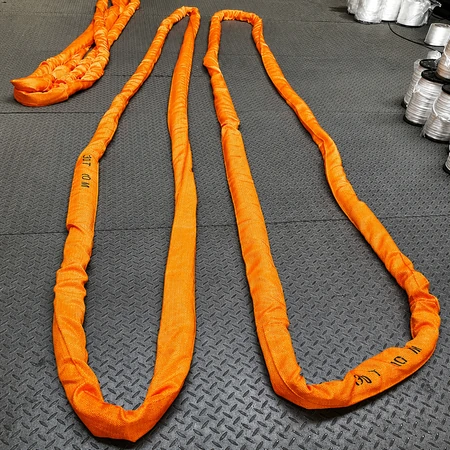
None of the three replaces another. For a fixed length and two known pick-up points see the mata-mata bilog na lambanog; for a wide face and a visible load path see the walang katapusang flat webbing sling. Both round sling forms are built from the same core and sleeve, so the choice is a rigging decision rather than a capacity one. For hard service the dobleng manggas na bilog na lambanog nagdaragdag ng pangalawang layer ng pagsusuot sa parehong rating, for weight-critical work there is a UHMWPE round sling core, and for hot loads an aramid bilog na lambanog.
Inspeksyon at pagreretiro
Hindi makikita ang core, so the sleeve is the record of what the sling has been through. Suriin bago ang bawat paggamit, at pormal sa pagitan na kailangan ng iyong rehimen.
- Check the full length of the sleeve for cuts, mga sagabal, nagpapakinang, natutunaw at paglamlam ng kemikal, and open the sleeve at the join if anything looks wrong.
- Read the print and the label. If the working load limit or the length can no longer be read, ang lambanog ay hindi mabe-verify at hindi na magagamit.
- Pakiramdam ang grit sa loob ng manggas; ito abrades ang core mula sa loob ng mahabang panahon matapos ang bakuran ay swept.
- Retire on any cut or hole that exposes the core, init glazing, isang core na naging matigas o bukol, atake ng kemikal, o isang nawawalang label.
- Mag-imbak ng nakapulupot at wala sa sahig, sa labas ng liwanag ng araw at malayo sa init, solvents at weld spatter. Never store a sling wet in a closed bag.
- Never drag a loaded sling sideways, and never lift on a damaged sleeve.
Mga madalas itanong
What is the difference between an endless round sling and a round sling with eyes?
An endless round sling is a closed loop with no termination: the core runs continuously inside the sleeve and nothing is spliced or sewn into the load path. A bilog na lambanog na may mga mata has two defined eyes at a fixed distance, so its length is set by the eyes and it works in one orientation.
Is the length the circumference or the effective length?
Both are used and they differ by a factor of two. Effective length is half the loop — hook down to the load and back up. Circumference is the full loop. A 4 m epektibong haba ay isang 8 m loop, so the convention has to be stated on the order.
How much capacity is lost in a choker?
A choked endless round sling is rated at 0.8 of its vertical working load limit, kaya a 5 nagbibigay ang t lambanog 4 t. A basket raises the figure to 2.0 at 0–7°, 1.4 at 7–45° and 1.0 at 45–60°. A four-leg set is calculated on three legs, giving 2.1 at 0–45° from vertical and 1.5 at 45–60°.
What does LFTEERS-10 mean?
Ang numero ng artikulo ay ang working load limit sa tonelada: LFTEERS-10 is 10,000 kg patayo, LFTEERS-100 is 100,000 kg and LFTEERS-1000 is 1,000,000 kg. Ang hanay ay sumusunod sa 1-2-3-4-5-6-8-10-12-15-20-25-30-40-50-60-80-100-200-300-400-500-600-700-800-900-1000 hagdan, so there is no 7 t, 9 t o 11 t artikulo.
How heavy is a long endless sling?
The last column of the article table is the weight per metre: 0.47 kg/m at LFTEERS-1, 3.00 kg/m at LFTEERS-10 and 226 kg/m at LFTEERS-1000. Multiply by the loop length and add the label and packing to get the figure to put against the crane. Where that number is a problem, a UHMWPE core gives the same capacity at a fraction of the weight.
Can the same sling be used in a basket and a choke?
Oo, and that is one of the reasons for the endless form: the same article goes round the load either way. What changes is the working figure, so the rating has to be recalculated for the hitch actually used.
How is the sling tested and documented?
Each sling is proof loaded before dispatch and the test record is matched to the serial number on the sewn label. Breaking load is 7 × the working load limit, and the factor can be varied to order where the market requires it.
Request an endless round sling quotation
Ipadala ang load sa bawat binti, the hitch and the leg angle, the distance between pick-up points and the headroom to the hook — plus the length convention and any marking or documentation your site requires. Kukumpirmahin namin ang kapasidad, haba at manggas, at quote factory-direct na may drawing, a proof-load record and a sample. Tingnan ang full round sling range for the rest of the series.
Kumuha ng libreng quote at sample