 702461526


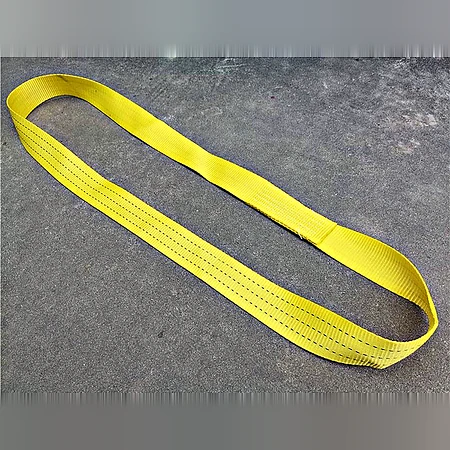
Lift sling rigging company produce Endless Type Webbing Sling.
Endless Type Webbing Sling
An Endless Type A Flat Woven Webbing Sling to EN 1492-1 — No Eyes, No Fittings, One Continuous Loop You Can Turn
An endless type webbing sling is the form that has no ends at all. A length of flat woven webbing is lapped back over itself and stitched to close the loop, so what comes off the shelf is one continuous band with no eyes to hook and no fittings to lose. Under EN 1492-1 this is the endless type A flat woven webbing sling, and it is made from one or two layers of webbing. Two things follow from that construction, and they are the whole point of the design: the loop can be rigged straight, choked, in a basket or double wrapped without changing the article, and because there is nothing fixed on it, the loop can be turned after every lift so that the wear point, the hook contact point and the joint itself keep moving around the webbing instead of staying in one place.
- No eyes, no fittings — nothing to hook wrongly and nothing to lose
- One loop, four hitches — straight, choked, basket and double wrap from the same sling
- Turn the loop to move the wear — the wear point, the hook point and the joint can all be rotated
- Lapped and stitched to full strength — one joint, heavily reinforced, and it is the first thing you inspect


Key Features
Nothing to Hook and Nothing to Lose
An eye has to go on the hook the right way, and a fitting can be dropped, swapped or lost. An endless sling is one band — there is nothing to assemble and nothing to leave on the floor.
Rotate the Loop, Spread the Wear
Every sling wears where it bears. With no fixed eyes, the bearing point, the hook contact point and the lap joint can all be moved around the webbing, so the loop wears evenly instead of at two points.
One Sling, Four Hitches
Straight, choked, basket and double wrap all come from the same loop, so one size on the rack covers the whole job and re-rigging is quick.
Never Too Long to Reach
A loop has no fixed pick-up points, so it can be doubled or shortened by taking another turn — which is why an endless sling often covers two sling lengths in one article.
Single or Double Ply
Built from one or two layers of webbing. Double ply is specified where the band will run over an edge or where a stiffer, longer-wearing sling is wanted.
From −40 °C to +100 °C
The standard polyester build covers that whole range, so the same sling works in a freezer store, a foundry yard in summer, and everything in between.
The Lapped Joint — What “Endless Type” Actually Means
It is worth being precise about this, because “endless” is used loosely in the trade and two very different articles answer to it.
An endless webbing sling is made from a length of flat woven webbing whose two ends are laid over one another and stitched together to close the loop. The result is genuinely endless in use — there are no ends to hook and no fitting anywhere — but it is not a seamless article. It has exactly one joint: the lapped and stitched closure, and that joint is made as a full-strength lap, closed across its whole length by several dense parallel rows of stitching, designed to carry the rated load.
That single fact changes how the sling is used and how it is inspected:
- The joint is the first thing you look at. It is the one place in the loop where the load passes through a made connection rather than through continuous weave, so it earns the first thirty seconds of every inspection.
- The joint can be rotated too. Because the whole loop turns, the joint can be moved out of the bearing area and out of the hook contact area, so it is not repeatedly loaded and worked in the same spot.
- The joint should be kept out of the bearing point where the geometry allows. It is built to take the load, but a lap that is repeatedly crushed between a hard edge and the load is a lap being used up unnecessarily. Rotating the loop is the cheapest way to avoid that.
Endless Webbing Sling or Eye and Eye Webbing Sling?
Both are flat woven webbing slings to the same standard and the same capacity ladder; the difference is the end arrangement, and therefore what the sling is good at.
| Property | Endless type webbing sling | Eye and eye webbing sling |
|---|---|---|
| Ends | None — one continuous loop | Two flat eyes, one at each end |
| Length | Not fixed by the article; can be doubled or taken up by another turn | A fixed length between two defined pick-up points |
| On the hook | The loop is simply sat over the hook; no eye to line up | Each eye has to be placed on the hook or shackle |
| Wear points | None fixed — the whole loop can be rotated | Always the same two bearing points and two eyes |
| Service life | Longer, because wear and the joint can be moved around the loop | Condemned when the fixed points wear out, even if the rest of the band is sound |
| Handle and store | Coils into a small bundle with no ends to tangle | Eyes can catch on racking and on each other |
| Best for | Choked lifts, bundles, general yard and site work, and any job where the same sling has to serve several different lifts | Lifts where the two pick-up points must be known and repeated, and where a defined length is part of the method |
Endless Webbing Sling vs Endless Round Sling
These two are both “endless”, both close into a loop and both come with no fittings — and they are not the same article at all. This is the distinction worth getting right before you buy either.
| Property | Endless type webbing sling | Endless round sling |
|---|---|---|
| Standard | EN 1492-1 — flat woven webbing slings | EN 1492-2 — round slings |
| Section | Flat band, rectangular cross-section | Round tube, circular cross-section |
| Load-bearing element | The flat woven webbing itself | A parallel fibre core, hidden inside a woven sleeve |
| Joint | One lapped and stitched joint closes the loop | No joint — the core is continuous; only the sleeve is a tube |
| First inspection point | The lap joint and the two bearing points | The sleeve over the whole loop, because the core is hidden |
| Bearing on the load | A broad flat contact patch — spreads the load over more surface | A narrow contact line that conforms closely to the shape |
| Fits round and awkward shapes | Good, but a flat band is less happy around tight curves | Excellent — a round section sits into curves and corners |
| Fits under a flat, wide load | Excellent — the flat band lies flat and spreads the bearing | Concentrates the bearing on a narrower line |
| Effect of a cut | Immediately visible and immediately serious — the load path is a single band | A cut sleeve is visible, but the core behind it may also be damaged and cannot be seen |
| Cost for the same capacity | Generally lower — simpler construction | Higher — a core and a sleeve are both made and assembled |

Colour, Capacity Stripes and Safety Factor — What the Marking Tells You
Under EN 1492-1 the colour of the webbing certifies one thing only: a working load limit band, in straight lift. It does not certify the material, the length, the safety factor, the manufacturer or the condition of the sling. Alongside the colour, the sling carries one black transverse stripe for every tonne of working load limit, so the two markings can be cross-checked against each other.
| WLL (straight lift) | Webbing colour | Black stripes | Reference width | Choked (× 0.8) | MBL at 7:1 |
|---|---|---|---|---|---|
| 1 t | Violet | 1 | Confirm | 0.8 t | 7 t |
| 2 t | Green | 2 | 50 mm | 1.6 t | 14 t |
| 3 t | Yellow | 3 | 75 mm | 2.4 t | 21 t |
| 4 t | Grey | 4 | 100 mm | 3.2 t | 28 t |
| 5 t | Red | 5 | 125 mm | 4.0 t | 35 t |
| 6 t | Brown | 6 | 150 mm | 4.8 t | 42 t |
| 8 t | Blue | 8 | 200 mm | 6.4 t | 56 t |
| 10 t | Orange | 10 | 250 mm | 8.0 t | 70 t |
Above 10 t the colour no longer identifies the sling, so the working load limit printed on the sewn label governs — read the label, not the colour. The label colour tells you a third, entirely separate thing: the fibre the webbing is made from. Blue label = polyester (PES); green label = polyamide (nylon); brown label = polypropylene.
Our position. Endless webbing slings supplied for EN 1492-1 markets are built with a 7:1 safety factor and marked to the standard, with a batch test certificate available on request. We also build to ASME B30.9 and AS 1353 where the destination market calls for it — the safety factor on the label changes, so state the destination on the enquiry.
How the Length of an Endless Webbing Sling Is Specified
An endless sling has no ends, so there is nothing to measure end to end. It is quoted in one of two ways, and the two differ by about a factor of two — which is the most common cause of an endless sling arriving at the wrong length.
- Circumference — the total perimeter of the loop: the length of webbing in the finished sling.
- Effective working length — the usable height you actually get, which is roughly half the circumference, because the loop is doubled when it hangs.
| Circumference ordered | Approx. effective working length | Typical use |
|---|---|---|
| 2 m | 1 m | Chokes and short lifts, tight rigging |
| 4 m | 2 m | The general-purpose size |
| 6 m | 3 m | Basket lifts on plant and fabrications |
| 8 m | 4 m | Long sections, bundles and pipework |
| 10 m | 5 m | Structure and large plant |
| 12 m | 6 m | Standard longest; longer to order |
Rigging the Loop — Straight, Choke, Basket and Angled Choke
The label figure is the straight lift rating. Every other arrangement is derived from it by a mode factor, and on a flat webbing sling the two you will use most are the choke and the basket.
| Hitch or mode | Mode factor M | What it means in practice |
|---|---|---|
| Straight lift | 1.0 | The label figure. The loop hangs as a U with both parts on the hook. |
| Choked | 0.8 | The loop passes round the load and back through itself so it grips. The natural way to pick up a steel section or a bundle — and it costs you a fifth of the rating. |
| Basket, 0–7° | 2.0 | The loop passes under the load with both legs on the hook, legs within 7° of vertical. Two parts of the webbing share the load. |
| Basket, 7–45° | 1.4 | As the legs open out, the tension in each rises and the usable capacity falls. |
| Basket, 45–60° | 1.0 | At this spread the basket gives you no more than a straight lift. |
| Angled choke at 45° | 0.7 | Where the sling is choked and the legs then open away from vertical. A choke placed straight onto the hook keeps the 0.8 factor. |
| Angled choke at 60° | 0.5 | The most heavily reduced arrangement in common use — check this figure before the lift, not after. |

Two flat-webbing habits are worth stating, because they do not apply to a round sling. Keep the band flat. A flat webbing sling that is allowed to twist into a rope concentrates the load on one edge of the band and loses the contact area that is its whole advantage. And protect the band at edges. On a machined or sheared steel edge, a webbing sling will fail at the edge long before it fails at the load — use an edge sleeve or a corner protector.

Technical Specifications
| Product name | Endless type webbing sling / endless type A flat woven webbing sling / circular webbing sling / endless flat webbing sling |
|---|---|
| Type | Endless, type A flat woven webbing sling to EN 1492-1 — a length of webbing lapped back over itself and stitched to close the loop |
| Material | 100% high-tenacity polyester (PES), blue label per the EN 1492-1 material convention; polyamide (nylon) and polypropylene also available |
| Working load limit | 1 t to 30 t (straight lift), in the EN 1492-1 band ladder |
| Safety factor | 7:1 to EN 1492-1 as standard; 5:1 to ASME B30.9 and 8:1 to AS 1353 built to order |
| Ply | Single ply as standard; double ply (duplex) on request |
| Webbing width | Matched to the band — the published reference series for this range is 2 t = 50 mm, 3 t = 75 mm, 4 t = 100 mm, 5 t = 125 mm, 6 t = 150 mm, 8 t = 200 mm, 10 t = 250 mm. The final width is stated on the order acknowledgement |
| Length | 1 m to 12 m as standard, longer on request; quoted by circumference or by effective working length — state which |
| Elongation | Maximum 3% at the working load limit; maximum 10% at the breaking load |
| Temperature range | −40 °C to +100 °C |
| Colour and marking | EN 1492-1 capacity colour with one black transverse stripe per tonne; sewn label carrying the WLL for straight lift, the material, the standard reference, the manufacturer, the length and a traceability code |
| Testing | Batch tested; test certificate supplied per batch on request |
| Packing | Coiled and bagged, labelled carton; custom export packing |
| MOQ & OEM | Low MOQ for trial orders; full OEM — band, ply, width, length, fibre, colour, label layout and packing |
Handling, Inspection and Limitations
An endless webbing sling is easy to inspect compared with a round sling, because the load path is the webbing itself and everything you need to see is on the surface. Inspect in this order.
- The lap joint first. Check every stitch row across the whole lap, check the webbing at the step at each end of the lap, and check that the two layers of the lap are still lying flat and parallel to each other. Broken, slack or pulled stitching condemns the sling.
- The bearing points. Where the band has been wrapped on loads — cuts, abrasion, glazing or a worn edge.
- The hook contact area. Where the loop has sat in the hook bowl, and where the webbing folds over itself.
- The rest of the band. A flat band carries the load across its whole width, so a cut at any point matters. Run the whole loop through your hands.
- Look for cuts at the edges from the load’s own corners. The classic flat webbing failure, and the classic reason an edge protector was needed.
- Look for glazing and hardening — a band that has become shiny or stiff has met heat or sustained friction.
- Rotate as policy, not as repair. Turn the loop after each lift so the bearing point, the hook point and the joint keep moving. Turning it only once it is worn is too late.
- Keep the band flat and untwisted in the hitch, and keep the joint out of the bearing area where you can.
- Protect against edges and heat. Both destroy flat webbing faster than load does.
- Record it. Log the lifts, the hitches, the loads and any damage, so a wear pattern is visible before it becomes a failure.
Applications
- Choked lifts on structural steel sections, beams and welded fabrications
- Basket lifts on plant, machinery, skids, dies and castings
- Bundles of tube, pipe and sections, choked or double wrapped
- Precast concrete units where a flat, broad bearing is wanted
- Crates, stillages and boxed goods
- General yard, depot and site work where one sling has to serve many different lifts
- Cold stores and cold-climate work, down to −40 °C
- Wet and damp conditions where a rust-free, rot-resistant sling is wanted
- Any lift where a sling with fixed ends keeps wearing out at the same two points
Customisation and OEM Service
Because the loop carries no hardware, an endless webbing sling is straightforward to build to order.
- Capacity — 1 t to 30 t, in the standard EN 1492-1 bands and in intermediate steps
- Ply and width — single or double ply, at the width that suits the load and the edge condition
- Length — by circumference or by effective working length, 1 m to 12 m as standard and longer on request
- Fibre — polyester (blue label) as standard; polyamide (green label) for low temperature and shock loading; polypropylene (brown label) for wet or mildly aggressive environments
- Colour and marking — the EN 1492-1 capacity colour and stripes, or your own marking scheme where the market allows; your label layout and language
- Joint position — the lap can be positioned and marked where your method statement requires it
- Matching items — eye and eye webbing slings, round slings and edge protectors for the same lift
Quality Control
Every length of webbing is checked for weave, width and colour before it is cut. Every lap joint is checked on its overlap length, the alignment of the two layers and the number and continuity of its stitch rows. Every finished sling is checked on its circumference or working length, its band marking, its label and its traceability code before packing, and each batch is tested. We have manufactured slings, webbing and rope products for industrial, safety and export customers for close to three decades, and we keep the process visible: on request we supply the webbing certificate, the batch test figures and a sample sling for you to handle and test before volume production begins.
Frequently Asked Questions
What is an endless type webbing sling?
Under EN 1492-1 it is the endless type A flat woven webbing sling: a length of flat woven webbing whose two ends are lapped back over one another and stitched together to close the loop. The result is a continuous loop with no eyes to hook and no fittings to lose, made from one or two layers of webbing. It has exactly one joint — the lapped and stitched closure — and that joint is built to carry the rated load.
Is an endless webbing sling really seamless?
No, and it is worth being clear about it. It is endless in use — there are no ends and no fittings — but the loop is closed by a lapped and stitched joint, so there is one made connection in it. That joint is a full-strength lap with several dense rows of stitching, and it is the first thing to inspect. If you need an endless sling with no joint at all in the load-bearing element, that is an endless round sling, where the load-bearing core is continuous and only the outer sleeve is a tube.
Should I choose an endless webbing sling or an eye and eye webbing sling?
Endless if you want the longest life and the most versatility from one sling: there are no fixed bearing points, so the loop can be rotated to move the wear, the hook contact area and the joint around the webbing. Eye and eye if your method statement has to state where the sling attaches and at what length — two defined pick-up points are easier to hook, shackle and hand over between shifts. Both are made from the same webbing, at the same capacities.
How do I specify the length?
Say which convention your figure is in, because the two differ by about a factor of two. Circumference is the total perimeter of the loop — the length of webbing in the finished sling. Effective working length is the usable height you actually get, and it works out at roughly half the circumference because the loop is doubled when it hangs. If you would rather, just tell us how far the hook will be from the load and we will size the loop to it.
How much can it lift in a choke or a basket?
The label gives the straight-lift working load limit. A choke reduces it to 0.8 times that figure. A basket at a narrow angle increases it to 2 times, falling to 1.4 times between 7 and 45 degrees and to 1 times between 45 and 60 degrees. An angled choke — choked, with the legs then opening away from vertical — is reduced further, to 0.7 at 45 degrees and 0.5 at 60 degrees. Always confirm the hitch and the angle before the lift.
Does the colour tell me everything I need to know?
No. Under EN 1492-1 the webbing colour certifies one thing only: the working load limit band, in straight lift. It does not tell you the material, the length, the safety factor or the condition of the sling. The black transverse stripes give the tonne figure so the two markings can be cross-checked, and the label colour separately tells you the fibre — blue for polyester, green for polyamide, brown for polypropylene. Note the trap: green webbing means a 2 t band, while a green label means nylon. Two unrelated meanings for the same word on the same object.
Can I get a custom band, ply, length, fibre and marking?
Yes. We build from 1 t to 30 t in the EN 1492-1 bands, in single or double ply, at the width that suits your load, in any length to 12 m as standard and longer on request, in polyester (blue label), polyamide (green label) or polypropylene (brown label), with the standard capacity colour and stripes or your own marking scheme where the market allows. Tell us the load, the hitch and the destination market and we will work the specification out with you.
Request a Quote for Endless Webbing Slings
Send us the load and its shape, the hitch you intend to use, whether you are quoting circumference or working length, the fibre you need, and the standard and destination market the sling must be built to. We will come back with a band, a ply, a width, a length, a sample and a factory-direct price.