 702461526
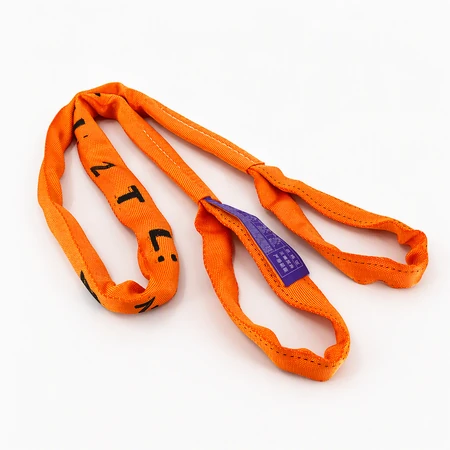

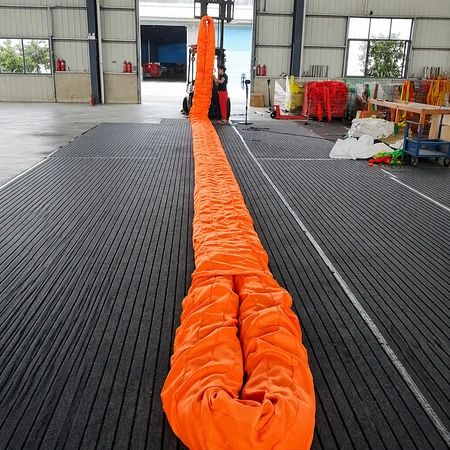

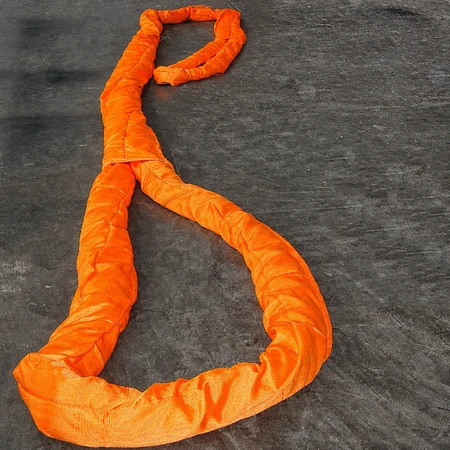
Lift sling rigging company produce Eye-Eye Round Sling,Eye & Eye Round Sling,Eye and Eye Polyester Round Sling,double-eye round sling.
Eye to Eye Round Sling With Protection
Stainless Steel Thimbles in the Eyes · Reinforced Eyes · Replaceable Wear Sleeves Over the Body
This is the protected version of an eye-and-eye round sling. The construction beneath is familiar — a load-bearing parallel core inside a woven sleeve, gathered and stitched into an eye at each end — but every part of the sling that touches something hard has been given a sacrificial layer. A stainless steel thimble is seated inside each eye, so the hook bowl and the shackle pin bear on steel instead of on the sleeve and its stitching. The eyes themselves are reinforced, and the body carries replaceable wear sleeves over the sections that bear on the load. The logic is simple and it comes from where these slings actually fail: on an unprotected eye-and-eye sling the eye is the first thing to go, because the metal bears directly on it. This sling puts a replaceable part at exactly that point.
- Thimbles in both eyes — steel on steel at the hook, not steel on fabric
- Reinforced eyes — the termination that fails first, made heavier
- Replaceable wear sleeves — the abrasion happens to a part you can re-order
- Same capacity — protection does not reduce the working load limit


Why Protection — and Where It Goes
An eye-and-eye round sling has one point that an endless round sling does not have: the termination. On an endless sling the load transfers continuously around the loop. On this design it has to pass through two stitched eyes — and those two eyes take every contact with the hook, the shackle, the beam lug and the edge of the load, in the same place, every lift.
That is why an unprotected eye-and-eye sling wears out at the eyes first, and why the protection on this sling is concentrated in three places rather than spread evenly:
- Inside the eye — a thimble. The hook bowl and the shackle pin normally bear directly on the sleeve and on the stitch rows. A seated steel thimble takes that contact, spreads it over a curved hard surface and keeps the eye open so it can be placed quickly.
- The eye itself — reinforcement. Extra material and extra stitch rows at the gather, so the termination that wears first starts with more to wear.
- The body — wear sleeves. Where the sling bears on a sharp or abrasive load edge, a separate outer sleeve takes the abrasion instead of the load-bearing sleeve beneath it.
Key Features
Steel Bearing at the Hook
The thimble turns point contact between a hook bowl and fabric into a broad steel-on-steel bearing, which is what stops the eye being cut through at the hook.
Reinforced Terminations
The eyes carry extra material and extra stitching. On a sling whose eyes are the first thing to wear, that is where the reserve belongs.
Wear Parts You Can Re-order
Thimbles and wear sleeves are separate items. A worn thimble or a burnt-through sleeve is a replacement part, not a reason to scrap the sling.
Eyes That Stay Open
A thimbled eye holds its shape, so it can be dropped over a hook or threaded onto a shackle in gloves, in poor light and at height.
Built for Sharp Loads
A wear sleeve between the sling and a sheared steel edge is the difference between an abrasion mark and a cut load path.
Capacity Unchanged
Protection does not cost capacity. The working load limit, the colour code and the mode factors are the same as for any round sling of the same sleeve.
Thimble Options
| Thimble type | Material | Bearing behaviour | Choose it for |
|---|---|---|---|
| Heavy-duty steel thimble | Galvanised steel, heavy section | Hard steel on steel, maximum wear life | Heavy service, repeated hook and shackle work, abrasive sites |
| Stainless steel thimble | AISI 304 / 316 stainless | Hard and corrosion resistant | Wet, marine, chemical or wash-down environments |
| Light steel thimble | Galvanised steel, lighter section | Hard steel, less weight | Moderate service where sling weight or hook congestion matters |
| Polymer thimble | Engineering polymer | Softer bearing surface | Where the hook or an adjacent component must not be marked, or a lighter sling is wanted |
| No thimble (plain stitched eye) | — | Fabric bears directly on the hook | Light and moderate service, and where the eye has to pass through a tight aperture |
Wear Protection Options
| Protection | What it covers | Replaceable | Choose it for |
|---|---|---|---|
| Reinforced eye | The two eyes, built into the sling | No — part of the sling | Hard service where a loose pad would be lost or forgotten |
| Eye wear pad | The two eyes, as a separate item | Yes | Where the eyes meet a rough hook bowl, a shackle pin or a load edge |
| Body wear sleeve (sliding) | Any chosen section of the body | Yes | Where the body bears on a sharp or abrasive load edge that stays in one place |
| Full-length body sleeve | The whole body | Yes | High-abrasion service, or where the bearing point moves from lift to lift |
| Edge protector (separate) | The contact point only | Yes | Sharp sheared edges, used together with any of the above |
Protected vs Unprotected Eye and Eye Round Sling
Same core, same sleeve, same capacity. The difference is entirely in what happens at the points of contact.
| Property | Protected (this sling) | Plain eye and eye round sling |
|---|---|---|
| Bearing at the hook | Steel thimble bears on steel | Fabric eye bears directly on the hook |
| What wears first | The thimble — a replaceable part | The eye — the sling itself |
| Bearing on a sharp load edge | A wear sleeve takes the abrasion | The load-bearing sleeve takes it directly |
| Replaceable components | Thimbles and wear sleeves | None — the whole sling is the consumable |
| Eye stiffness | Holds its shape; quick to place | Soft; collapses and must be worked onto the hook |
| Weight | Slightly heavier | Lightest |
| Passing a tight aperture | The thimble adds bulk | A soft eye threads through more easily |
| Inspection points | Thimble, eye stitching, wear sleeve, body | Eye stitching, body |
| Choose it for | Repeated hooking, abrasive loads, sharp edges, hard service, wet or marine sites | Light and moderate service, and lifts where the eye must thread through something |
Working Load Limit, Colour Code and Configuration
Protection does not change the rating. The working load limit is the same as for any round sling of the same sleeve, and the figure on the label is the vertical rating. Every other arrangement is derived from it by a mode factor.
| WLL (vertical) | EN 1492-2 colour | Choked (× 0.8) | Basket 0–7° (× 2.0) | Basket 7–45° (× 1.4) | Basket 45–60° (× 1.0) |
|---|---|---|---|---|---|
| 1 t | Purple | 0.8 t | 2.0 t | 1.4 t | 1.0 t |
| 2 t | Green | 1.6 t | 4.0 t | 2.8 t | 2.0 t |
| 3 t | Yellow | 2.4 t | 6.0 t | 4.2 t | 3.0 t |
| 4 t | Grey | 3.2 t | 8.0 t | 5.6 t | 4.0 t |
| 5 t | Red | 4.0 t | 10.0 t | 7.0 t | 5.0 t |
| 6 t | Brown | 4.8 t | 12.0 t | 8.4 t | 6.0 t |
| 8 t | Blue | 6.4 t | 16.0 t | 11.2 t | 8.0 t |
| 10 t | Orange | 8.0 t | 20.0 t | 14.0 t | 10.0 t |
| 12 t | Orange | 9.6 t | 24.0 t | 16.8 t | 12.0 t |
The colour code runs from 1 t to 10 t, with 12 t also orange. Above 12 t the colour no longer identifies the sling, so the working load limit printed on the sewn label is the figure that governs — read it, do not read the colour.
Technical Specifications
| Product name | Eye to eye round sling with protection / protected round sling / round sling with thimbles / reinforced eye round sling |
|---|---|
| Construction | Continuous parallel core inside a woven tubular sleeve; the sleeve gathered and stitched at each end into a reinforced eye, with a thimble seated in each eye |
| Core material | High-tenacity polyester parallel yarn as standard; aramid and other fibres available on request |
| Sleeve material | Woven high-tenacity polyester, single or double layer; heat resistant and other sleeves to order |
| Thimbles | Heavy-duty galvanised steel, stainless steel, light steel or polymer — one fitted in each eye |
| Wear protection | Reinforced eyes, eye wear pads, sliding or full-length body wear sleeves, and separate edge protectors |
| Working load limit | 1 t to 100 t, in the standard steps 1 · 2 · 3 · 4 · 5 · 6 · 8 · 10 · 12 · 15 · 20 · 25 · 30 · 40 · 50 · 100 t |
| Safety factor | EN 1492-2 practice is 7:1; other factors produced to order where your market requires them |
| Length | Specified as the eye-to-eye distance. The thimble adds slightly to the overall length and a minimum applies which rises with the capacity |
| Elongation | Low stretch — a parallel polyester core elongates far less than a nylon sling of the same capacity |
| Marking | Sewn label with working load limit, eye-to-eye length and batch |
| Packing | Coil in a poly bag or carry bag, labelled carton, custom export packing |
| MOQ & OEM | Low MOQ for trial orders; full OEM — capacity, length, thimble type, protection, sleeve colour and fibre, label layout and packing |
Handling, Inspection and Limitations
This sling has one more thing to inspect than a plain eye-and-eye sling, and one of those things is metal. Inspect it in this order, every use.
- The thimbles first. Look for a reduced section, a flattened or distorted shape, cracking, deep grooving where the hook has borne on it, corrosion, and any sharp edge or burr at the ends of the thimble. A thimble worn thin or sharpened by the hook must be replaced before the next lift.
- Then the eyes. As on any eye-and-eye sling: look at the stitch rows, the gather where the sleeve narrows, and the sleeve where it passes around and through the eye. Broken, slack, pulled or abraded stitching takes the sling out of service.
- Then the wear sleeves and pads. These are the consumable parts. Worn through, hardened, burnt or holed, they have done their job — replace them rather than run the sling on the exposed layer beneath.
- Then the whole body. Cuts, abrasion, glazing, and any place the core is showing or bulging.
- Do not mix thimble sizes or types. A thimble that does not match the eye it is fitted to does not protect it, and can cut it.
- Do not hook the thimble on a worn or sharp hook. A hook with a grooved bowl will wear the thimble fast; a hook with a burr will cut it.
- Never exceed the working load limit because protection is fitted. The protection changes what wears, not what the sling can carry.
- Record it — log the lifts and record the date each thimble and wear sleeve was replaced, so the pattern of wear is visible before it becomes a failure.
Applications
- Steel plate, sheet and coil packs with sharp sheared edges
- Repeated hooking and un-hooking, where a soft eye wears out long before the body does
- Shackle rigging, where the pin bears directly on the eye on every lift
- Abrasive and gritty sites — foundries, quarries, castings and concrete products
- Marine, port and wash-down environments, where a stainless thimble earns its place
- Machinery, dies and castings where the load edge is hard and the bearing point is fixed
- Any lift where an unprotected eye-and-eye sling has been wearing out at the eyes


Customisation and OEM Service
Protection is specified against the actual points of contact on your lift, so tell us what the sling touches and where. The capacity and the eye-to-eye length set the sling; the contact points set the protection.
- Capacity — 1 t to 100 t, including intermediate steps between the standard sizes
- Eye-to-eye length — specified to your measurement, within the minimum for the capacity
- Thimbles — heavy-duty steel, stainless, light steel or polymer, or no thimble where the eye must thread through an aperture
- Wear protection — reinforced eyes, eye pads, sliding or full-length body sleeves, and edge protectors
- Spares — thimbles, pads and wear sleeves supplied separately so the sling can be kept in service
- Marking and related items — your label layout and language; matching plain round slings and webbing slings for the same lift
Quality Control
Every core is checked for filament count and lay before the sleeve is closed; the sleeves and thimbles are checked for material, fit and finish; and every finished sling is checked on its eye stitching, its thimble seating, its eye-to-eye length, its working load limit marking and its label before packing. We have manufactured slings, webbing and rope products for industrial, safety and export customers for close to three decades, and we keep the process visible: on request we supply the fibre certificate, the thimble material certificate, the batch test figures and a sample sling for you to handle and test before volume production begins.
Frequently Asked Questions
What is a protected eye to eye round sling?
An eye-and-eye round sling — a parallel core inside a woven sleeve, gathered and stitched into an eye at each end — with stainless or galvanised steel thimbles seated in the eyes, reinforced terminations, and separate replaceable wear sleeves over the sections of the body that bear on the load. It keeps the round sling’s capacity and adds sacrificial parts at the points that actually wear.
What does the thimble actually do?
It changes what bears on what. Without a thimble, the hook bowl or the shackle pin bears directly on the sleeve and on the stitch rows of the eye — which is why the eye is the first part of an unprotected eye-and-eye sling to fail. With a thimble, the metal bears on steel: the contact is spread over a curved hard surface, the stitching is shielded, and the thimble is the part that wears and gets replaced. It also holds the eye open, which makes the sling much quicker to place on a hook.
Does the thimble increase the working load limit?
No. The working load limit is set by the core and the sleeve, and it is identical to the same sling without thimbles. The thimble is a bearing surface and a wear part, not a separately rated lifting fitting. Never take the presence of a thimble as permission to lift more.
Why wear sleeves on the body as well as thimbles in the eyes?
Because they address two different contacts. The thimble handles the contact at the hook, where the sling meets metal hardware. The body wear sleeves handle the contact with the load, where a sheared steel edge or a rough casting abrades the sleeve. A sling can need one, the other, or both, depending on where it touches something hard.
How do I know when to replace a thimble or a wear sleeve?
On condition. A thimble should be replaced when its section is visibly reduced, when it is flattened, grooved, cracked or corroded, or when the hook has worn a sharp edge onto it. A wear sleeve or pad should be replaced when it is worn through, hardened, burnt or holed — that is what it is there for. Both are separate items, so replacing them costs far less than replacing the sling.
Can I have it without thimbles, or with a different thimble type?
Yes. We supply heavy-duty galvanised steel, stainless steel, light steel and polymer thimbles, and we build the same sling with plain stitched eyes where the eye has to pass through a tight aperture. Tell us the environment and the hardware the eye will sit on and we will specify the thimble — or tell you that none is needed.
Request a Quote for Protected Eye to Eye Round Slings
Send us the capacity, the eye-to-eye length, the hardware the eyes will sit on, what the body will bear against and the environment — plus any marking or certification your market requires. We will come back with the thimble type, the protection, a sample and a factory-direct price.