 702461526
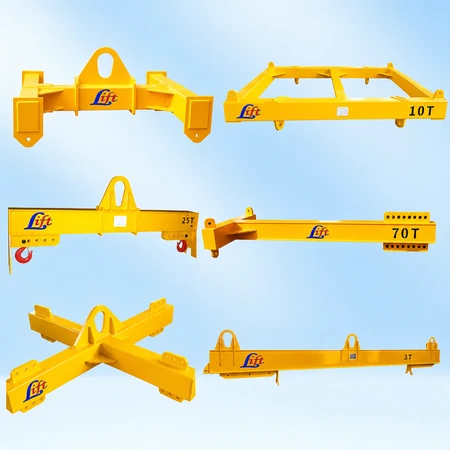

Lift sling rigging company produce Lifting Beam,Balance Lifting Beam,H-shaped lifting beam,Adjustable lifting beam,Crane lifting beam,Adjustable and fixed length lifting beams.
Lifting Beam
Spreader Beam & Lifting Spreader Beam — 100 kg to 180 Tonnes, Custom Spans to 25 m
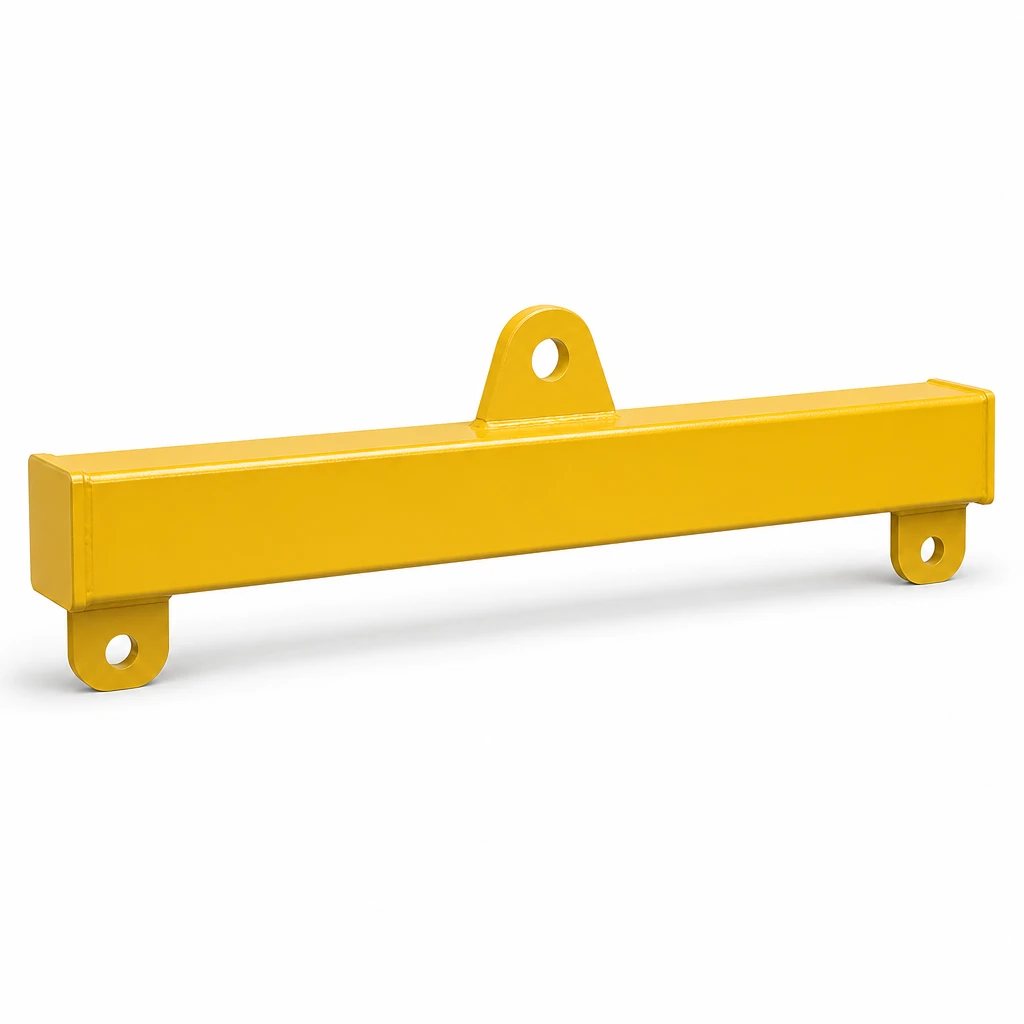
A lifting beam hangs from the crane hook and spreads the slings apart, so the load is picked up at two, four or more points that are already in the correct position. Because the slings hang vertically, the load is never squeezed inward — a two-leg sling at a wide included angle does exactly that, and it also multiplies the tension in the sling legs. A lifting beam converts those forces into simple bending inside the beam. We manufacture fixed, adjustable and telescopic lifting beams and spreader beams from 100 kg to 180 tonnes, in spans up to 25 m, in box, H-section and truss construction, proof load tested before dispatch.
- Slings stay vertical — no inward squeeze on the load, no load damage
- Cuts sling tension — the beam absorbs the forces that a wide sling angle would multiply
- Low headroom option — spreads the pick points without eating lifting height
- Balanced, stable lifts — adjustable hook positions let you set the centre of gravity
Key Features of Our Lifting Beam
Vertical Slings, Undamaged Load
Because the pick points sit directly above the attachment points, the slings hang vertically and put no inward compression on the load — critical for thin plates, coated sections, precast panels and finished machined parts.
Lower Sling Tension
A two-leg sling at 120° included angle has to carry the full load weight in each leg. A lifting beam takes that multiplication out of the system, so you can rig with lighter, more manageable slings.
Low-Headroom Designs
Where the crane hook cannot be raised far above the load, a shallow box or plate beam spreads the pick points without consuming the vertical space a wide sling angle would need.
Adjustable Hook Positions
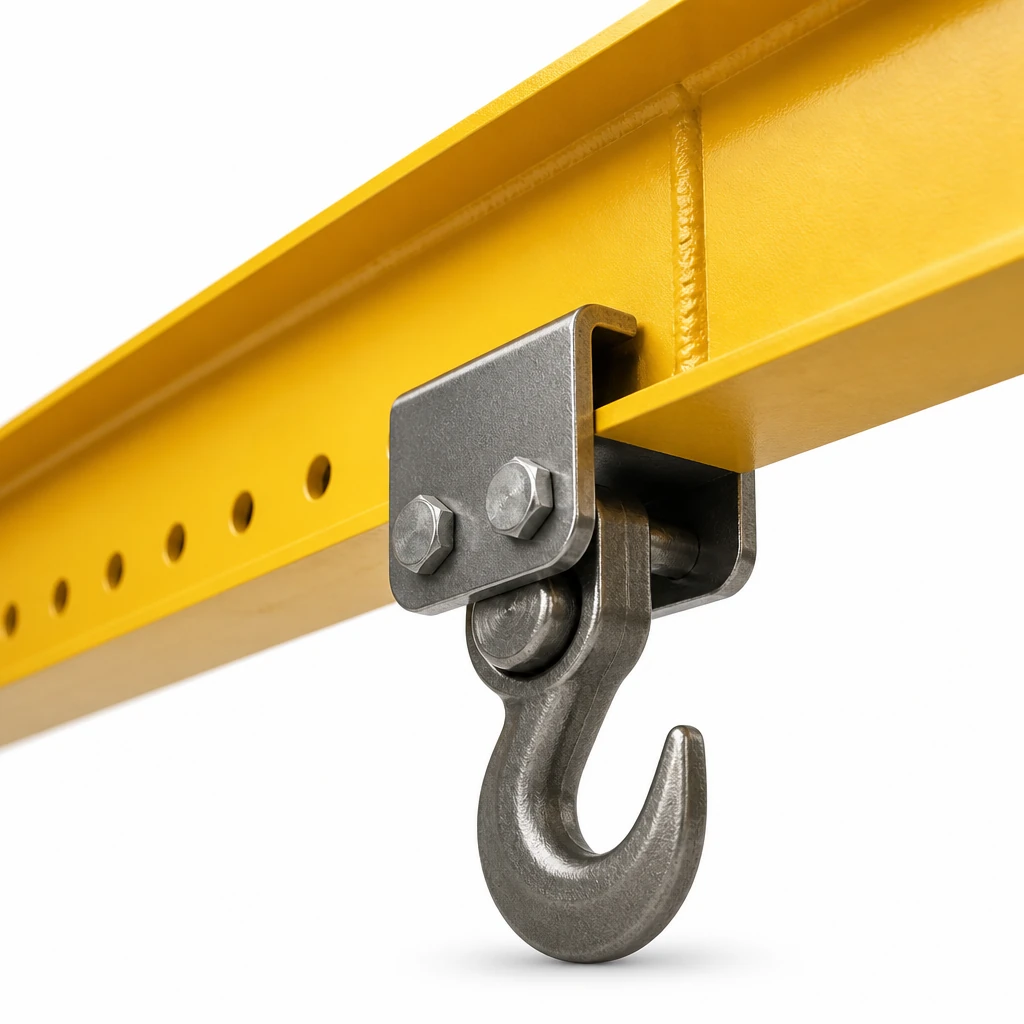
Multiple hook positions along the beam, or a sliding trolley bracket, let you match the beam to different load lengths and shift the pick points to balance an off-centre centre of gravity.
Built to Your Load Case
Every beam is designed against the actual rated capacity, span and pick-point geometry you specify — not chosen from a fixed table. Spans to 25 m and capacities to 180 t.
Tested and Documented
Proof load tested to 125 % of rated capacity before dispatch, with the rated capacity, tare weight, serial number and year of manufacture marked on the beam and a test certificate supplied.
Types of Lifting Beam
| Fixed lifting beam | Pick points welded in a fixed position. The simplest and lightest option when the load size never changes — best for a dedicated, repetitive lift. |
|---|---|
| Lifting beam with adjustable hooks | Several hook positions along the beam, or a sliding bracket secured by bolts or pins. Lets one beam handle a range of load lengths and be trimmed to balance the load. |
| Telescopic spreader beam | A beam that extends and locks at different lengths, so the span can be adjusted on site. Suited to lifting yards handling mixed sizes of load. |
| Box-section beam | Welded closed box section — the stiffest option for its weight and the usual choice from small capacities up to around 20 t. |
| H-section (welded) beam | Welded H or I profile, easier to fit brackets and hooks to and economical at medium capacities and spans. |
| Truss spreader beam | Lattice construction for long spans and high capacities where a solid beam would become too heavy. Common from 32 t upward and beyond 12 m. |
| Adjustable balance beam | A beam with a movable top suspension point, used to trim the balance of a load whose centre of gravity is off-centre or unknown. |
| Purpose-built lifting devices | I-beam lifting devices, steel billet fixtures, steel plate lifting devices and car or vehicle lifting devices built to a specific handling problem. |
Technical Specifications
| Product name | Lifting beam / spreader beam / lifting spreader beam / spreader bar / below-the-hook lifting device |
|---|---|
| Rated capacity (WLL) | 100 kg to 180 t standard range; larger custom designs quoted on request |
| Span / overall length | 0.5 m to 25 m depending on capacity and section (custom) |
| Beam section | Welded box section · welded H-section · lattice truss for long spans and high capacities |
| Material | Q235B / Q345B (S235JR / S355JR) structural steel; high-strength steel for large-tonnage designs |
| Welding | Full-penetration welds by qualified welders; weld inspection records available on request |
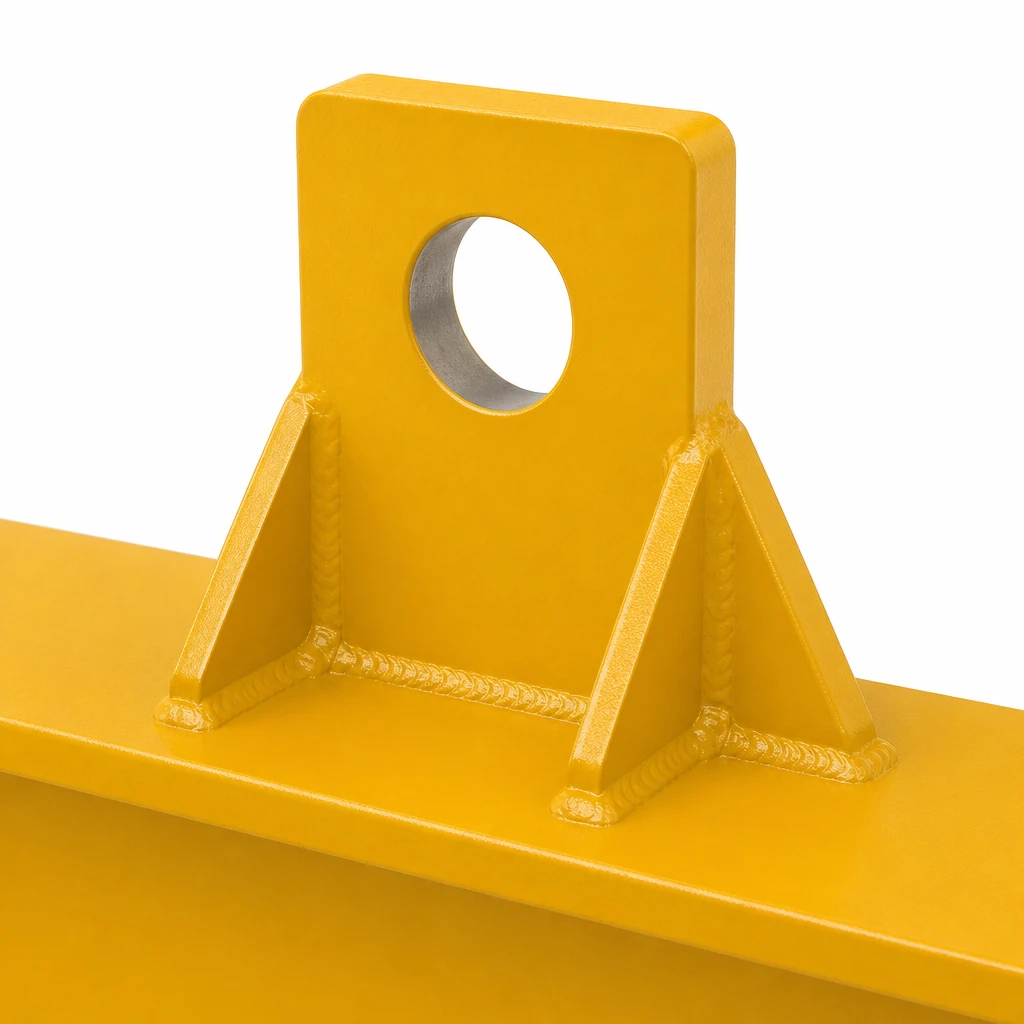
| Top lifting point | Single welded shackle lug (standard) · double lug · adjustable/balancing suspension point |
| Bottom lifting points | Welded end lugs · multi-position hook holes · sliding adjustable hook brackets · swivel hooks · 2, 4 or more points |
| Design factor | Applied against the rated capacity per the applicable standard and service class — typically 3:1 to 5:1; confirmed per project |
| Proof load test | 125 % of rated capacity before dispatch, with a load test certificate |
| Surface treatment | Shot blast to Sa 2.5 + epoxy primer + polyurethane topcoat (safety yellow) · optional hot-dip galvanising |
| Marking | Rated capacity (WLL), tare weight, serial number and year of manufacture marked on the beam |
| Documentation | General arrangement drawing, material certificate, weld record and proof load test certificate |
| Reference standards | Designed and manufactured with reference to ASME B30.20 / ASME BTH-1 and EN 13155 practice for below-the-hook lifting devices — confirm the standard and design factor that apply in your market |
| Options | Adjustable hooks · fitted chain, wire rope or webbing slings · swivel hooks · storage stand · tag line points · four-point lifting · custom colour |
| Packing | Steel frame or pallet, seaworthy packing for export |
| MOQ & OEM | Single units and fully custom designs welcome; OEM with your own markings and documentation |
Capacity and Span Range
A lifting beam cannot simply be scaled up: for the same capacity, doubling the span multiplies the bending moment in the beam, so the section and the dead weight both grow quickly. The table below shows the practical span range for each capacity band and the beam type normally used. Tell us the capacity, the span and the number of pick points and we will confirm the section and the beam’s own weight.
| Rated capacity (WLL) | Typical overall length / span | Lifting points | Typical beam type |
|---|---|---|---|
| 0.5 t | 1.0 – 2.5 m | 2 | Box section |
| 1 t | 1.0 – 3.0 m | 2 | Box section |
| 2 t | 1.5 – 4.0 m | 2 | Box section |
| 3 t | 2.0 – 5.0 m | 2 | Box section |
| 5 t | 2.5 – 6.0 m | 2 | Box section |
| 10 t | 3.0 – 8.0 m | 2 or 4 | Box / welded H |
| 16 t | 4.0 – 10.0 m | 2 or 4 | Welded H |
| 20 t | 5.0 – 12.0 m | 2 or 4 | Welded H |
| 32 t | 6.0 – 14.0 m | 4 | Welded H / truss |
| 50 t | 8.0 – 16.0 m | 4 | Welded H / truss |
| 80 t | 10.0 – 18.0 m | 4 | Truss |
| 100 t | 10.0 – 20.0 m | 4 | Truss |
| 180 t | 12.0 – 25.0 m (custom) | 4 or more | Custom truss |
Why Use a Lifting Beam?
Without a beam, a two-leg sling has to reach a wide included angle to pick up a long load. That creates two problems at the same time. First, the sling legs are no longer vertical, so they pull inward and compress the load — which is how thin plates bow, coated sections get marked and precast panels crack. Second, the tension in each sling leg rises sharply as the angle opens.
| Included angle θ | Tension per leg | Effect |
|---|---|---|
| 0° (legs vertical) | 0.50 × load | The ideal — half the load in each leg, no inward squeeze. What a lifting beam restores. |
| 60° | 0.58 × load | Still comfortable; a common working angle. |
| 90° | 0.71 × load | Leg tension already 41 % higher than vertical; inward compression on the load is significant. |
| 120° | 1.00 × load | Each leg carries the full load weight — the sling capacity is effectively halved. |
| 150° | 1.93 × load | Each leg carries nearly double the load. Never rig at this angle. |
A lifting beam breaks that trade-off. The slings stay vertical so the load is never squeezed, and the beam itself takes the horizontal reaction as bending. That is why a spreader beam lets you lift a long, thin or surface-finished load with light slings, at full sling capacity, without marking it.
Setting the pick points
Two pick points will not keep a load level if its centre of gravity is not exactly between them. If the load is heavier at one end, either move the hook positions along an adjustable beam until it hangs level, or use four points so the load is supported on both sides of its centre of gravity. Tell us the load’s centre of gravity — or send us a drawing — and we will position the lifting points on the beam accordingly.
Design, Testing and Documentation
- Designed against your load case — rated capacity, span, pick-point positions, number of legs and the headroom available are all inputs to the design, not afterthoughts.
- Full-penetration welding — the lug plates and gussets are welded by qualified welders, with weld inspection records available on request.
- Proof load tested — every beam is proof load tested to 125 % of its rated capacity before dispatch, and the test certificate is issued with the beam.
- Clearly marked — rated capacity, tare weight, serial number and year of manufacture are marked on the beam, so the operator always knows what it is rated for and how much of the crane’s capacity it consumes.
Applications
- Lifting steel plate, sheet and long sections level and free of surface marking
- Precast concrete wall panels, beams, stair flights and pile sections
- Pipes, tube bundles, bar bundles and timber packs
- Fabricated steelwork, trusses and welded assemblies
- Machined parts, moulds and dies where no inward pressure is allowed
- Wind turbine components, tower sections and nacelle parts
- Steel coil and billet handling with a purpose-built device
- Vehicle, container and equipment handling in ports and yards


Customisation and OEM Service
Lifting beams are almost always a custom item, and we build them that way. Send us the load, the span, the pick points, the crane hook and the headroom, and we will propose the section, the dead weight and the rigging. Common customisations include:
- Capacity and span — 100 kg to 180 t, spans to 25 m, or a one-off design outside that range
- Pick points — 2, 4, 6 or more; fixed, multi-position or sliding adjustable; swivel hooks or plain lug holes
- Adjustability — bolt-and-pin hook positions, sliding trolley, or a fully telescopic beam
- Complete rigging sets — beam supplied with matched chain, wire rope or webbing slings, shackles and hooks
- Marking and documentation — your own tag format, part numbers, drawings and certificates
- Finish — safety yellow, your own colour, or hot-dip galvanised for outdoor and marine use
Quality Control
Each beam is checked on dimensions, plate thickness, weld quality, lug and hole geometry and surface finish before testing, then proof load tested and re-inspected. We have manufactured lifting equipment for industrial, construction, port and public-safety customers for close to three decades — including 100-tonne class lifting belts and large-tonnage lifting devices — and we keep the process visible: on request we supply the material certificate, the weld record, the general arrangement drawing and the proof load test certificate for your beam.
Frequently Asked Questions
What is the difference between a lifting beam and a spreader beam?
The terms are often used interchangeably. Strictly, a spreader beam keeps the slings vertical and takes the horizontal reaction as bending, so it does not compress the load. A lifting beam is the broader term for any below-the-hook beam, including rigid beams whose slings are not vertical. Tell us whether the slings must hang vertically on your lift and we will specify the right arrangement.
How do I know what capacity lifting beam I need?
Start from the load weight, then add any dynamic or off-centre effects. Size the beam for the span you actually need, not the shortest span possible — bending moment grows with span, so an over-long beam costs weight and capacity. Finally, remember the beam’s own dead weight is deducted from the crane’s available capacity.
Why does the sling angle matter so much?
Because it multiplies the load in each sling leg. At a 120° included angle each leg carries the full weight of the load, so a sling rated for it is effectively halved; at 150° each leg carries nearly double. A wide angle also pulls inward on the load. A lifting beam avoids both problems by keeping the slings vertical.
Can the lifting beam be adjustable?
Yes. We build beams with several hook positions along the beam, with a sliding bracket secured by bolts or pins, or as a fully telescopic beam. Adjustability lets one beam serve a range of load lengths and lets you trim the pick points until an off-centre load hangs level.
Is a lifting beam tested before delivery?
Yes. Every beam is proof load tested to 125 % of its rated capacity before dispatch and is issued with a load test certificate. The rated capacity, tare weight, serial number and year of manufacture are marked on the beam itself.
Do you make custom and OEM lifting beams?
Yes — that is most of what we do. Send the load, the span, the pick points, the crane hook details and the headroom available, and we will propose a design, its dead weight and the matching rigging. We supply single custom units as well as OEM production with your own markings, drawings and documentation.
Request a Quote for a Lifting Beam
Send us the load weight, the span you need, the number of pick points, the crane hook and the headroom available. Our team will come back with a proposed section, dead weight, rigging and a factory-direct price.
Related Products